
PAN: Bridging the Gap Between Pipeline Precision and Neural Fluency in SIoT
PAN: Pipeline assisted neural networks model for data-to-text generation in social internet of things
This paper introduces PAN (Pipeline Assisted Neural Networks), a hybrid model designed for data-to-text generation in the Social Internet of Things (SIoT). By integrating traditional pipeline modules with deep neural architectures, PAN achieves SOTA performance on the ROTOWIRE dataset, significantly improving text fidelity and coherence.
Executive Summary
TL;DR: The paper presents PAN (Pipeline Assisted Neural Networks), a model that masters the transition from structured SIoT data (like NBA box scores) to human-readable social media posts. By combining the structured logic of traditional pipelines with the fluid generation power of LSTMs and GRUs, PAN achieves a massive reduction in text repetition and a significant boost in factual accuracy.
Positioning: This work represents a sophisticated "Refinement" approach in the NLG (Natural Language Generation) trajectory—moving away from pure end-to-end "black boxes" back toward more controllable, modular neural structures that mimic human writing logic.
Deep Dive into the Motivation
In the Social Internet of Things (SIoT), smart objects need to "talk" to humans. Converting millions of sensor logs or sports statistics into social media summaries is the core challenge of Data-to-Text.
Prior works like the "Wiseman-2017" baseline suffered from three major "Neural Ailments":
- Redundancy: Mentioning the same stat or entity repeatedly (31.55% duplication).
- Incoherence: Jumping between entities (e.g., Team A to Player B) without logical transitions.
- Factual Error: Attributing one player's points to another due to poor attention weights.
The authors' insight? Content Planning needs a dedicated memory. Just as a human writer decides who to talk about before what to say, the model needs an explicit mechanism to select salient spans and transition between them.
Methodology: The PAN Architecture
The PAN model is split into a robust feature-joint encoder and a memory-augmented decoder.
1. The Intelligent Filter (Encoder)
Before generating a single word, PAN looks at the entire table. It uses Self-Attention to calculate correlations between records (e.g., linking a "winning score" to the "winning team"). A Gating Mechanism then filters out redundant or low-importance records, ensuring the decoder isn't overwhelmed by noise.
2. Salient Span Selection (The "Brain")
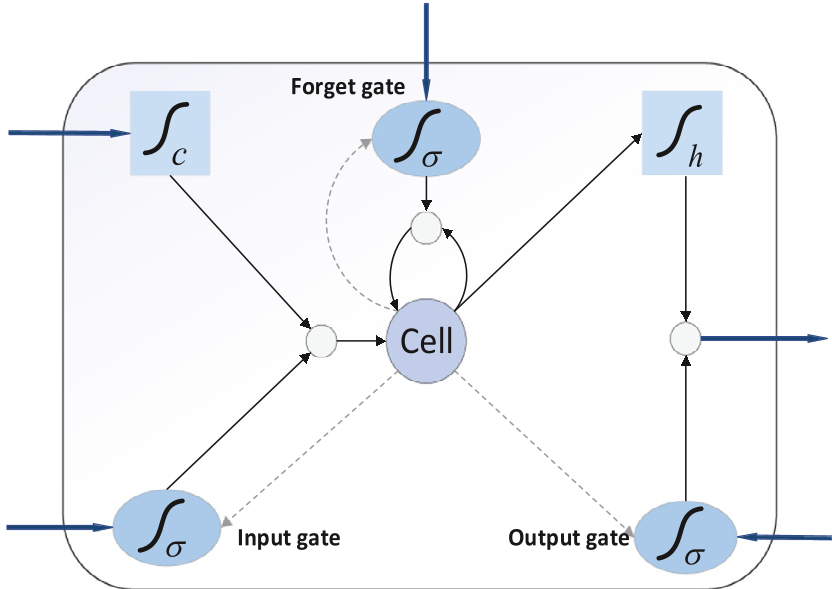
The most innovative part of PAN is its content planning module. It uses a GRU-based memory state () to track which entities have already been mentioned.
- The Transition Gate (): Decides whether to continue talking about the current entity or "transition" to a new salient one.
- The Pointing Mechanism: Once an entity is chosen, the model attends specifically to its attributes (Points, Rebounds, etc.) to generate the next sentence segment.
Experiments and Results
The authors tested PAN on the ROTOWIRE dataset, which consists of complex NBA game records.
Performance Gains
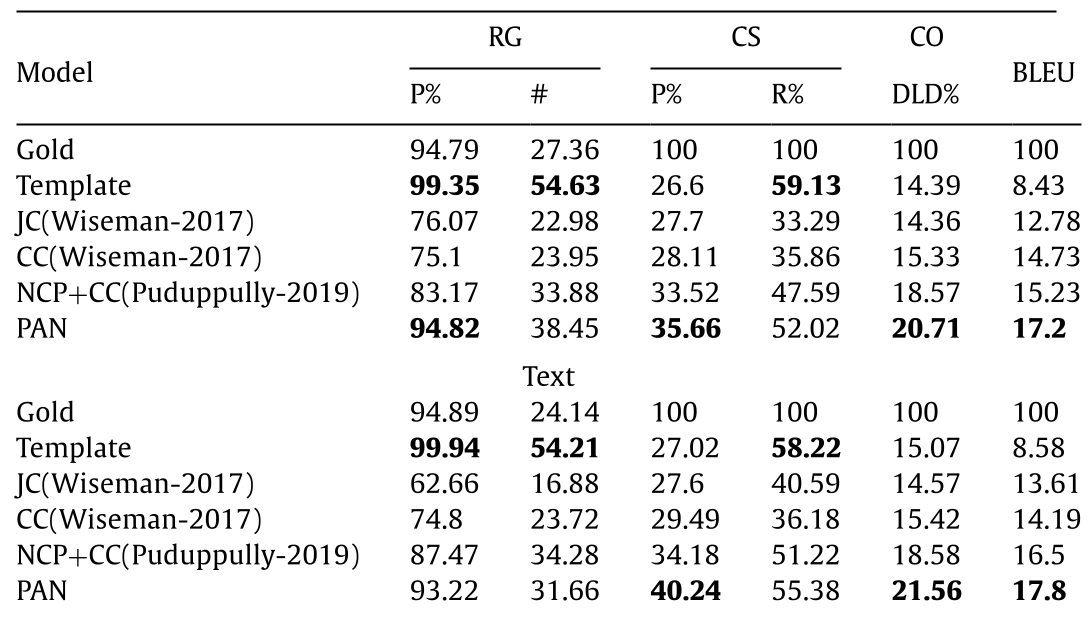
Comparing PAN against the prior SOTA (NCP+CC), the results were definitive:
- Higher Fidelity: Relation Generation (RG) precision reached 93.22%, ensuring the text matches the math.
- Better Logic: Content Ordering (CO) saw a significant jump, meaning the narrative flow felt more natural.
- Anti-Repetition: By utilizing the memory gate, PAN slashed the Duplicate Ratio to just 7.2%, far lower than any predecessor.
Critical Analysis & Conclusion
Takeaway
PAN proves that "Black Box" end-to-end models aren't always the answer for structured data. By re-incorporating Pipeline concepts—specifically separating "Content Selection" and "Content Planning"—into a neural framework, we get the best of both worlds: the interpretability of rules and the fluency of deep learning.
Limitations & Future Work
While PAN excels at NBA stats, SIoT data is often noisier and more heterogeneous (e.g., traffic sensors combined with weather reports). The next frontier will be applying this Salient Pointing mechanism to cross-domain data where the entities aren't as clearly defined as "Players" and "Teams."
Concluding Thought: This paper is a blueprint for building "Factual" AI. In an era where LLMs often hallucinate, PAN’s approach to constrained, memory-aware generation is more relevant than ever.