
Panoptic Studio: Solving the Social Interaction Capture Problem with Massively Multiview Redundancy
Panoptic Studio: A Massively Multiview System for Social Interaction Capture
The paper introduces Panoptic Studio, a massively multiview system for landmark-based 3D motion capture of multiple people in social interactions. It utilizes 521 synchronized sensors and a two-stage 3D skeletal reconstruction algorithm to achieve markerless, SOTA performance for group captures.
TL;DR
Panoptic Studio is a breakthrough system designed to capture the 3D motion of groups engaged in natural social interaction. By using 521 cameras distributed over a geodesic dome, it overcomes severe occlusions and eliminates the need for markers or pre-defined body templates. The core insight is that hundreds of "weak" 2D views can be fused into a "strong" 3D skeletal reconstruction that is robust, model-free, and scalable to multiple people.
Problem & Motivation: The "Occlusion" Wall
Capturing human motion in a social context is exponentially more difficult than capturing a single actor. The authors identify four principal hurdles:
- Functional Occlusion: People face each other, hug, or gesticulate, constantly blocking sensor lines of sight.
- Scale vs. Detail: Capturing a whole group requires a large volume, but social signals (like finger movements) require high precision.
- Appearance Diversity: Standard models fail when faced with different clothing, body types, or toddlers.
- The "Observer Effect": Attaching markers or asking subjects to hold a "T-pose" destroys the naturalness of social interaction.
Previous state-of-the-art (SOTA) methods relied heavily on template models—pre-scanned 3D meshes of specific individuals. These models are rigid, struggle with topological changes (like rolling up sleeves), and fail when multiple people interact closely.
Methodology: The Power of Five Hundred Views
The Panoptic Studio team suggests a shift in philosophy: Social motion capture should be performed by consolidating a large number of "weak" perceptual processes rather than a few sophisticated sensors.
1. Modularized Hardware
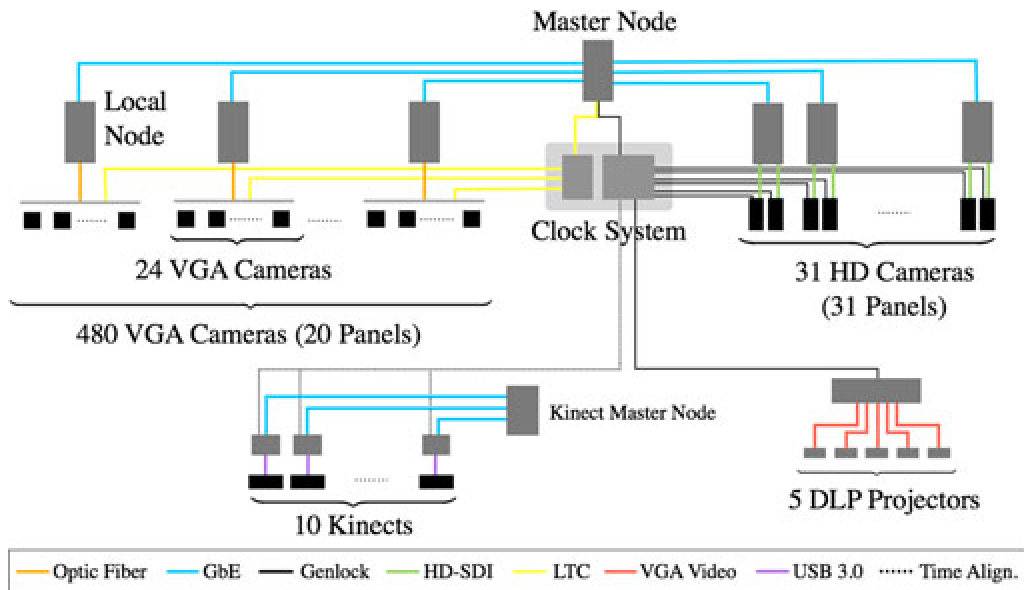
The hardware is a geodesic dome (5.49m diameter) housing:
- 480 VGA Cameras: Providing the primary multiview redundancy.
- 31 HD Cameras: Capturing high-resolution details.
- 10 Kinect v2 Sensors: Providing depth maps for initial surface geometry.
2. Two-Stage Reconstruction Pipeline
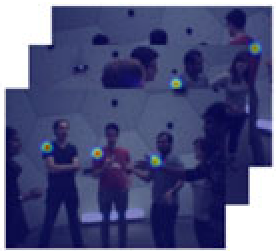
Stage 1: Generative Skeletal Proposals Instead of fitting a template, the system runs a 2D pose detector on every single view. It then projects these 2D "score maps" into 30-voxel space. By averaging these scores, the system creates a 3D Node Score Map. Through Dynamic Programming (DP), it pieces together these nodes into skeletal "proposals."
Stage 2: Temporal Refinement via Patch Trajectories To eliminate jitter, the system uses "3D patch trajectories"—dense point tracks on the body surface. By associating these surface tracks with the underlying skeletal parts, the system uses actual measured motion to smooth the animation, rather than relying on a mathematical smoothing prior that might erase subtle gestures.
Experiments: More Views vs. More Pixels
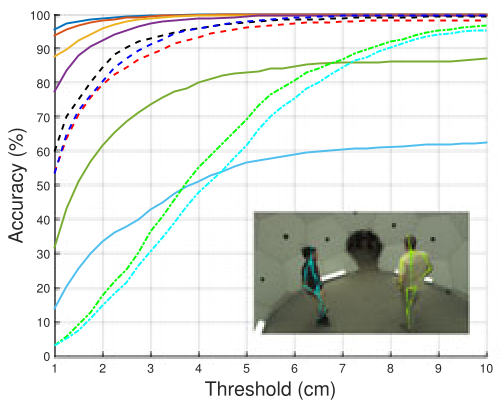
One of the most profound findings of this paper is the quantification of camera count. The authors tested the system's accuracy while varying the number of cameras from 19 to 480.
- Quantity over Quality: They found that 19 HD cameras (high resolution) performed significantly worse than a higher number of VGA cameras (low resolution).
- Complexity Scaling: For 2-3 people, 160 cameras are sufficient. However, as the group grows to 7-8 people, the performance gap between 160 and 480 cameras widens significantly.
- Accuracy: The system achieved a staggering 99.29% node accuracy in complex session captures.
Deep Insight: Why This Matters
The Panoptic Studio marks a transition from "Model-Based" to "Data-Driven" 3D vision. By removing the requirement for a 3D template, this system can capture a toddler playing with its mother or a cellist performing with an instrument—scenarios that would break a traditional skeletal tracker.
Limitations: The system is still heavily dependent on the quality of 2D pose detectors. If the 2D detector is consistently "tricked" by an unusual pose in all views, the 3D reconstruction will fail. Furthermore, the 29.4 Gbps data rate requires a massive RAID storage cluster, making this a "lab-only" solution for now.
Conclusion
Panoptic Studio is a monumental achievement in human sensing. It provides the largest dataset of its kind (3+ hours of group interaction) and proves that in the Battle of Occlusion, sheer multiview redundancy is the ultimate weapon. This work paves the way for future AI to understand the "elaborate code" of human social behavior through digital virtualization.