
The Moderate Leader Paradox: Why Middle-Ground Influence Can Backfire into Radicalization
Paradoxical dynamics of population Opinion in response to influence of moderate leader
This paper introduces an agent-based model using the SNODA framework to study opinion dynamics in hierarchical social networks. It uncovers a "paradoxical rebound" where a moderate leader—defined by medium confidence—unintentionally drives a polarized population toward the extreme opinion opposite to their own.
TL;DR
In a world of increasing polarization, we often look to moderate leaders to bridge divides. However, this paper by Sergey Malinchik and David Rosenbluth reveals a startling counter-intuitive reality: "Moderate" leaders—those who listen and adapt—can inadvertently act as the primary engines for driving a population to the opposite extreme. Using agent-based simulations, the researchers show that a leader’s lack of absolute conviction (moderate uncertainty) allows them to be "pulled" by the opposition while simultaneously silencing the extreme voices on their own side.
The Friction of Influence: Why Traditional Models Miss the Mark
Most sociological models assume a simple "pull" mechanism—if a leader is at point A, the population moves toward A. But the authors argue that this ignores the uncertainty dynamics.
The fundamental problem is that in a hierarchical network (like a government or a corporate board), the leader is not just a broadcaster; they are a node that receives feedback. When a leader's conviction is moderate, they become a high-bandwidth conduit for opinion exchange, often with unintended consequences.
Methodology: The Mechanics of Persistence
The study utilizes the SNODA (Social Networks and Opinion Dynamics Analysis) framework.
- Agents: Each has an Opinion ([-1, 1]) and Uncertainty ([0, 1]).
- The Rule: Influence is governed by a Gaussian function. If your opinion is too far from mine, I ignore you. If it's close, the person with lower uncertainty (more confidence) changes the other person more.
The Influence Formula
The core logic resides in an exponential decay function that determines how much agent changes their opinion after meeting agent :

This ensures that "confident" agents (low ) are the anchors of the society, while "uncertain" agents are the followers.
The Three Faces of Leadership
The authors tested three scenarios on a population of 5,000 agents:
- The Strong Leader (Uncertainty < 0.1): Successfully drags the population to their side. The population becomes homogeneous.
- The Weak Leader (Uncertainty > 0.5): The leader is essentially "swallowed" by the population average, serving only to speed up the existing consensus.
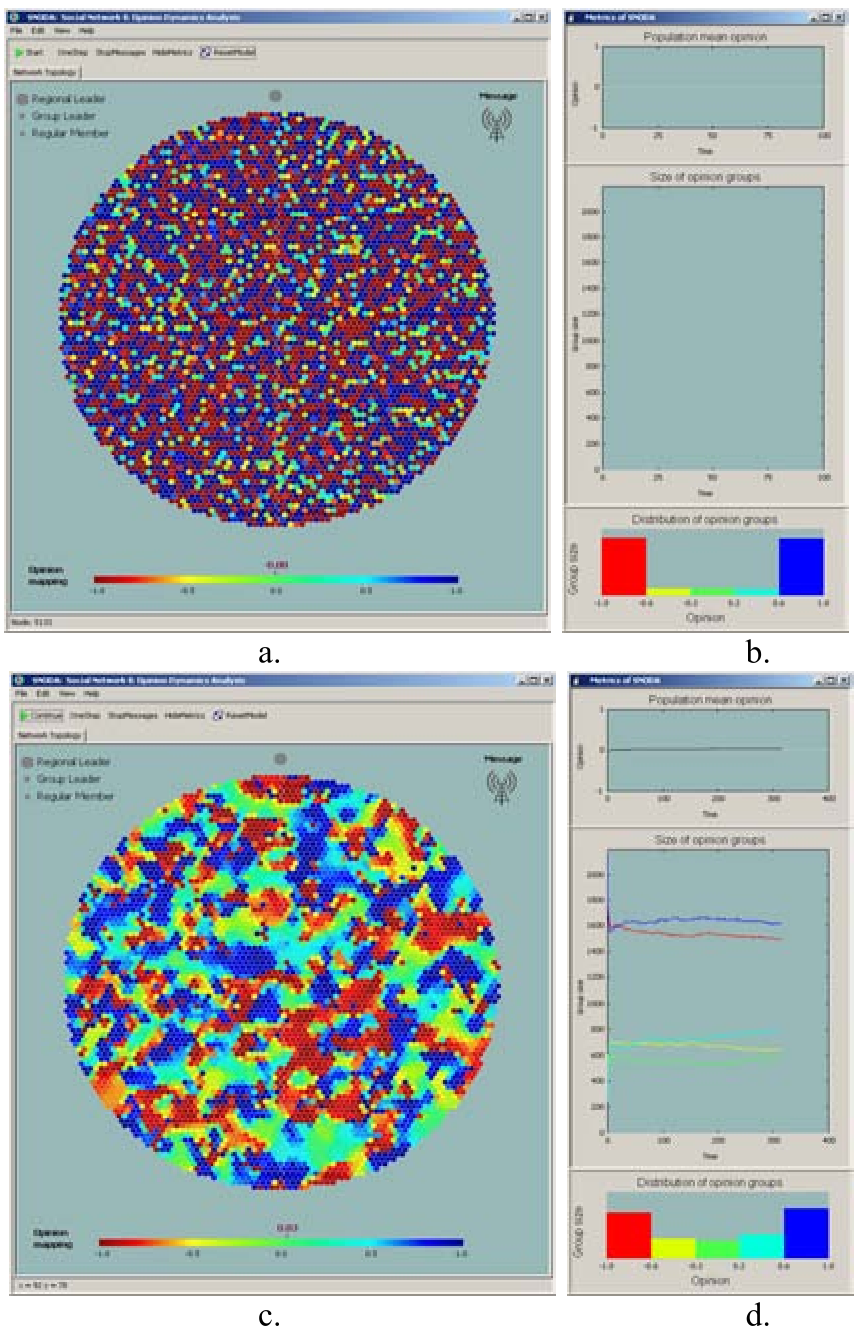
- The Moderate Leader (Uncertainty 0.12 - 0.2): The Paradox. The leader starts at +1 (Blue), but the population ends at -0.65 (Red).
Deep Dive: The Anatomy of a Rebound
The researchers identified a fascinating three-phase trajectory in the moderate leader case:
- Initial Capture: The leader quickly pulls the "movable middle" toward their side.
- The Neutralization Trap: Because the leader is relatively moderate, they are "willing to listen" to the extreme groups on their own side (Blue). Ironically, they stabilize and "moderate" their own supporters, reducing the radical energy of their own base.
- The Opinion Rebound: The leader is slightly influenced by the Red (opposition) groups. As the leader moves toward the center, they continue to pull their Blue supporters toward that center-red territory. Eventually, the Red groups—who remained radical and uninfluenced—become the dominant force, pulling the entire population, including the leader, into the Red spectrum.
The timeline above shows the mean opinion (top) starting at 0, spiking toward Blue (+), but eventually crashing into a stable Red (-) state.
Critical Analysis & Takeaways
This research challenges the "Common Sense" of leadership. It suggests that:
- Moderation is a structural weakness in the face of polarized conviction. By being open to influence, the moderate leader becomes a "bridge" that the opposition uses to colonize the leader's own side.
- The "Two-Step" Exchange: The leader acts as a medium for agents who aren't directly connected to exchange opinions, but this exchange is asymmetric if one side is more "confident" than the leader.
Limitations: The model is 1D (scalar opinions). Real-world politics involves multi-dimensional issues (fiscal vs. social) and dynamic uncertainty (people getting more stubborn over time). However, as a foundational study in Unintended Consequences, it serves as a stark warning for systemic stability in hierarchical organizations.
Future Work: The next frontier is applying this to "scale-free" networks like Twitter/X, where "leaders" (influencers) have huge connectivity but constantly fluctuating levels of "moderate" versus "extreme" stances to maintain engagement.