
Parallax: Breaking the Boundary Bias with Parameterized Local Linear Attention
Parallax: Parameterized Local Linear Attention for Language Modeling
The paper introduces Parallax, a Parameterized Local Linear Attention mechanism for Large Language Models. Parallax scales Local Linear Attention (LLA) by replacing the expensive per-token numerical solver with a learnable projector, achieving SOTA perplexity and recall in pretraining at 0.6B and 1.7B scales.
TL;DR
Parallax is a new attention mechanism that upgrades the standard "local constant" estimation of Softmax Attention to a "local linear" estimation. By replacing complex numerical solvers with a learnable probe and leveraging the Muon optimizer, Parallax achieves better perplexity and stronger recall than standard Transformers while remaining hardware-efficient.
Context: Why "Softmax" is Not Enough
Modern LLMs treat attention as a test-time regression solver. In this framework, Softmax Attention acts as a Nadaraya-Watson (NW) estimator—essentially a local constant estimate. While powerful, this approach has a known flaw: boundary bias. When the distribution of keys is non-uniform or concentrated near the query boundary, the constant estimate fails to capture the underlying data geometry.
While Theoretical "Local Linear Attention" (LLA) was proposed to fix this, it was "untrainable" at scale because it required solving a linear system (via Conjugate Gradient) for every single token.
The Core Insight: Covariance Correction
The authors of Parallax realized that the local linear estimate could be simplified into an additive correction term applied to standard Softmax Attention:
Where is a probe that captures the geometry of the Keys and Values. Instead of solving for the optimal (which is slow), Parallax learns it via a projection of the input. This effectively turns a nonparametric statistical problem into a scalable parametric architectural component.
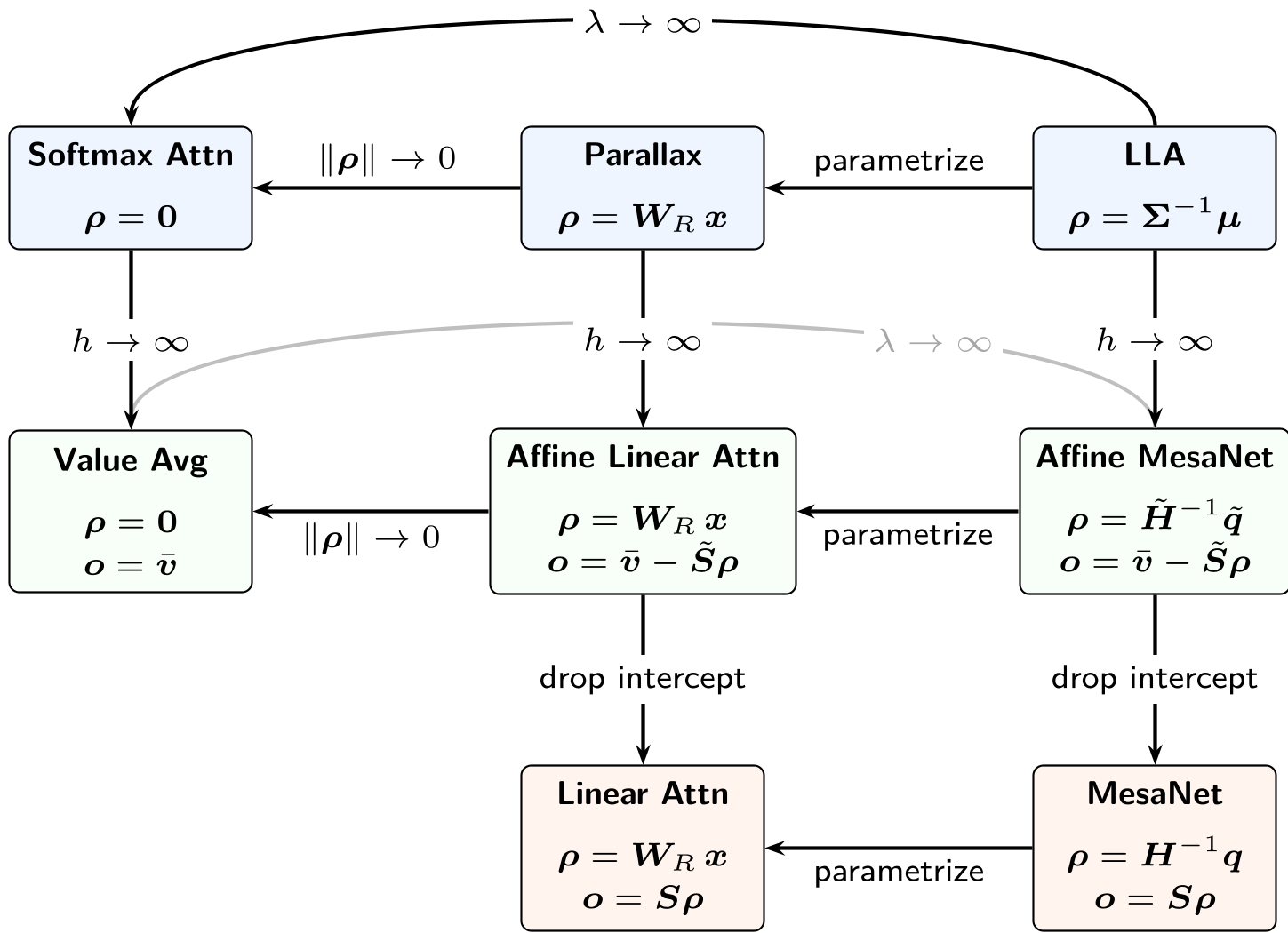 Figure 1: The family of attention mechanisms. Parallax sits in the "Softmax Weighted / Parametric" quadrant.
Architecture-Optimizer Codesign: The "Muon" Secret
One of the paper's most striking findings is that Parallax fails under standard AdamW but thrives under the Muon optimizer.
- The Problem: AdamW leads to "spectral collapse," where the effective rank of weight matrices shrinks. In Parallax, this causes the "correction branch" to be suppressed, making the model revert to standard attention.
- The Solution: Muon maintains high stable rank through orthogonal updates. This keeps the projection "open," allowing the model to utilize the covariance correction effectively.
Hardware Efficiency: Faster than Flash?
Critics might argue that adding a covariance branch makes attention slower. However, Parallax employs a hardware-aware streaming algorithm that increases Arithmetic Intensity (AI). Since most attention kernels are I/O bound (waiting for memory), adding more compute relative to memory access can actually improve efficiency.
The authors implemented a custom decode kernel on NVIDIA Hopper GPUs that joints the Softmax and Covariance branches in a single pass over the KV stream, matching or beating the gold standard, FlashAttention.
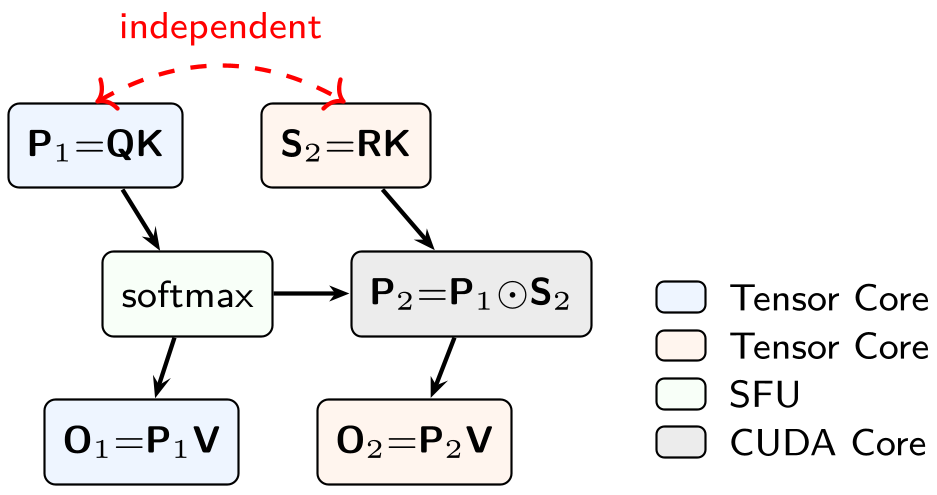 Figure 2: Custom GPU kernels for Parallax outperform or match FlashAttention 2/3 across various configurations.
Experimental Proof: Pareto Improvement
In head-to-head pretraining (0.6B and 1.7B scales), Parallax achieved:
- Lower Perplexity: Consistently better than Transformers on WikiText and LAMBADA.
- Superior Recall: On synthetic MAD-benchmarks (Recall/Selective Copying), Parallax maintained high accuracy as context length scaled, while others (like Mamba or standard Transformers) degraded.
- Ablation Success: Even when matching parameters (increasing Transformer head count) or matching compute (halving Parallax head dim), Parallax still won.
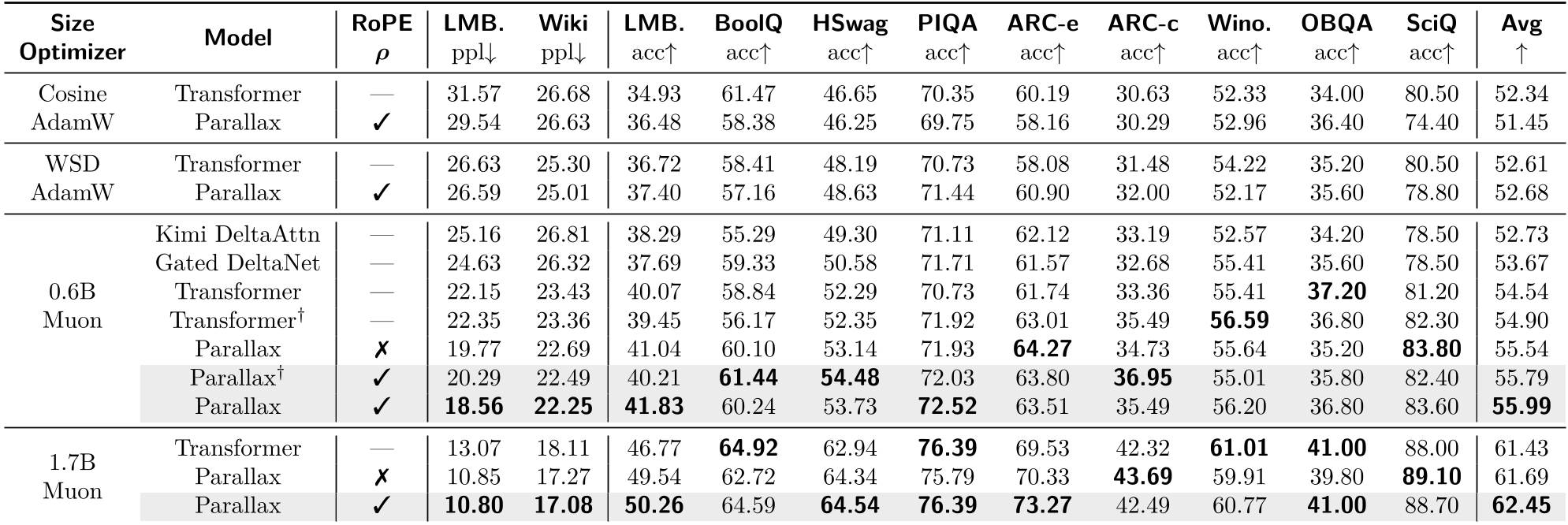 Table 3: Zero-shot accuracy and perplexity results show a clear Pareto improvement over standard Transformers.
Conclusion and Outlook
Parallax represents a rare "win-win" in LLM architecture: a theoretically grounded improvement that is also hardware-efficient. The discovery of the dependency on the Muon optimizer suggests that we may have been holding back architectural innovations for years simply because our optimizers (like AdamW) weren't "expressive" enough to train them.
Key Insights for Researchers:
- If you are building a new attention variant, test it with Muon.
- Local Constant estimates (standard Softmax) are the "lower bound" of what's possible; moving to Local Linear estimates provides a massive leap in associative memory capacity.
- Post-training adaptation is possible: you can convert a pretrained Transformer into a Parallax model and fine-tune.