
Scaling the Social Pulse: Parallel High-Dimensional Clustering in Cloud DIKW
Parallel Clustering of High-Dimensional Social Media Data Streams
This paper introduces a parallelized online K-Means clustering algorithm for high-dimensional social media streams, implemented within the "Cloud DIKW" environment. By leveraging Apache Storm and a custom "cluster-delta" synchronization mechanism via ActiveMQ, the system achieves real-time processing of the Twitter "gardenhose" stream (10% of total traffic) with up to 96-way parallelism.
TL;DR
Processing the firehose of social media data in real-time is a daunting task due to the high-dimensional nature of "protomemes" (text + social graph + metadata). This paper presents a parallelized clustering architecture that overcomes the technical hurdles of DAG-based stream engines like Apache Storm. By introducing a cluster-delta synchronization strategy, the authors achieved real-time clustering of the Twitter "gardenhose" stream, reducing a 43-hour sequential task to just 33 minutes.
The Scalability Wall: Why Sequential Fails
Social media posts are not just text; they are multifaceted entities. Modern state-of-the-art clustering (like the DESPIC pipeline) uses four high-dimensional vectors (Content, User IDs, Tweet IDs, and Diffusion Networks) to represent a "protomeme."
While this rich representation yields high-quality clusters, it comes at a price: Similarity computation is expensive. A sequential implementation of online K-Means can only process ~20,000 tweets per hour—far below the ~1,000,000+ tweets per hour generated by Twitter’s 10% stream. Parallelization is mandatory, but traditional distributed frameworks face two critical blockers:
- The Graph Constraint: Engines like Storm use Directed Acyclic Graphs (DAGs). Clustering requires feedback loops (broadcasting the global centroid back to workers), which creates cycles the DAG can't handle.
- The Sparsity Trap: Because vectors are sparse, adding new points to a centroid increases its "length" (non-zero entries) dramatically. Syncing the "full-centroid" across 100+ nodes creates a network storm.
Methodology: The Cloud DIKW Architecture
The researchers proposed Cloud DIKW, an environment that fuses batch and stream processing. The core innovation lies in its hybrid synchronization model.
1. The Out-of-Band Sync Channel
Instead of forcing synchronization through Storm's internal pipes, the authors integrated ActiveMQ, a pub-sub messaging system. This creates a side-channel where a "Sync Coordinator" can talk to parallel "Clustering Bolts" (cbolts) without violating the DAG structure of the primary processing flow.
2. From Full Centroids to Cluster-Deltas
This is the "Aha!" moment of the paper. In typical K-Means, you broadcast the new centroid. Here, the authors realized that transmitting the full sparse vector per batch is inefficient. Instead, the coordinator collects and broadcasts only the Deltas—the specific new protomemes added to each cluster since the last sync.
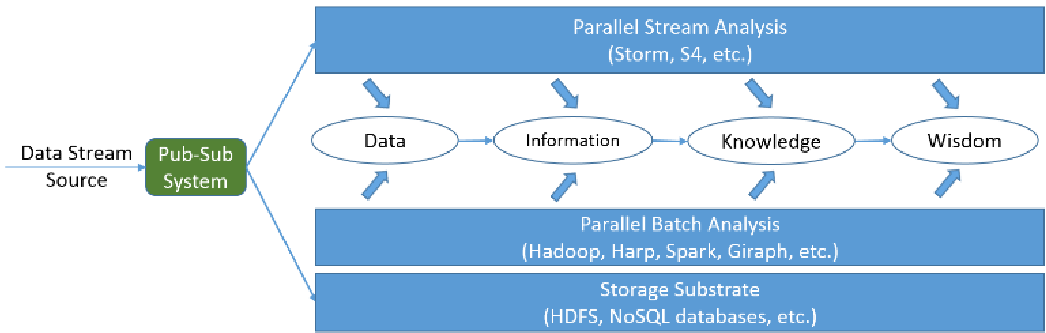 Fig 1: The Cloud DIKW architecture showing the separation of data flow and synchronization.
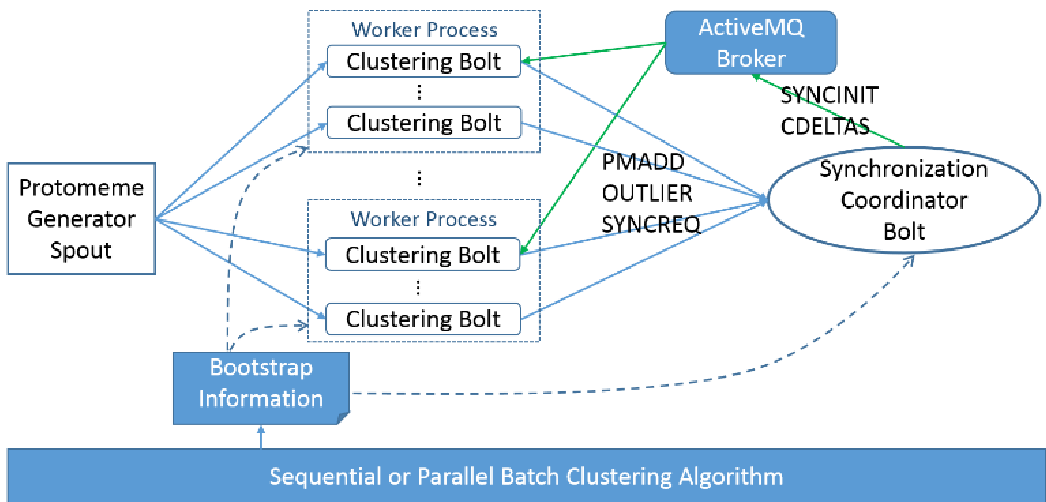 Fig 2: The Storm topology utilizing ActiveMQ for non-DAG state synchronization.
Experimental Results & SOTA Comparison
Using a real-world Twitter dataset, the authors compared the "Full-Centroid" strategy against their "Cluster-Delta" approach.
- Latency: The full-centroid strategy bottlenecks at 48 parallel workers because the sync message is too large.
- Throughput: The cluster-delta strategy maintains sub-linear scaling up to 96-way parallelism, successfully processing the 10% Twitter stream in real-time.
- Efficiency: The delta messages are ~500KB after compression, a fraction of the 22MB required for full centroids.
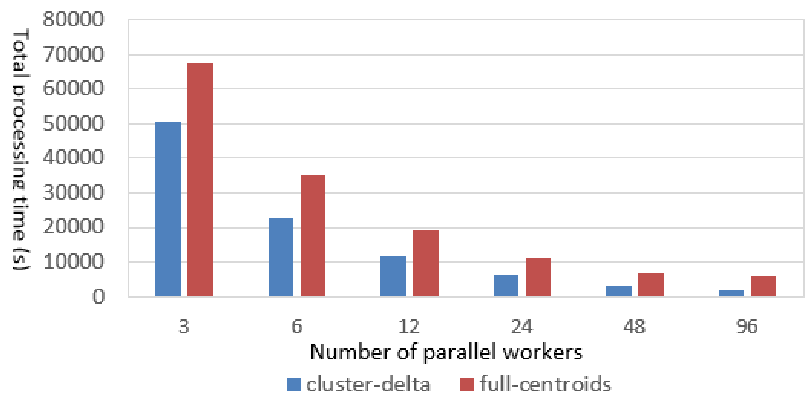 Fig 3: Processing time comparison showing the distinct advantage of the cluster-delta strategy as parallelism increases.
Critical Insight & Future Outlook
The beauty of the "Cluster-Delta" approach is its Inductive Bias toward the nature of streaming: since changes between time-steps are relatively small compared to the total state, communicating only those changes is mathematically sufficient and computationally superior.
Limitations: While effective, the system still relies on a single Sync Coordinator. As the authors move toward the "Firehose" (100% of Twitter traffic), even the Delta-broadcast might saturate a single node's bandwidth.
Future Work: The authors suggest integrating the Harp project, which uses a "communication chain" (Collective Communication) rather than a central hub. This would eliminate the single-coordinator bottleneck and potentially allow for 1000-way parallelism.
Final Takeaway
This paper serves as a blueprint for anyone building real-time ML systems on distributed engines: Don't let the framework's abstractions (like DAGs) dictate your algorithm's efficiency. If the state is big and sparse, sync the changes, not the state.