
PARSE: Scaling Subgraph Enumeration to Millions of Nodes via Parallel Color Coding
Subgraph Enumeration in Large Social Contact Networks Using Parallel Color Coding and Streaming
The paper introduces PARSE (Parallel Subgraph Enumeration), a randomized (ε, δ)-approximation algorithm for enumerating motifs in massive networks. By combining parallelized color-coding with a stream-based partitioning strategy, it achieves SOTA scalability, handling social contact networks with over 20 million nodes and 100 million edges.
Executive Summary
TL;DR: The paper presents PARSE, the first parallel randomized approximation scheme capable of enumerating complex subgraphs (motifs) in social contact networks with millions of nodes. By leveraging color coding and a novel stream-based partitioning, it breaks the memory barrier that restricted previous SOTA methods to graphs two orders of magnitude smaller.
Positioning: This work is a foundational scaling milestone. It moves subgraph isomorphism from a theoretical graph theory constraint into a practical tool for massive-scale network science (e.g., epidemic modeling, social network analysis).
The Bottleneck: Why Counting is Hard
Subgraph enumeration is notoriously difficult because identifying if a small "template" (T) exists within a large "world" graph (G) involves subgraph isomorphism—a problem that is NP-hard.
- Memory Ceiling: Massive social networks cannot fit into the RAM of a single machine.
- State Explosion: Backtracking algorithms require maintaining a massive search tree that is hard to distribute across processors without significant communication overhead.
- Structural Irregularity: Social networks aren't "nice" like grids; they have power-law distributions and high-degree hubs that create computational hotspots.
Methodology: The PARSE Architecture
The authors solve this by combining two powerful ideas: Color Coding and Cover-based Partitioning.
1. Randomized Color Coding
Instead of exact counting, PARSE colors each node in the graph randomly with colors (where is the template size). It then only counts "colorful" embeddings—those where every node has a unique color.
- The Intuition: The probability of a subgraph being colorful is . By repeating this process and scaling the result, we get a highly accurate -approximation.
- Dynamic Programming: Coloring transforms the search into a DP problem: .
2. Parallelizing the Cut-Edge
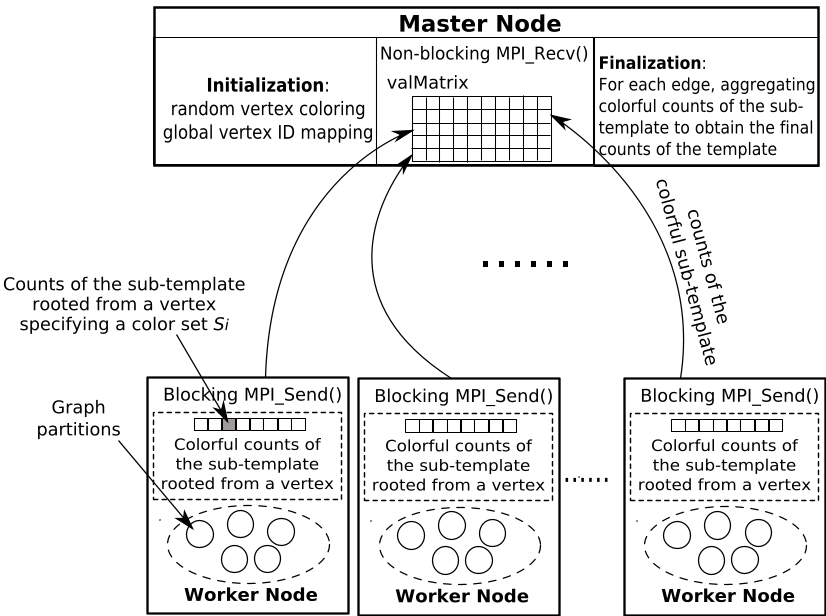
The core innovation is splitting the template into two sub-templates () connected by a cut-edge.
- Work nodes compute counts for and locally.
- The Master node joins these results. This "Template Partitioning" is the secret to their parallel efficiency.
3. Stream-based Partitioning
To handle graphs with 20M+ nodes, the algorithm uses a "Cover-based" approach. It creates overlapping partitions () such that any motif within a certain radius () can be found locally within at least one partition. Crucially, the algorithm generates these partitions in streaming passes, avoiding the need to ever load the full graph into memory.
Experiments & Results
The authors tested PARSE on massive synthetic social contact networks (NRV, Miami, Chicago).
- Scalability: PARSE demonstrated strong scaling up to 350 processors. As the number of processors increased, the time spent on "Local Counting" dropped significantly.
- Performance vs. Sequential: Against the sequential Huffner’s algorithm, PARSE achieved a 1,000,000x speedup on certain templates.
- Massive Scale: Even on "Miami10" (20 million nodes), the algorithm completed 5-clique counting in under 13 hours.
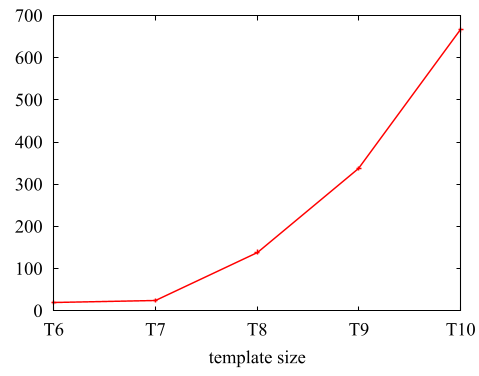 In the figure above, note how the "Counting" time (green) dominates for larger templates, while "Partitioning" remains a fixed overhead, proving that the computational load is successfully distributed.
Critical Analysis & Conclusion
Takeaways
The brilliance of PARSE lies in its hybrid strategy. It doesn't try to parallelize the backtracking search itself (which is messy); instead, it uses Color Coding to turn the problem into a count-aggregation task that is naturally parallelizable.
Limitations
- Template Constraints: The current implementation requires a "cut-edge" to split the template efficiently. For dense, highly connected templates (like larger cliques without cut-edges), the communication cost between the worker and master node would increase dramatically.
- Communication Bottleneck: As shown in their performance analysis, if the number of processors () exceeds a certain threshold relative to the template complexity, the communication overhead will begin to outweigh the skip-factor gains.
Future Outlook
PARSE opens the door for real-time motif discovery in dynamic networks. By optimizing the "aggregation" phase at the master node (perhaps using a tree-based reduction), the system could potentially scale to hundreds of millions of nodes, providing deep structural insights into global-scale social interactions.