
Parallel Data-Driven Modeling: Simulating the Pulse of Social Networks at Scale
Parallel Data-Driven Modeling of Information Spread in Social Networks
The paper introduces a parallel, data-driven multi-agent framework for simulating information spread in large-scale social networks. It integrates three sub-models (generation, activity, and reaction) and validates them using a 33.7-million-node dataset from the VK social network, achieving high fidelity in reproducing aggregated user behavior.
TL;DR
Researchers have developed a high-performance simulation framework capable of modeling information diffusion across tens of millions of users. By combining individualized activity rhythms with data-driven reaction models and a parallel MPI-based architecture, they have bridged the gap between microscopic agent behavior and macroscopic social trends, validated against 33.7 million nodes from the VK social network.
Context & Motivation: The Homogeneity Trap
Most classical models of information spread—like the epidemic-inspired SIR (Susceptible-Infected-Recovered) or the Independent Cascade model—treat social network users as interchangeable nodes. In reality, a user's likelihood to "repost" or "like" depends heavily on their personal daily routine, their historical engagement with a source, and the specific timing of the message.
The challenge is twofold:
- Personalization: How do we model individual behavioral nuances without falling into the trap of data sparsity?
- Scalability: How do we run these complex, rule-heavy simulations on networks with millions of edges?
Methodology: The Core Trinity
The authors decouple the simulation into three distinct, data-identifiable internal models:
- Generation Model (): Determines when and what content is posted by communities or users, using Gamma distributions to assign "virality" scores.
- Activity Model (): Defines if a user is "online" based on their specific demographic rhythm (e.g., night owls vs. morning users).
- Reaction Model (): Calculates the probability of a "Like," "Comment," or "Repost" as a function of the user’s type and the message's virality.
Scalable Architecture
To power this, a Master-Slave parallel scheme was implemented. The social graph is partitioned across multiple worker nodes (Slaves), while a Master node synchronizes message generation.
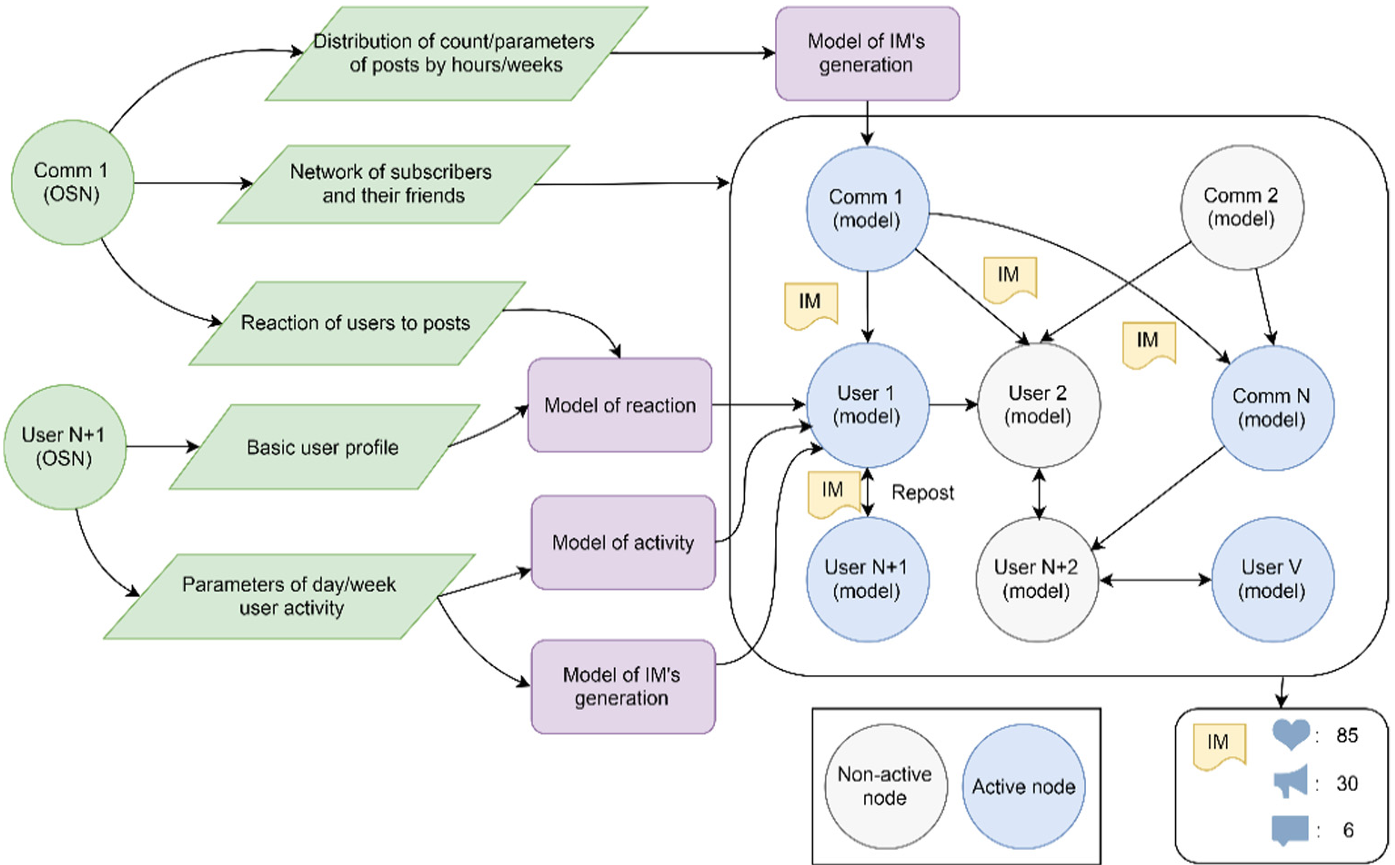 Figure 1: The framework's modular structure, linking real-world VK data (green) to the simulation entities.
The technical "secret sauce" here is the use of bitsets to track "viewers," "potential viewers," and "spreaders." This localized data structure significantly reduces the overhead of MPI synchronization when information jumps from one subnetwork to another.
Experimental Results: Matching the Real World
Using a massive dataset from the Russian social network vk.com (specifically a charity community with 33.7 million nodes), the team calibrated their parameters.
Accuracy in Dynamics
The simulation didn't just move information; it moved it at the right time. The model accounted for the "evening slump" and "morning peak," validating that message timing is crucial for engagement.
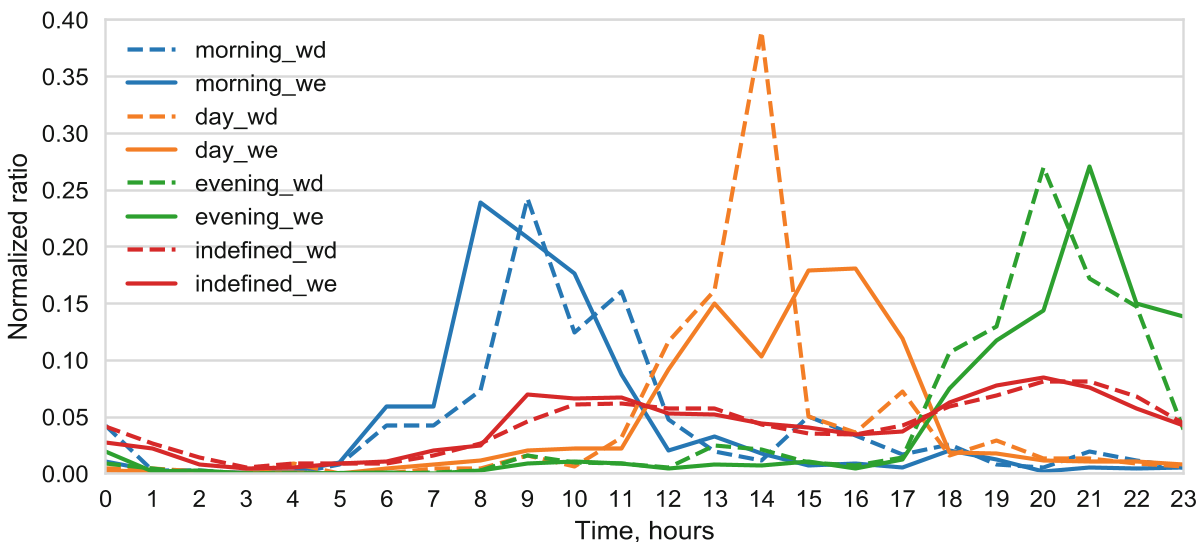 Figure 2: User activity patterns parsed by time of day and user type (wd/we).
Quantitative Success
- Performance: 3 months of network activity for 33 million agents simulated in ~3 hours on 8 processes.
- Fidelity: The Mean Absolute Error (MAE) for publication frequency was a staggering 0.099, and the distribution of reactions (likes vs. reposts) closely mirrored the "long-tail" behavior seen in actual social media data.
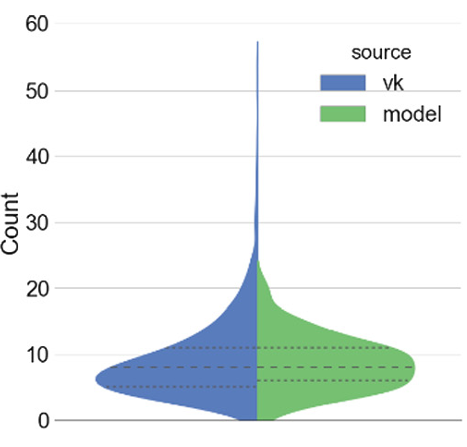 Figure 3: Violin plots showing the parity between real-world reactions and the simulated results.
Critical Insight & Conclusion
The true value of this work lies in its Bottom-Up approach. By accurately modeling the "micro" (the individual user’s sleep cycle and reaction habits), the researchers successfully predicted the "macro" (how a post goes viral across a community).
Limitations: While the model handles current state-based reactions well, it does not yet account for the longitudinal evolution of user opinions—how a user’s mindset changes after being exposed to a series of messages over months.
Future Outlook: This framework paves the way for "What-if" analysis in digital sociology, allowing community managers or public health officials to test communication strategies in a high-fidelity virtual environment before deploying them in the real world.