
Parallel Greedy Optimization: Mastering Multiple Influence Maximization in Modern Social Networks
Parallel Greedy Algorithm to Multiple Influence Maximization in Social Network
This paper introduces the Multiple Influence Maximization (MIM) problem, which seeks to select seeds to maximize the aggregate influence of different types of information propagating with distinct probabilities on the same social network. The authors propose a greedy framework with a approximation ratio and enhance it using parallel algorithms (PMIM/PRMIM) based on thread synchronization mechanisms.
TL;DR
In the real world, social networks aren't just for one product; they are battlegrounds for diverse information. This paper tackles the Multiple Influence Maximization (MIM) problem—selecting seeds to maximize the combined reach of different information types, each with its own propagation probability. By framing this as a submodular optimization under two matroid constraints, the authors deliver a parallelized greedy framework that cuts running time by 70% while ensuring a robust 1/3 approximation guarantee.
Background: Why the "Single Product" Assumption Fails
Most classic Influence Maximization (IM) research assumes a single piece of content spreading through a network. However, as the authors from Shanghai Jiao Tong University point out, a company usually promotes a portfolio (e.g., refrigerators and air conditioners) to the same users.
The catch?
- User Preference: A user might be a "super-influencer" for tech gadgets but have zero sway over home decor. This means edge weights (influence probabilities) must be product-specific.
- Influencer Fatigue: You cannot ask a single YouTube celebrity to promote 10 different clips at once; the followers will get "dispersed," and the influencer's impact will plummet. Thus, the model requires that each seed user supports only one product.
Methodology: Matroids, Greedy Solvers, and Parallelism
The MIM Problem Definition
The MIM problem is formulated to maximize: subject to a total budget and a disjoint constraint .
The authors demonstrate that this structure corresponds to two matroids: a partition matroid (limiting one product per user) and a cardinality matroid (the total budget ). According to classical optimization theory, a greedy approach here yields a approximation ratio.
The Parallel Architecture (PMIM)
The core innovation lies in making this greedy process fast enough for million-node graphs. The authors used Pruned Monte-Carlo (PMC) as the base solver but wrapped it in a multi-threaded architecture:
- Sub-Threads: Each thread runs a PMC solver for a specific product , calculating marginal gains.
- Main Thread: Manages a priority queue to pick the "best of the best" across all products.
- Semaphore Synchronization: Semaphores handle communication, ensuring the main thread only wakes up when a sub-thread has a valid candidate.
- Collision Handling: If two threads want the same user, the "loser" thread must trigger a Backup and Recovery mechanism—restoring its solver state to a point before that user was picked and finding a new candidate.
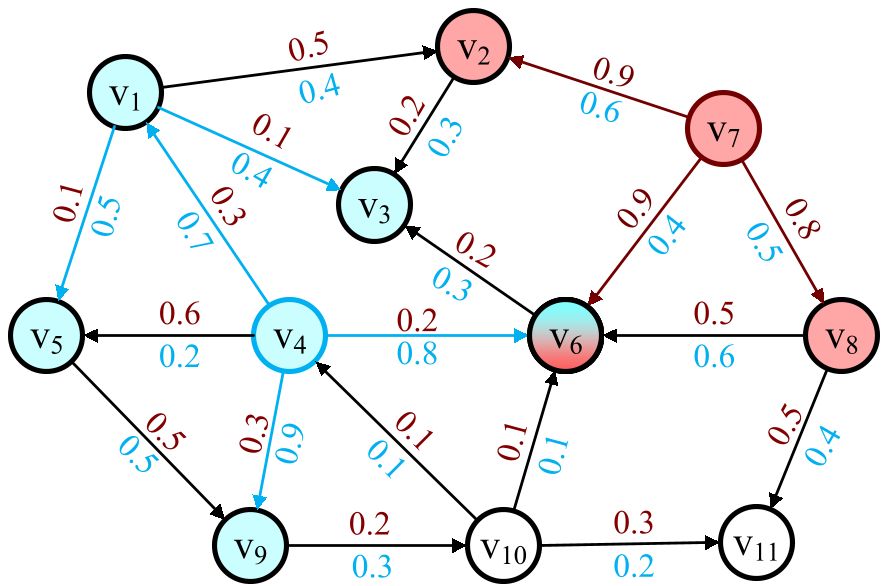 Figure: An example of different influence probabilities for two products on the same graph structure.
Experiments: Scaling to 1.1 Million Nodes
The authors tested their algorithms against heuristics like PageRank and High-Degree across datasets including DBLP and YouTube.
- Influence Superiority: The (R)MIM-Greedy approach consistently found seed sets with significantly higher influence spread than structural heuristics, especially as the budget increased.
- Time Efficiency: By utilizing multi-core machines, the PRMIM and PMIM algorithms reduced latency by over 70%.
- Memory Trade-off: While parallelization speeds up the process, storing "backup states" for solvers increases memory usage, though the authors provide a
THRESHOLDparameter to cap this overhead.
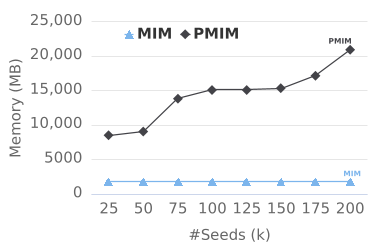 Figure: Running time vs. Seed Budget. Parallel versions (PMIM) show massive speed gains over serial versions.
Critical Analysis & Takeaways
This work effectively bridges the gap between theoretical submodular optimization and high-performance computing.
Strengths:
- Theoretical Grounding: Proving the ratio transforms the problem from a "heuristic guess" into a mathematically backed solution.
- Practical Parallelism: The use of semaphores and state-backups is a clever way to handle the dependencies inherent in greedy selection.
Limitations:
- Context Independence: The model assumes products spread independently. In reality, products might be complementary or competitive (e.g., buying one refrigerator might decrease the immediate need for another model).
- Memory Scaling: On exceptionally sparse or massive graphs, the state-backup mechanism might hit a memory wall if not carefully tuned.
Conclusion
The Parallel Greedy Framework for MIM is a significant step forward for viral marketing systems. It acknowledges the complexity of human interests and the limitations of influencer capacity, providing a scalable engine to optimize multi-product campaigns in the era of billion-scale social graphs.