
Parallel-SFT: Unlocking the Rosetta Stone of Code RL
Parallel-SFT: Improving Zero-Shot Cross-Programming-Language Transfer for Code RL
Parallel-SFT is a supervised fine-tuning (SFT) strategy designed to enhance zero-shot cross-programming-language (PL) transfer in Reinforcement Learning (RL) for code models. It utilizes "parallel programs"—functionally equivalent code across multiple PLs anchored by identical natural language instructions—to ground model representations in execution equivalence, significantly boosting performance on low-resource target languages like Go, PHP, and Ruby.
TL;DR
Even the most powerful LLMs like Llama-3.1 struggle to transfer their "intelligence" from one programming language to another. A model perfected in Python via Reinforcement Learning (RL) often becomes worse at Ruby or Go. Parallel-SFT solves this by pre-conditioning the model with "parallel programs"—structurally diverse but functionally identical code snippets—forcing the model to care about what the code does rather than just how it looks.
The Problem: The "Babel" of Programming Languages
In natural language, we have the luxury of "incidental bilingualism"—web pages that translated sentences side-by-side. Programming languages (PLs) don't have this. Python code usually lives in machine learning scripts, while C++ lives in game engines. They inhabit different "realities," leading to fragmented latent spaces.
When we perform RL on a specific language, the model over-indexes on that language's syntax. The authors find that for Llama-3.1, RL training in a source PL leads to a plateau or even a performance drop in target PLs—a phenomenon known as Negative Transfer.
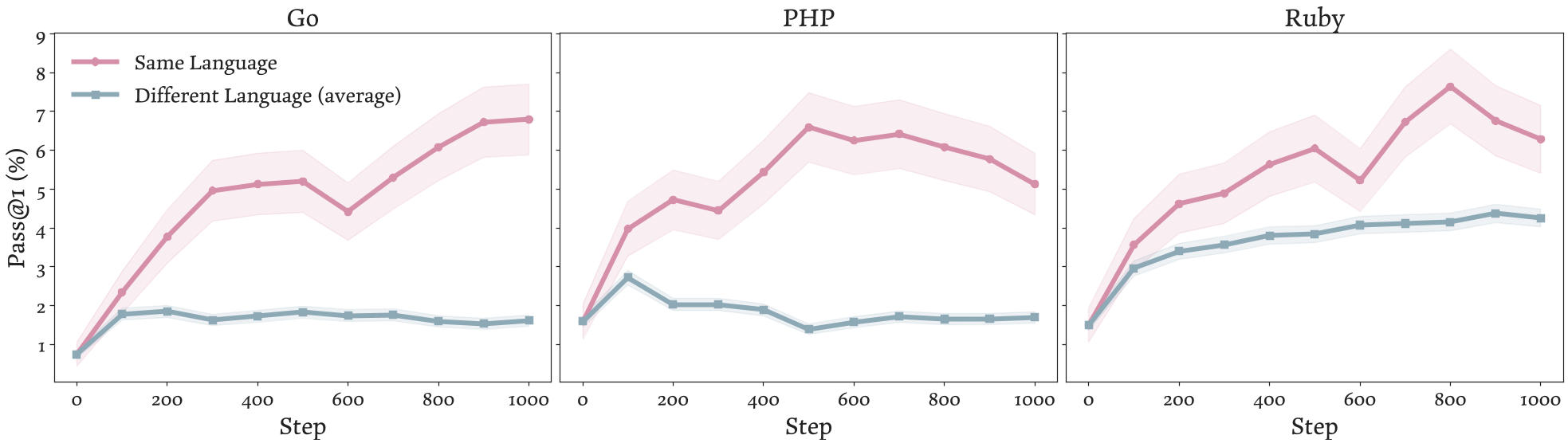 Figure 1: While RL on the target language itself works, transferring from a different source language (naive transfer) often fails to show gains.
Methodology: Engineering a "Semantic Hub"
The core insight of Parallel-SFT is to provide the model with a "Rosetta Stone" during the Supervised Fine-Tuning (SFT) phase.
1. Parallel Data Construction
The researchers used a high-parameter "Oracle" model (Llama-4-Maverick) to translate Python solutions into 8 different languages (C++, Java, Go, etc.). Crucially, they filtered these translations via execution. If the code didn't pass the unit tests, it was discarded. This ensures the model learns "functional equivalence."
2. The SFT Mixture
Unlike standard multi-PL SFT, which might show Question A in Python and Question B in Java, Parallel-SFT shows Question A in Python AND Question A in Java.
Input: "Write binary search." -> Output: [Python Impl, C++ Impl, Java Impl...]
This setup forces the model's hidden layers to map these diverse tokens to the same semantic representation of "Binary Search."
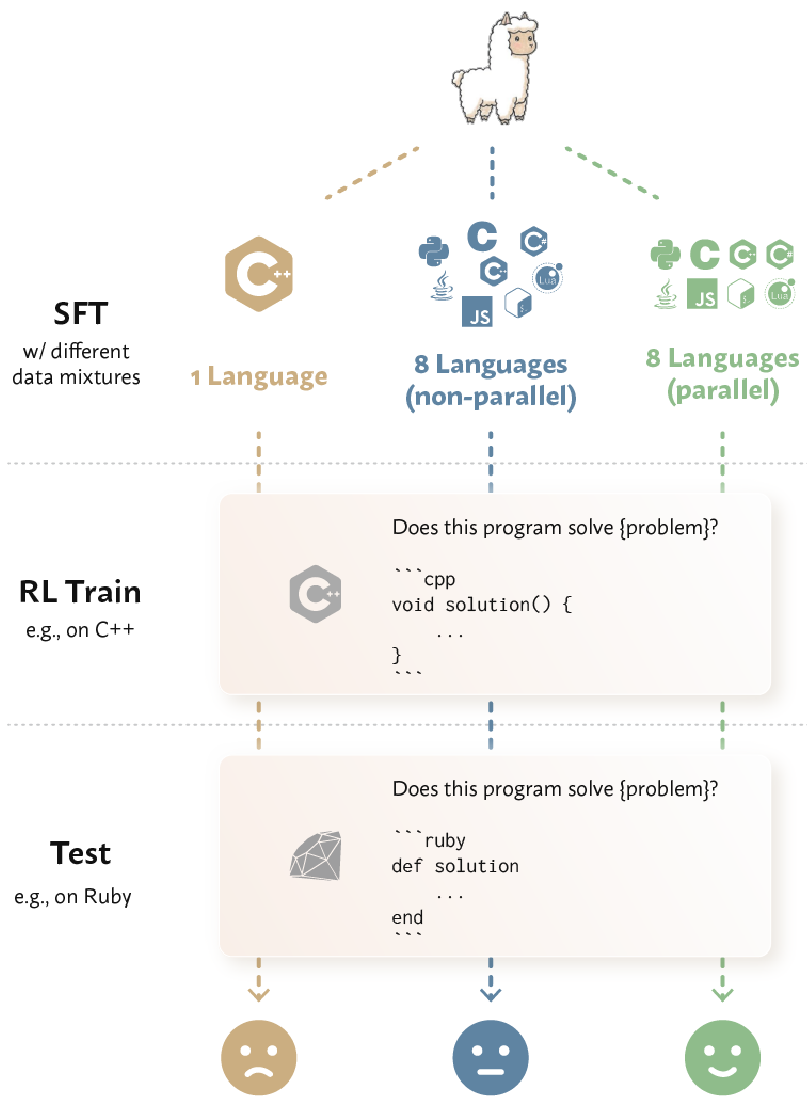 Figure 2: The Parallel-SFT workflow: aligning representations via parallel samples before RL.
Experiments: Surpassing the Oracle
The authors tested the transfer from high-resource (Python, C++) to low-resource (Go, PHP, Ruby) languages across two tasks: Code Generation and Code Validation.
Key Results:
- Zero-Shot Mastery: Parallel-SFT consistently provided the best starting point for RL.
- Beating the Oracle: In some cases, a model trained via Parallel-SFT on Python/C++ and then RL-tuned on the source language actually outperformed a model trained directly on the target language's data.
- Robustness: The method works for both generating code and the more complex task of "validating" code (predicting if a snippet is correct).
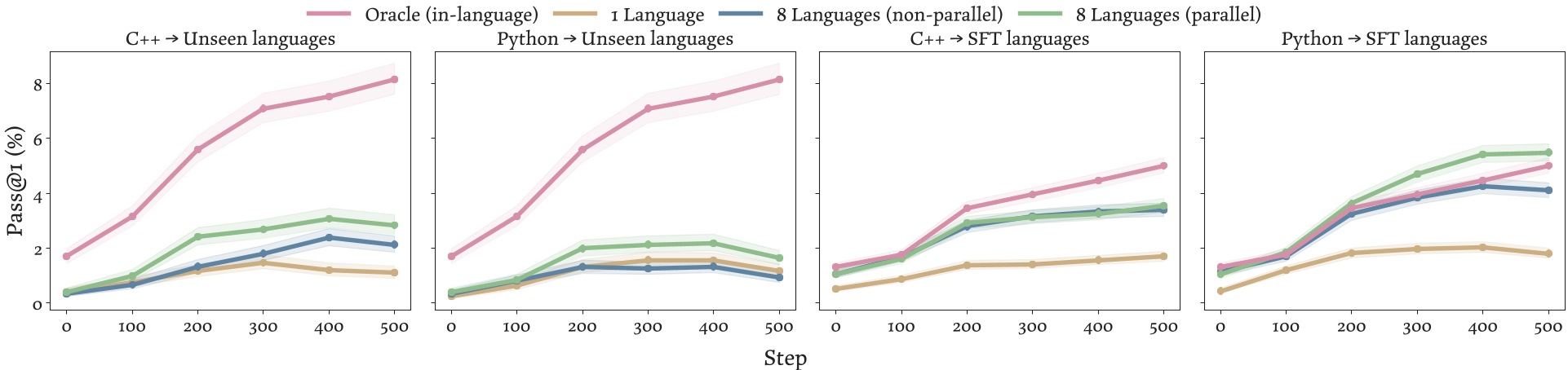 Figure 3: Performance of Parallel-SFT vs. Baselines. Note how Parallel-SFT (Green line) consistently holds the lead.
Technical Insight: What's Happening Inside?
The authors analyzed the model's internal representations using adjusted cosine similarity. They discovered that Parallel-SFT creates a "Semantic Hub" in the middle layers of the Transformer.
While the first and last layers are specialized for the syntax (the "surface form") of a specific language, the middle layers develop language-agnostic reasoning. Parallel-SFT significantly strengthens this hub, making the model's "internal thought process" much more similar regardless of whether it's looking at Go, PHP, or Ruby.
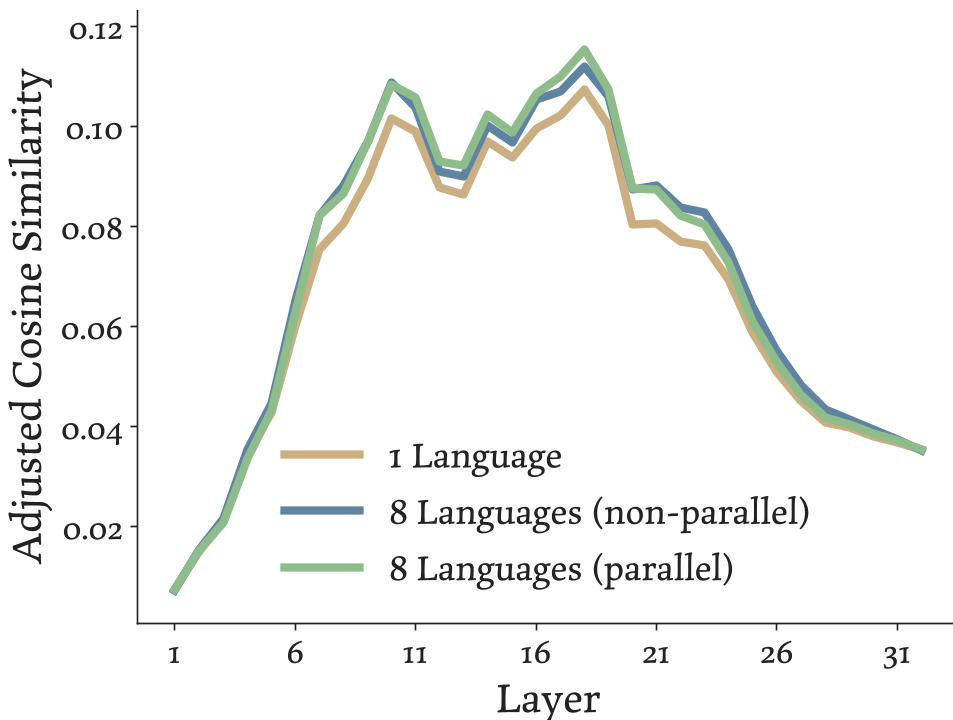 Figure 4: Middle layers act as a semantic hub where parallel programs are more tightly clustered than in standard models.
Conclusion & Future Outlook
Parallel-SFT proves that "Execution-Grounded Alignment" is the antidote to fragmented code representations. By teaching models that code is defined by its output rather than its tokens, we can build AI that truly "understands" programming as a universal logic.
The broader implication? This architecture might be the key not just for programming languages, but for transferring reasoning across any domain with distinct syntaxes but shared underlying truths—from math to formal logic.
Takeaways for Engineers:
- If you are fine-tuning a code model for a niche internal language, don't just use that language's data.
- Use a high-resource language and include parallel pairs to bootstrap the model's reasoning.
- Focus on execution-verified data; "semantic grounding" beats "volume" every time.