
Scaling Information Cascades: Parallel Simulation of Social Media Super-Hubs
Parallel Simulation of Community-Wide Information Spreading in Online Social Networks
The paper presents a parallel simulation algorithm for community-wide information spreading in large-scale social networks. By utilizing a Master-Slave architecture on the Lomonosov supercomputer, the authors achieve efficient modeling of news propagation across networks with up to 33 million nodes from VK.com.
TL;DR
Information propagation in modern social networks like VK.com or Facebook is no longer just about person-to-person sharing; it is driven by communities acting as superspreaders. This paper introduces a high-performance parallel simulation framework that handles networks of 33M+ nodes by shifting the focus to "news-oriented" state management, delivering results in minutes rather than hours.
The Problem: The Complexity of the "Super-Hub"
Most classical information spread models (like independent cascade or linear threshold) assume a relatively homogeneous network where nodes have similar influence. However, real-world data from VK.com reveals a massive disparity: a median user has 180 subscribers, while large communities boast millions.
From a computational standpoint, this creates two major hurdles:
- Memory Bottlenecks: Storing the interaction state of every user for every piece of news exhausts standard RAM.
- Scalability: Information processes in OSNs are rapid. Sequential simulations cannot provide the "operative forecasting" needed for real-time social sensing.
Methodology: News-Oriented Parallelism
The authors' core "insight" is that instead of tracking everything a user does, we should track what happens to a specific piece of news.
1. The Tri-Mask State Machine
To minimize memory, the Slaves store three bit-masks for each piece of news:
- Potential Viewers: Users who have the news in their feed but haven't interacted yet.
- Spreaders: Users who have shared the news.
- Viewers: Users who have already seen it (preventing redundant processing).
2. Master-Slave Architecture
The system utilizes the MPI standard. The Master process acts as the conductor—generating news according to "daily rhythms" (e.g., people post more on weekends) and synchronizing cross-node interactions. The Slaves perform the heavy lifting, calculating whether a user "likes," "comments," or "shares" based on probabilistic behavioral models.
 Figure 1: Conceptual overview of the OSN entities (Users, Communities, and Messages) and their interactions.
Experimental Performance
The team tested the algorithm on the Lomonosov Supercomputer.
Real-World Data (VK.com)
Using a dataset centered around a large charity community (33.7 million vertices), they achieved significant speedups. By increasing the number of processes to 64, the execution time dropped exponentially.
| Processes | Simulation Time (s) |
|---|---|
| 1 (Sequential) | 19,820.2 |
| 16 | 6,959.3 |
| 64 | 1,793.5 |
Artificial Data & Load Balancing
One critical observation: Parallel efficiency improves as the network gets more complex. In experiments with synthetic "n-ary tree" forests, the researchers found that adding more communities (super-hubs) filled the computational pipeline more effectively, preventing the Slave nodes from idling.
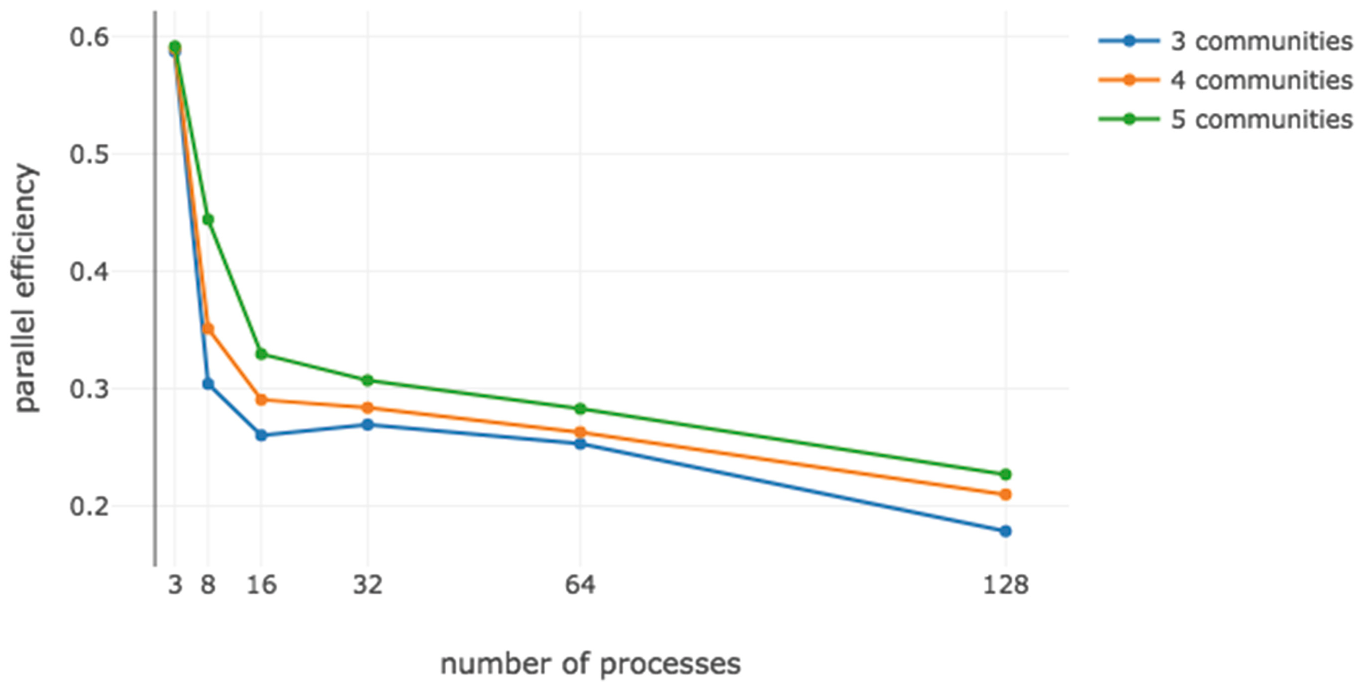 Figure 2: Parallel efficiency metrics showing that higher community counts lead to better resource utilization.
Deep Insights & Future Outlook
While the speedup is impressive, the authors acknowledge a "low parallel efficiency" in certain scenarios where the computational load is too light for the overhead.
The Takeaway: The architecture's true strength lies in its modularity. Because the behavioral models (Activity, Reaction, Generation) are independent of the core parallel engine, researchers can plug in AI-driven behavioral models or "daily rhythm" data without rewriting the simulation logic.
Future Directions: The next frontier involves overlapping audiences. In reality, users subscribe to multiple communities. Modeling the interference and synergy between different news sources in a multi-community landscape will be the ultimate test for this parallel framework.