
ActionRank: Unleashing Levy Flight Patterns for Large-Scale Social Influence Mining
Parallel Social Influence Model with Levy Flight Pattern Introduced for Large-Graph Mining on Weibo.com
The paper introduces ActionRank, a novel social influence model for ranking users on Weibo.com by integrating Social Network Centricity (SNC) and Weibo Heat Trend (WHT) into a user-weibo behavior graph. Leveraging a Levy flight pattern to account for non-connected retweet behaviors, the model achieves superior influence spread and is implemented via MapReduce to handle large-scale graphs with up to 1.1 billion edges.
TL;DR
To identify true influencers on Weibo, researchers developed ActionRank, a model that moves beyond simple follower counts. By identifying a "Large-Distance Behavior Phenomenon"—where 22% of retweets bypass direct social links—the authors applied Levy flight patterns to graph mining. Implemented on Hadoop, the model efficiently identifies users who spark the widest information cascades across billions of edges.
Problem & Motivation: The Follower Fallacy
In the era of "robot fans" and passive following, the number of followers a user has is a poor proxy for actual influence. Existing models like TURank improved the situation by looking at user-tweet interactions but were limited by two factors:
- Hop-limited spread: They often ignored propagation beyond the first or second hop.
- The "Random Walk" Assumption: They assumed information spreads link-by-link.
The authors observed that on Weibo, information often "jumps" across the network to users who aren't even followers of the original poster. This non-local diffusion suggests that a standard Random Walk (used in PageRank) is insufficient to model how viral content actually travels.
Methodology: ActionRank and the Levy Flight Insight
The core innovation lies in the User-Weibo Behavior Graph and the introduction of the Levy Flight pattern.
1. New Impact Factors
- Social Network Centricity (SNC): Measures a user's position using bidirectional edges (true friendships) not just for the user, but for their friends' friends.
- Weibo Heat Trend (WHT): Measures the average retweet "heat" over time, accounting for the temporal decay and viral potential of specific content.
2. The Levy Flight Jump
The researchers found that Retweet Cascade Hops (RCH) follow a power-law distribution. In physics, a random walk where step lengths follow a power-law distribution is a Levy Flight. By setting the random jump probability based on the retweet cascade hops (), ActionRank captures the likelihood of "long-distance" influence.
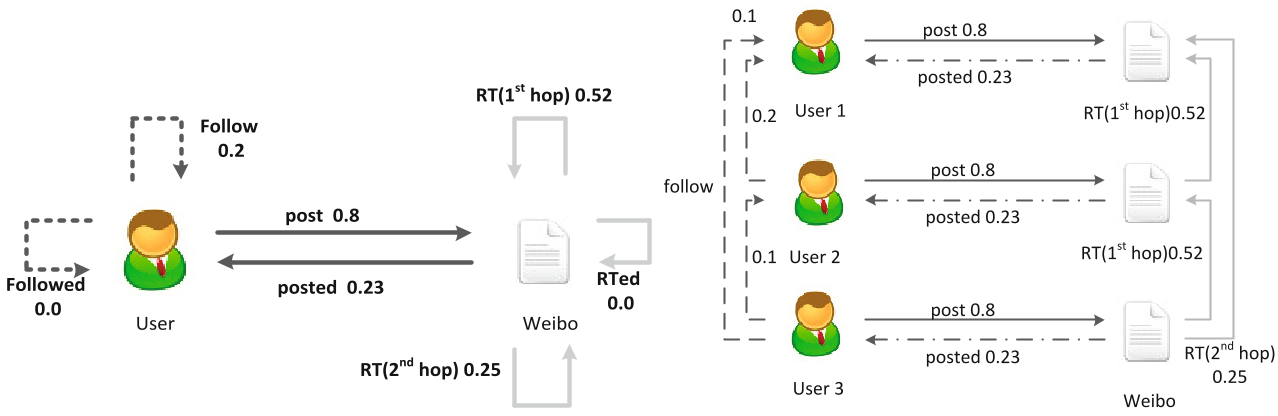 Figure 1: The schema graph defining weights for posts, follows, and multi-hop retweets.
3. Parallelism via MapReduce
To handle datasets like the "Technology" domain (containing 1.1 billion edges), the authors implemented a parallel version of ActionRank. Each iteration of the rank calculation is mapped across a Hadoop cluster, ensuring the model scales linearly with data size.
Experiments & Results: Real-World Performance
The authors tested ActionRank against PageRank, TURank, and a random baseline across four massive datasets.
- Dominance of ActionRankLF: In every dataset, the Levy Flight version (ActionRankLF) achieved the largest influence spread.
- Consistency: Whether on the 20M edge "Sports" dataset or the 1000M+ "Technology" dataset, the model's ranking remained robust.
- Scalability: The speedup curve shows that as the graph grows, the MapReduce implementation becomes increasingly efficient, hitting a speedup of >3x with 5 nodes.
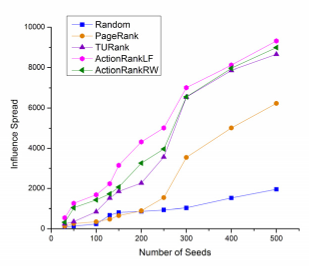 Figure 2: Influence spread comparison across different seed sizes for the Technology dataset.
Critical Analysis & Conclusion
Takeaway
ActionRank proves that the topology of influence is not the same as the topology of the social graph. By mathematically modeling the "jumps" in information propagation using Levy flights, we can find influencers who are invisible to standard PageRank-style algorithms.
Limitations & Future Work
While highly effective at graph-based ranking, the current model struggles with the semantics of the posts. The authors note that in the "Entertainment" dataset, the gap between models narrowed because content was often "mood-based" rather than "information-based." Future iterations aims to integrate NLP (Topic Modeling) and Semi-supervised learning to better understand why certain jumps happen for specific topics.
In conclusion, for developers and marketers dealing with massive social graphs, ActionRank provides a scalable, mathematically grounded framework to find the "nodes" that actually move the needle in information diffusion.