
Deciphering the Complexity of Team Formation: Why Finding the Perfect Team is Mathematically Exhausting
Parameterized complexity of team formation in social networks
The paper provides a comprehensive parameterized complexity analysis of the Team Formation problem in social networks, specifically comparing two communication cost measures: Diameter (Diam) and Minimum Spanning Tree (Mst). It identifies that while Mst-based formation is Fixed-Parameter Tractable (FPT) with respect to the number of skills, Diam-based formation is significantly more intractable, reaching W[1] or W[2] hardness across most single parameters.
TL;DR
Building a team isn't just about finding people with the right skills; it’s about ensuring they can actually talk to each other. This paper treats "Team Formation" as a graph problem where we minimize communication costs. The verdict? If you measure cost by the diameter of the team's social network, the problem is "brutally" hard (W[1]/W[2]-hard). However, if your team is organized as a tree, or the network has a very low degree, there’s a mathematical path to optimality.
Problem & Motivation: The Geometry of Collaboration
In a social network, edges represent relationships (joint projects, proximity). When a task requires a set of skills, we must pick a subset of people (vertices) that cover these skills. But a group of geniuses who can't coordinate is useless.
Previous research (Lappas et al.) proposed two main metrics for communication cost:
- MST (Minimum Spanning Tree): The minimum total "wiring" needed to connect the team.
- Diameter (Diam): The longest distance between any two team members (the "worst-case" communication delay).
While both are NP-hard, this paper asks: Where exactly does the hardness come from? Is it the number of skills? The size of the team? Or the structure of the social network itself?
Methodology: The Parameterized "Fingerprint"
The authors use Parameterized Complexity. Instead of just saying a problem is "hard," they look for a parameter that, if kept small, allows the problem to be solved efficiently ().
1. The Diameter Trap
The authors prove that Diam-Team Formation is essentially a harder version of the Set Cover problem. Even if you only need to cover a few skills, or even if the social network is very sparse (max degree 3), finding the minimum diameter team is W[1]-hard.
 Fig 1: A visualization of the input graph where skills (T) must be covered by selected vertices (V') while maintaining low Diameter or MST cost.
2. The Power of Trees
One of the paper's highlights is showing that when the social network is a tree (representing a strict hierarchy), the problem becomes Fixed-Parameter Tractable (FPT) for the number of skills .
The researchers designed a Dynamic Programming (DP) algorithm that tracks —the smallest team in the subtree of covering skills with diameter and depth .
Experiments & Key Insights
The paper is primarily theoretical, providing mathematical proofs of hardness and tractability.
Hardness Results Comparison
| Parameter | Diameter (Diam) | MST |
|---|---|---|
| No. of Skills (k) | W[1]-hard (Intractable) | FPT (Tractable via Group Steiner Tree) |
| Team Size (l) | W[2]-hard | Intractable |
| Max Degree () | NP-hard (even for ) | Intractable |
The difference is stark: MST is easier than Diameter. This is because MST has a "local" additive structure that relates to the Group Steiner Tree problem, whereas Diameter creates "global" constraints that are harder to satisfy.
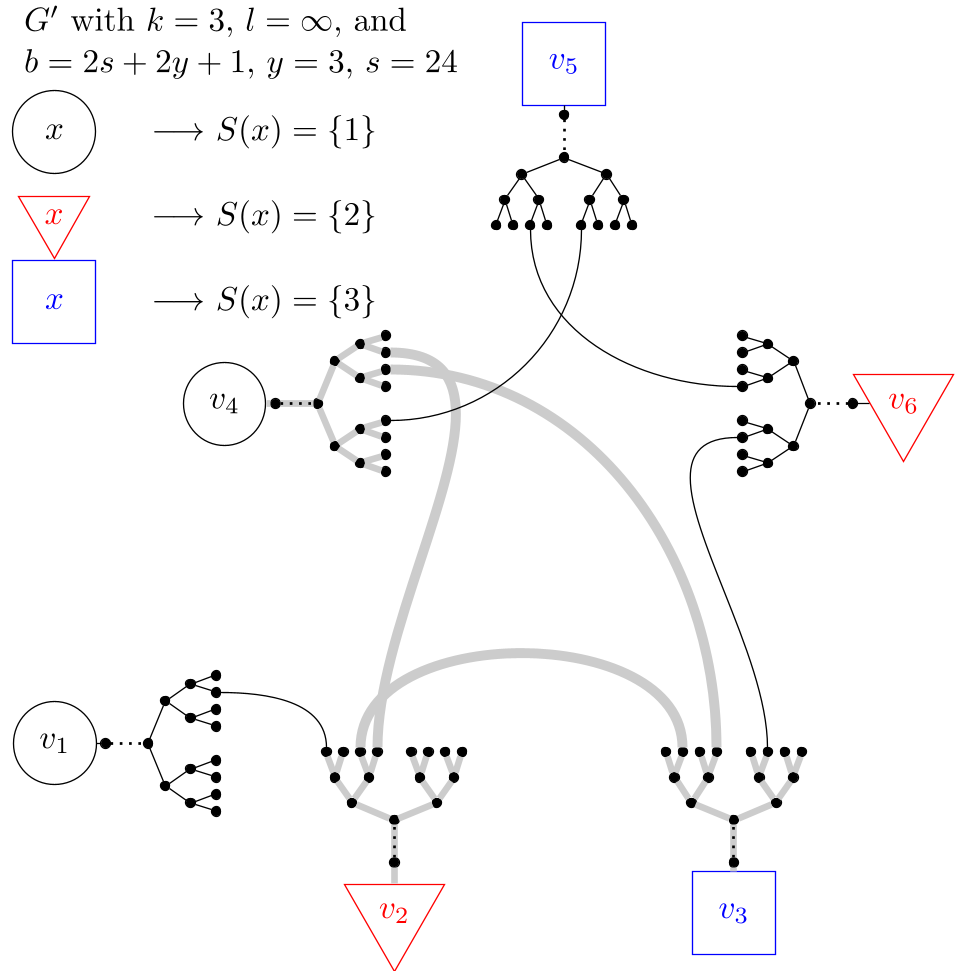 Fig 2: A reduction from Multicolored Clique to Team Formation, proving that even with a fixed number of skills, the search space remains exponentially explosive.
Critical Analysis & Conclusion
Takeaways
- Metric Matters: If you are building a team-recommendation algorithm, choosing MST as your cost function allows for much faster, optimal solutions compared to Diameter.
- Sparsity isn't enough: Just because your social network is sparse (low degree) doesn't mean the problem is easy. You need both a low degree AND a small budget/team size to achieve tractability.
Limitations & Future Work
The study assumes "binary" skills (you either have it or you don't). In the real world, expertise is a spectrum. The authors suggest that moving to "graded skills" or incorporating "Treewidth" (a measure of how tree-like a graph is) would be the next logical step for this research.
In conclusion, the paper serves as a warning to practitioners: the "Minimum Diameter" team problem is one of the "hardest" types of hard problems, and heuristics are likely the only way forward for large, complex networks.