
Paraphrase Acquisition: Scaling to Passage-Level via Crowdsourcing and ML
Paraphrase acquisition via crowdsourcing and machine learning
The paper introduces the Webis Crowd Paraphrase Corpus 2011 (Webis-CPC-11), a large-scale dataset of 7,859 passage-level paraphrase pairs acquired via Amazon Mechanical Turk. It proposes a machine learning framework for automatic quality assurance in crowdsourcing, achieving 0.98 precision in identifying valid paraphrases.
TL;DR
This seminal 2013 paper addresses the scarcity of long-form paraphrase data by introducing the Webis Crowd Paraphrase Corpus (Webis-CPC-11). By combining Amazon Mechanical Turk (AMT) with a robust Machine Learning filtering layer, the authors prove that we can acquire high-quality, passage-level paraphrases at scale, reducing research time by over 100 hours while maintaining nearly 98% precision.
The Gap: Why Sentences Aren't Enough
For years, the NLP community focused on sentence-level paraphrasing (e.g., MSRPC corpus). However, real-world challenges like plagiarism detection happen at the passage or section level. The authors noted a "wide gap" in the PAN 2010 competition: while machines could detect verbatim copies, they failed miserably at detecting human-authored paraphrases (achieving less than 0.28 recall).
The problem was circular: we couldn't build better detectors without a large corpus, but building a large corpus manually was too expensive.
Methodology: The Crowdsourcing Pipeline
The authors turned to Amazon Mechanical Turk but faced a major hurdle—Quality Assurance. Crowdsourcing is often plagued by low-effort submissions (copy-pasting, word-shuffling, or unrelated text).
1. Data Collection
Using 4,067 excerpts from Project Gutenberg, the team asked "Turkers" to rewrite passages so they maintained meaning but used "completely different wording."
- Keystroke Monitoring: They recorded keystrokes to ensure workers weren't just copy-pasting.
- Demographics: 1,130 workers participated, bringing a diversity of styles that single-author corpora lack.
2. Automated Quality Control
Instead of manual verification (which took 83+ hours for the pilot), they treated quality control as a binary classification problem.
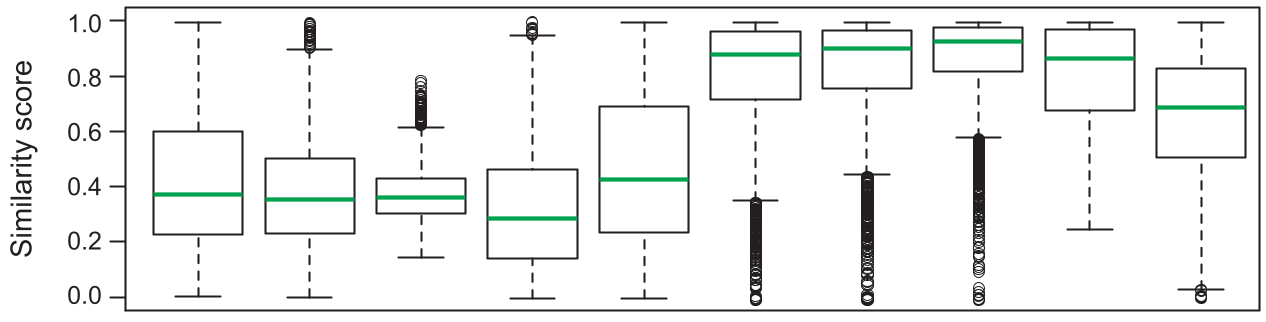
They extracted features using 10 similarity metrics:
- N-gram Overlap & BLEU: To catch lexical similarity.
- Sumo Metric: Specifically designed to catch near-duplicates.
- Edit Distance: Normalized for length.
Experiments & Results: Precision is King
In the context of corpus construction, Precision is more critical than Recall. We can afford to discard a few good samples, but we cannot afford to include "trash" in a gold-standard dataset.
The results were striking:
- Best Performer: The k-Nearest Neighbor (k-NN) classifier.
- Performance: At a recall of 0.523, the system achieved 0.980 precision.
- Trade-off: While they discarded nearly half of the legitimate samples, the "surviving" data was pure enough to be used as a research benchmark without manual intervention.

The Economic Insight: Is it Worth it?
The authors provided a rare, detailed cost-benefit analysis. By using their automated method:
- Financial Savings: Approximately 18% cost reduction.
- Time Savings: Over 111 hours of research staff time returned. Even when starting a new corpus type (requiring some manual training data), the time savings remained massive (70+ hours), proving that the bottleneck in NLP research isn't just compute—it's human logistics.
Final Thought
"Paraphrase Acquisition via Crowdsourcing and Machine Learning" shifted the paradigm from "how do we find paraphrases?" to "how do we filter the noise of human-generated data?" It remains a foundational blueprint for anyone building large-scale linguistic assets in the age of distributed human labor.
Limitations: The study primarily focused on English and utilized 2013-era similarity metrics. Modern LLMs (like GPT-4) could likely achieve even higher recall, but the core logic of high-precision filtering remains essential.