
[Parcae] Stable Looped Language Models: Turning Recurrence into a Predictable Scaling Axis
Parcae: Scaling Laws For Stable Looped Language Models
This paper studies language modeling with looped architectures and introduces Parcae, a stable looped language model that treats recurrence as a dynamical system and enforces stability through a spectrally constrained injection parameterization. Parcae improves validation perplexity by up to 6.3% over prior large-scale looped models and, at 1.3B parameters, outperforms parameter-matched Transformers by 2.99 Core points and 1.18 Core-Extended points while reaching up to 87.5% of the quality of a Transformer twice its size.
Executive Summary
TL;DR
Looped language models promise something extremely attractive: more compute and better quality without paying the full memory cost of a larger fixed-depth Transformer. The problem is that existing looped architectures often train like unstable dynamical systems, with exploding residual states, hyperparameter sensitivity, and nasty late-stage loss spikes.
Parcae’s key contribution is to stop treating recurrence as just “reusing layers” and instead model it explicitly as a dynamical system over the residual stream. That viewpoint exposes the real failure mode: the recurrent injection operator can become spectrally unstable. Once the authors constrain that operator by design, looping becomes not only trainable, but scalable, with both training-time and test-time scaling laws that are surprisingly clean.
In short: this is not merely a benchmark paper. It is a structural repair of looped language models, plus an argument that recurrence can be an orthogonal axis of scaling alongside parameters and data.
Background Positioning
This paper sits at an important junction in the scaling literature:
- It is not the first paper to propose looped or recurrent-depth Transformers.
- It is one of the first to give a principled stability account for why prior looped models fail at scale.
- More importantly, it upgrades looping from an interesting architectural trick into a candidate scaling primitive with measurable laws for both training and inference.
That makes Parcae feel less like a one-off SOTA tweak and more like infrastructure for a broader research direction.
Problem & Motivation
Why loop at all?
The conventional recipe for better language models is simple:
- increase parameters,
- increase data,
- spend more training FLOPs.
This works, but it comes with an obvious systems-level cost: larger parameter count means larger memory footprint, higher deployment cost, and worse fit for edge or memory-limited settings.
Looped models propose a different tradeoff:
- keep parameters relatively fixed,
- increase effective depth by repeatedly applying a recurrent block,
- scale compute through looping instead of parameter growth.
If that works, you get a model that is more parameter-efficient and potentially more flexible at inference time.
Why prior looped models are unstable
The paper’s critique of prior work is sharp and technically well-motivated. Existing middle-looped architectures typically inject the original embedding into the recurrent state using either:
- addition, or
- concatenation plus projection.
Both sound innocuous. But under a dynamical-systems lens, they induce bad transition behavior:
- addition corresponds roughly to an identity transition, which is only marginally stable,
- concatenation yields a learned transition matrix with no spectral constraint, which can be unstable.
That means repeated looping can amplify the residual stream instead of refining it.
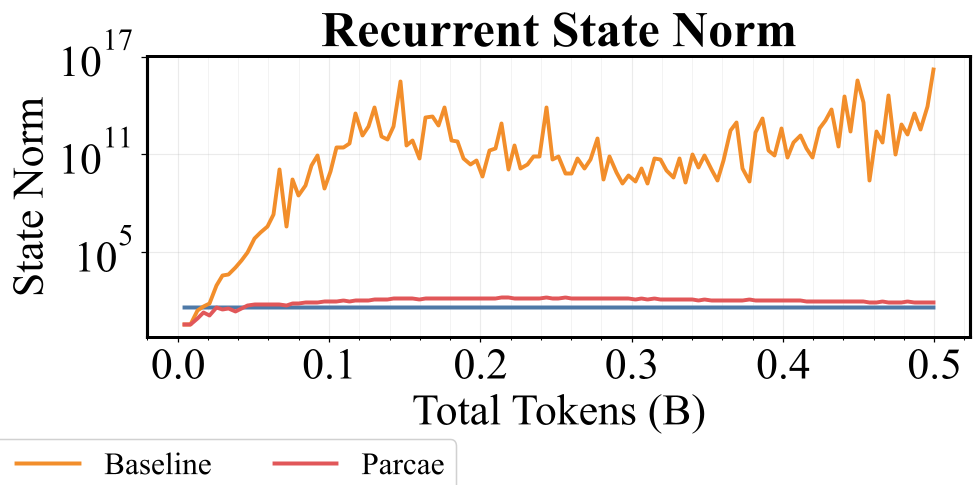
The authors show that the actual failure pattern in training is exactly what control theory would predict:
- residual state norm explodes,
- loss diverges or spikes,
- convergence depends heavily on learning rate and normalization tricks.
This is a strong point of the paper: instability is not described as “Transformers are hard to optimize.” It is localized to a concrete operator in the recurrent update.
The deeper intuition
A looped model is not just a shallow model with weight sharing. Functionally, it is an iterative solver over latent states. Once you accept that interpretation, the correct question is no longer:
“Can the same block be reused multiple times?”
It becomes:
“Does this iterative map contract toward a useful representation, or does it drift and explode?”
Parcae is powerful because it answers that second question directly.
Methodology - The Core
1. Recasting recurrence as a dynamical system
The paper writes the looped residual update in the form:
- previous state contribution,
- input injection contribution,
- nonlinear Transformer update.
Abstractly:
Agoverns how much previous residual state is carried forward,Binjects the input embedding,Rcaptures the nonlinear Transformer operations.
This decomposition matters because if we temporarily linearize the system by dropping the nonlinear term, we get an LTI-style recurrence. Then classical stability theory applies.
For a discrete linear system, stability requires the transition operator to have spectral radius below 1. If not, repeated recurrence can diverge.
This is the conceptual move that unlocks the paper.
Why this matters physically
The residual stream in a looped model is like a latent memory trajectory through depth. Every recurrence should do one of two things:
- refine the latent state,
- or move it toward a fixed-point-like representation.
If the transition operator is not contractive enough, each recurrence amplifies perturbations instead. Then “more thinking steps” becomes “more numerical damage.”
That is why the spectral norm of the injection/transition path is not a minor implementation detail. It is the difference between iterative refinement and runaway dynamics.
2. Stable parameterization of the recurrent transition
Parcae fixes the issue by parameterizing the continuous-time transition matrix as a negative diagonal matrix and then discretizing it using zero-order hold (ZOH):
- negativity in continuous time ensures stable decay modes,
- discretization maps that to a discrete operator with spectral norm below 1.
This gives a structurally stable recurrent operator instead of hoping SGD learns one.
The design is intentionally conservative:
- diagonal rather than full-rank,
- simple rather than expressive,
- cheap rather than elaborate.
That is a good engineering choice for a first stability paper. The point is not to maximize recurrence expressivity at all costs, but to guarantee that the recurrent backbone is not inherently explosive.
The paper’s summary table is one of its most important technical artifacts:
- prior additive injection: marginally stable,
- prior concatenative injection: potentially unstable,
- Parcae: explicitly stable by construction.

3. Prelude normalization fixes late-stage spikes
One subtle but useful contribution is that Parcae’s story does not end at the transition matrix.
At 1.3B scale, the authors found that even when A and B remained well-behaved, late-stage instability still appeared. Their diagnosis is revealing:
- the instability did not mainly come from the nonlinear recurrent block,
- it was triggered by the injected embedding
ecoming out of the prelude block.
So they add a normalization to the prelude output:
e = LN(P(s))
This seems small, but it is a high-value systems insight. In recurrent architectures, the injection path is effectively applied at every loop. Even moderate variance here gets reintroduced repeatedly. Normalizing it reduces both state explosions and gradient pathologies.
4. Per-sequence stochastic depth sampling
Training looped models involves sampling recurrence depth. Prior work sampled depth per micro-batch; Parcae samples depth per sequence within a batch.
Why is that better?
Because the training objective is an expectation over recurrence depth. Per-sequence sampling gives a richer Monte Carlo estimate of that expectation inside each batch. Empirically, that reduces loss spikes and improves generalization across test-time depths.
This is a very good example of an algorithmic tweak that looks minor on paper but changes the optimization noise geometry in a meaningful way.
Overall architecture intuition
Parcae keeps the classic:
- prelude block
P, - recurrent middle block
R, - coda block
C.
The architectural novelty is not a giant redesign. It is that the loop is wrapped in a stable state-space-style update rule. That is exactly the right level of intervention: preserve the useful inductive bias of looped depth, repair the unstable recurrence mechanics.
Experiments & Results
1. End-to-end quality against prior looped models
Against prior RDM baselines, Parcae consistently wins.
At the smaller scales reported:
- 100M: validation perplexity improves from 14.23 to 13.59
- 350M: validation perplexity improves from 10.76 to 10.09
The paper summarizes the broader gain as:
- up to 6.2% lower validation perplexity
- up to 9.1% lower WikiText perplexity
- up to 1.8 points higher downstream average score
This is important because Parcae is not just “more stable but same quality.” The stability fix translates into real quality gains.
Why the gain is believable
The ablation table makes the causal chain convincing:
- unconstrained baseline diverges,
- constrained
Arestores trainability, - per-sequence sampling improves behavior at lower test-time depths,
- prelude norm improves convergence and robustness.
This is a clean ablation narrative, not a kitchen-sink result.
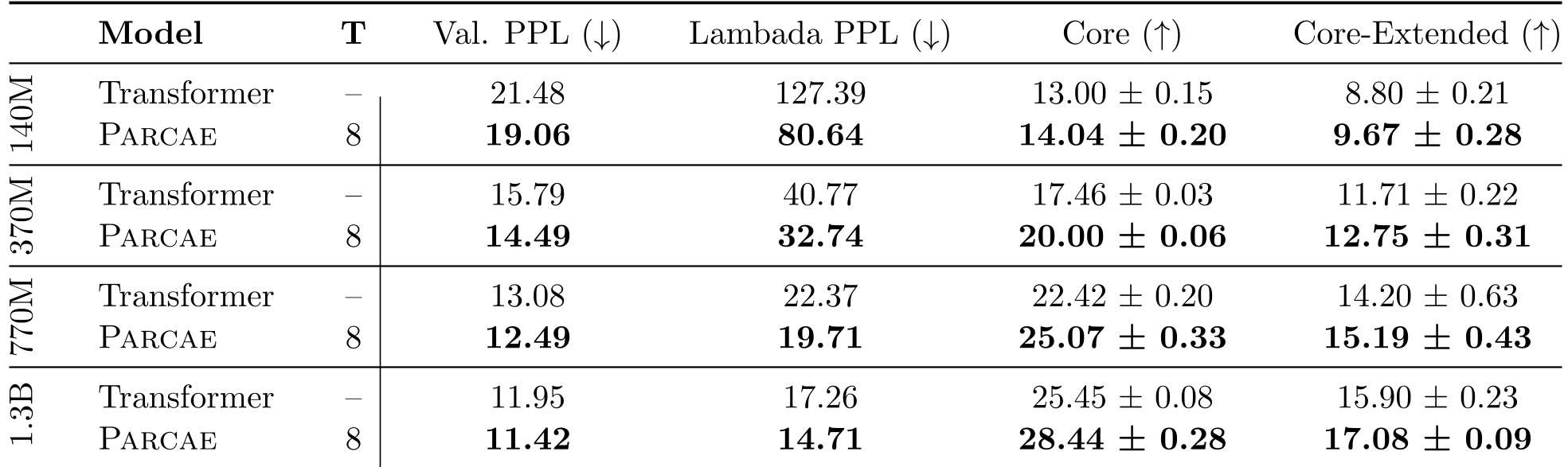
2. Comparison against parameter-matched Transformers
This is the headline result that will attract most readers.
Compared to parameter-matched fixed-depth Transformers:
- 140M: Core 13.00 → 14.04, Core-Extended 8.80 → 9.67
- 370M: Core 17.46 → 20.00, Core-Extended 11.71 → 12.75
- 770M: Core 22.42 → 25.07, Core-Extended 14.20 → 15.19
- 1.3B: Core 25.45 → 28.44, Core-Extended 15.90 → 17.08
At 1.3B, that is:
- +2.99 Core
- +1.18 Core-Extended
Validation perplexity also improves by 4.3% to 9.2% across scales.
The strongest qualitative framing is this:
- a 770M Parcae reaches quality comparable to a 1.3B Transformer on Core.
That is not “free lunch,” since recurrence adds compute. But it is a very meaningful memory-quality tradeoff.
3. Looping as an orthogonal training scaling axis
This is arguably the most research-interesting part of the paper.
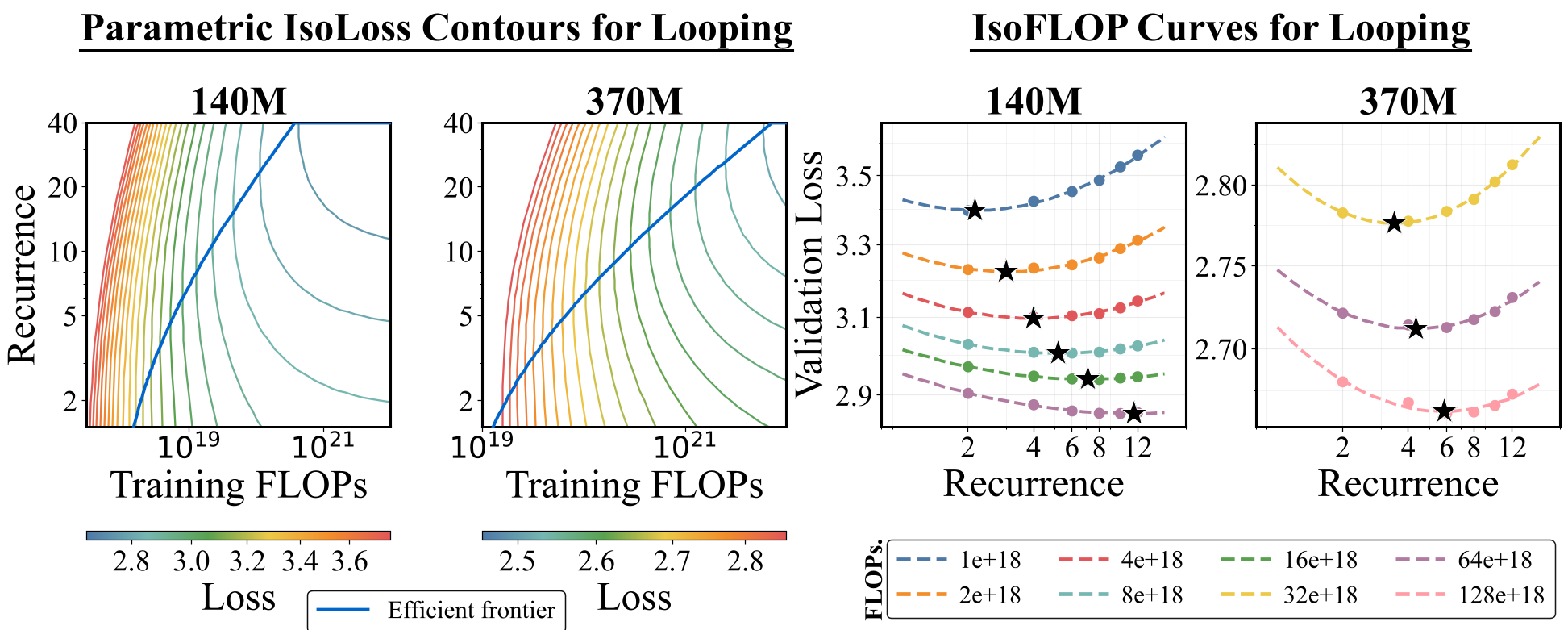
The authors study isoFLOP settings where total compute is fixed and ask:
given a fixed FLOP budget and fixed parameter budget, how should we trade off looping depth versus data?
Their answer is elegant:
- optimal training does not put all extra compute into more tokens,
- it also increases recurrence,
- and the two follow empirical power laws.
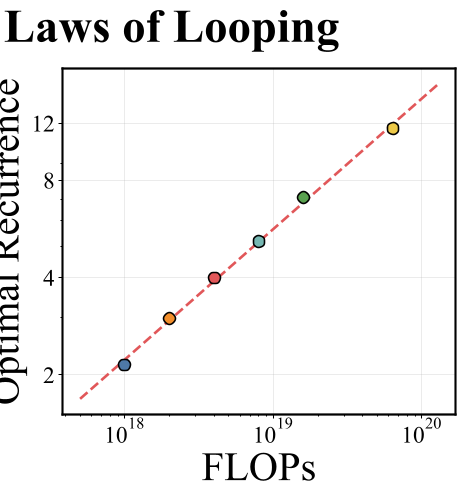
Specifically, they find approximate exponents:
- optimal recurrence scales with FLOPs at about
γμ ≈ 0.40 - optimal tokens scale with FLOPs at about
γD ≈ 0.78
So looping behaves like a genuine scaling axis, not just a curiosity.
Why this matters
In standard scaling law language, we usually think in terms of:
- parameters,
- data,
- compute.
Parcae suggests that for looped models, recurrence depth should be treated as a separate controllable degree of freedom. That is a nontrivial extension of the classic Chinchilla-style picture.
The implication is subtle but important: if you hold parameter count fixed, there may still be a compute-optimal path that increases model quality through recurrence rather than width/depth growth.
4. Test-time scaling is real but saturating
The paper also studies inference-time recurrence. The result is notably less hype-driven than some latent reasoning narratives:
- yes, extra loops at test time help,
- no, the gains are not unbounded,
- the improvement follows a saturating exponential decay.
They fit:
L(T) = L∞ + Z exp(-zT)
and find that this matches the empirical curves extremely well.
This is one of the most intellectually honest aspects of the paper. It explicitly rejects the fantasy that unlimited test-time recurrence will endlessly improve performance. Instead, training depth sets a ceiling, and test-time loops approach that ceiling asymptotically.
That is a more mature framing of inference-time compute scaling.
5. Unified training + test-time scaling law
The final conceptual payoff is a unified law:
- training sets the irreducible floor,
- test-time looping yields exponential decay toward that floor,
- decay depends on the ratio
T / μrec.
This is attractive because it turns recurrence into a quantitatively modelable object at both stages:
- how much looping to train with,
- how much looping to use at inference.
The held-out prediction error is low enough to suggest the law is not merely descriptive curve fitting:
- around 0.85% to 1.31% average error on held-out test-time loss prediction.
That is strong evidence that the phenomenon is systematic.
Critical Analysis & Conclusion
What Parcae really contributes
The most important contribution is not just a new architecture. It is a change in viewpoint:
- looped models should be analyzed as dynamical systems,
- stability should be enforced structurally,
- once stabilized, recurrence exhibits predictable scaling behavior.
That framing upgrades looping from “parameter sharing trick” to “controlled iterative computation.”
Why the method works
Parcae works because it addresses the actual instability bottleneck:
- repeated recurrence magnifies any unstable mode,
- prior injection parameterizations allowed such modes,
- stable diagonal transition dynamics eliminate them by construction,
- normalization and per-sequence sampling then clean up remaining optimization variance.
The method is effective precisely because it separates:
- structural stability from
- optimization hygiene.
Many papers solve only the second part.
Limitations
The paper is strong, but several limitations are real:
- Restricted parameterization of
A: the diagonal transition is safe, but may underuse the expressive potential of recurrent state mixing. - Scale ceiling remains open: most scaling-law analysis is done at relatively modest model sizes compared with frontier LLM training.
- Inference cost still grows with loops: parameter efficiency improves, but latency can worsen if many recurrent steps are needed.
- Dependence on training depth: test-time scaling saturates near the capability induced by training-time recurrence, so inference-only compute is not magic.
- Loop design space is still underexplored: loop placement, recurrent unit composition, and extreme-depth regimes remain largely open.
My take
This paper is more significant than a raw metric table would suggest.
Why?
Because it attacks an increasingly relevant systems problem: how to buy more capability with compute instead of memory. In an era where inference dominates deployment cost and edge deployment matters more, that is a strategically important question.
Parcae does not prove that looped language models will replace fixed-depth Transformers. But it does establish three things that were previously missing:
- a principled stability diagnosis,
- a stable architectural recipe,
- a scaling-law framework for recurrence.
That is enough to make looping a serious research direction rather than a niche curiosity.
Future Work
The most interesting next steps are clear:
- richer but still stable transition parameterizations beyond negative diagonal forms,
- larger-scale validation of the training and inference scaling laws,
- adaptive halting or routing on top of stable recurrence,
- extension to multimodal and vision settings,
- methods that preserve recurrence benefits with fewer inference-time steps.
If those lines succeed, Parcae may end up being remembered less as a specific model and more as the paper that made stable recurrent-depth scaling scientifically legible.
Final Takeaway
Parcae’s central lesson is simple: recurrence only becomes a useful scaling axis once it is treated as a stability problem first and an architecture problem second. By imposing spectral discipline on the loop and pairing it with better depth sampling, the paper turns looped language models from fragile experiments into predictable compute-scalable systems.