
[ArXiv 2025] Parcae: Stabilizing the "Loop" to Break the Transformer Scaling Limit
Parcae: Scaling Laws For Stable Looped Language Models
The paper introduces Parcae, a stable looped Transformer architecture that scales model quality by iteratively processing activations through shared layers. By treating the residual stream as a linear time-invariant (LTI) system, the authors derive stability constraints that allow looped models to match the performance of Transformers twice their size, achieving up to a 6.3% reduction in perplexity and significant gains on reasoning benchmarks.
TL;DR
Parcae is a breakthrough in looped language models that rethinks layer recurrence through the lens of Control Theory. By constraining the spectral norm of the residual stream, the authors have created a stable training recipe that allows a model to "think longer" through shared weights. The result? A model that matches the performance of traditional Transformers twice its size with near-zero parameter overhead.
The "Residual Explosion" Problem
Why don't we just loop the middle layers of a Transformer to increase depth without adding parameters? Because it usually breaks. In standard looped models (like RDMs), the hidden state often grows exponentially—a phenomenon known as residual explosion.
Previous attempts to fix this used "band-aids" like excessive LayerNorms or very small learning rates. The authors of Parcae discovered the root cause: the "injection" logic (how the input is mixed into the loop) creates a marginal or unstable dynamical system where the spectral radius of the transition matrix .
Methodology: From Transformers to Dynamical Systems
The genius of Parcae lies in recasting the Transformer forward pass as a linear time-invariant (LTI) system:
To ensure this system never "explodes," Parcae enforces three key innovations:
- Stable Transition (A): They parameterize the matrix as a negative diagonal, ensuring all eigenvalues are negative. When discretized via Zero-Order Hold (ZOH), it guarantees .
- Prelude Normalization: They identified that late-stage training spikes often come from the input injection. Adding a normalization layer right before the loop prevents the initial state from jumping to unmanageable magnitudes.
- Stochastic Per-Sequence Sampling: Instead of the whole batch having the same loop depth, each sequence is sampled independently. This provides a more stable gradient signal for the model to learn "any-depth" logic.
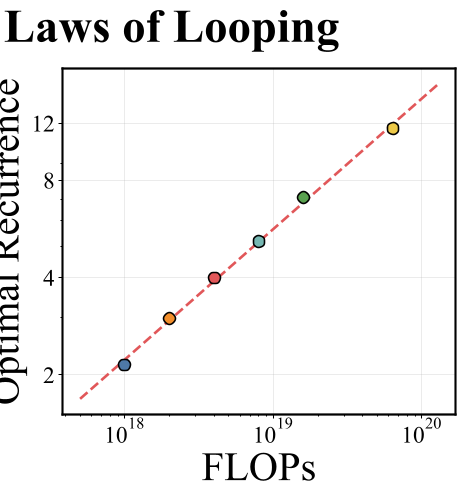 Figure 1: Parcae's stabilized injection mechanism vs. the scaling power laws of looping.
Scaling Laws for Looping
We are all familiar with the Chinchilla scaling laws (scaling parameters and tokens). Parcae introduces a third dimension: Recursion (\mu_{rec}).
The paper finds that:
- Training Scaling: To get the most "bang for your buck," if you increase your FLOP budget, you shouldn't just add more data; you should also increase the number of loops following a predictable power law.
- Test-Time Scaling: Unlike most Transformers that are fixed at inference, Parcae can be "unrolled" further at test-time to improve quality, following a saturating exponential decay.
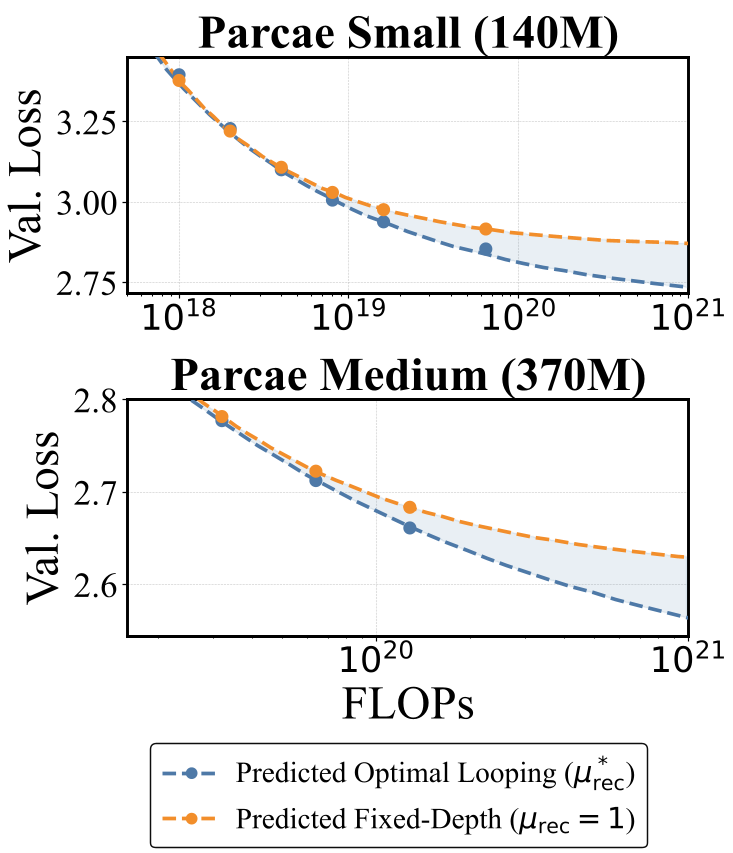 Figure 2: Optimal tokens and recursion levels following predictable power laws.
Results: Doing More with Less
Parcae isn't just a theoretical curiosity; it's a SOTA contender.
- Efficiency: A 770M Parcae model achieves a 25.07 Core score, outperforming a 1.3B standard Transformer (25.45) while being nearly 2x smaller in memory footprint.
- Stability: While baseline RDMs diverged at higher learning rates, Parcae remained rock-solid even at .
Critical Analysis & Future Work
Limitations: While Parcae is parameter-efficient, it isn't necessarily faster at inference. Looping times still takes times the compute. The current challenge is making these loops faster using techniques like Medusa-heads or speculative decoding.
The Takeaway: Parcae proves that the "depth" of a model shouldn't be a fixed structural choice, but a dynamic, controllable parameter. It opens the door for Edge AI, where memory is the bottleneck, but computation can be scaled as needed.
Conclusion
By treating the residual stream as a dynamical system, Parcae provides the mathematical safety rail needed to scale looped models. As we reach the limits of how much data we can scrape, scaling via "thinking longer" (looping) might be the next great frontier in AI.