
Parental Security Control: Moving Beyond Static Blacklists with ML
Parental Security Control: A tool for monitoring and securing children's online activities.
The paper introduces a "Parental Security Control" tool, a five-layered architecture designed to monitor and secure children's online browsing. It utilizes dynamic web scraping and Machine Learning classifiers (Logistic Regression and XGBoost) to categorize websites into ten distinct sub-domains in real-time.
TL;DR
With the surge in online education, children are more exposed to the "dark side" of the internet than ever. This paper presents a smart Parental Security Control tool that abandons the fragile "static list" approach of traditional software. By combining real-time web scraping with Machine Learning (Logistic Regression and XGBoost), the system dynamically analyzes a webpage’s actual content before allowing access, ensuring that even obscure or new sites are properly filtered.
The Problem: The Static Database Fallacy
Most commercial parental control tools operate on a database-driven filtering mechanism. If a URL isn't in their "blacklist," it’s often let through. The authors highlight a critical flaw: popular tools like Kaspersky failed to block gaming content on reputable non-gaming sites (e.g., Softonic) because the domain itself was whitelisted.
In an era where thousands of new URLs are generated daily, a static or cloud-synced database is always one step behind. Furthermore, centralized cloud-based filtering raises significant privacy concerns regarding the tracking of a family's browsing habits.
Methodology: The Five-Layered Shield
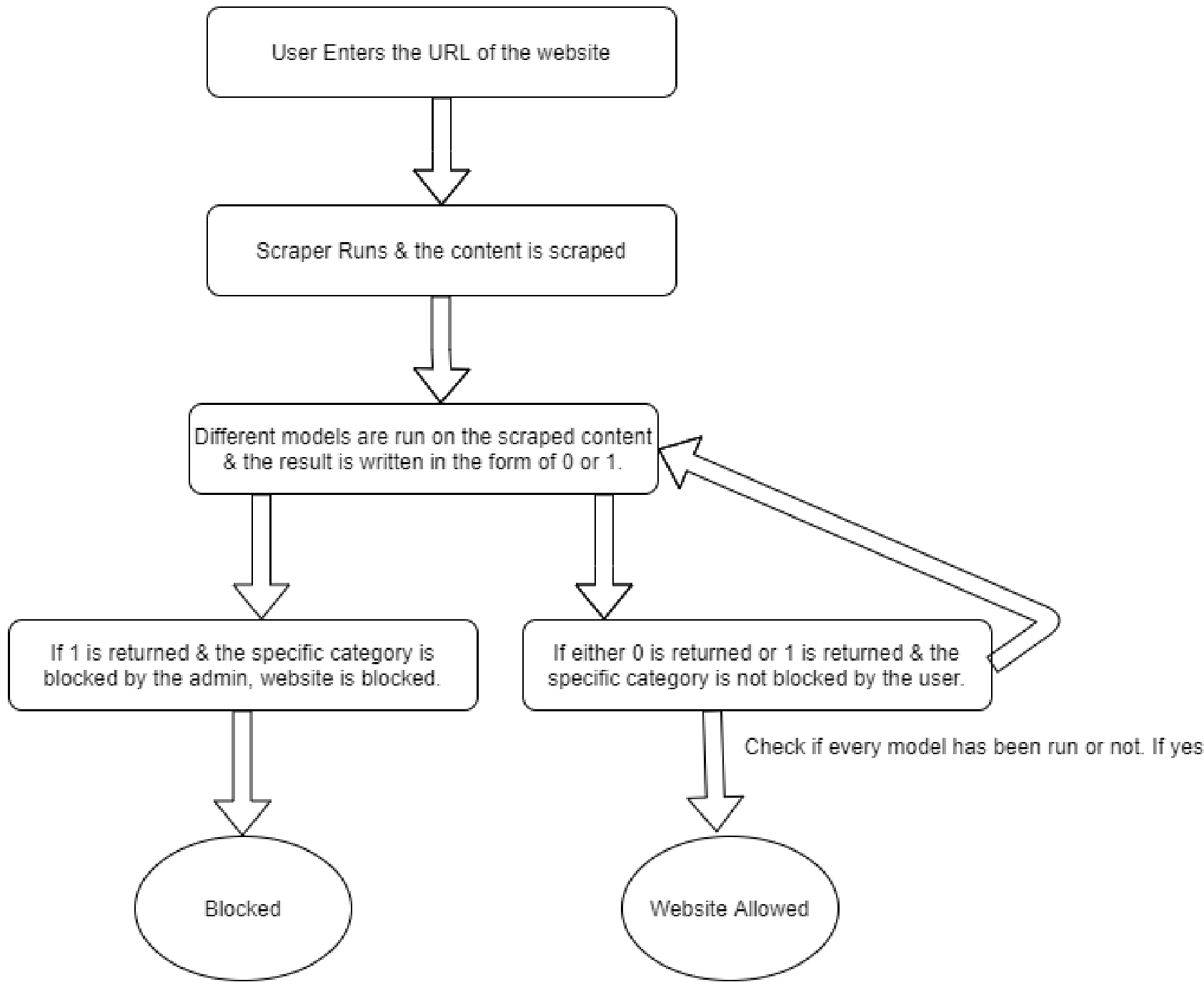
The authors propose a sophisticated pipeline that moves from "lightweight" to "heavyweight" analysis to balance speed and accuracy:
1. The Architecture
The system is split between a Browser Extension and a Django-based Backend Server.
- Layer 1 (The Gatekeeper): A browser plugin intercepts requests. It uses Regex to check titles and metadata. If it finds an obvious mismatch, it blocks the site instantly.
- Layer 2 & 3 (The Processor): If the site looks "innocent," the Selenium/Scrapy engine fetches the full text. This text is cleaned via NLTK (tokenized, lemmatized, and stripped of stop words).
- Layer 4 (The Brain): This is where the ML happens. The system uses a One-vs-Rest strategy with ten models (one for each category like Adult, Gaming, or Torrents).
- Layer 5 (The Human-in-the-Loop): A feedback layer allowing parents to override false positives.
Why Machine Learning?
The core innovation is treating web filtering as a Multi-label Classification problem.
- Logistic Regression: Chosen for its speed and interpretability in real-time scenarios. It achieved a 2% improvement over Naive Bayes.
- XGBoost: Employed to handle more complex feature relationships. As an ensemble gradient boosting method, it minimizes loss by iteratively correcting the residuals of previous trees, making it highly effective for "grey area" content.
The "Bag of Words" and TF-IDF (Term Frequency-Inverse Document Frequency) approach allows the model to ignore common words and focus on the "signal"—the words that truly define a category (e.g., "betting" vs. "education").
Experimental Results & Comparison
The authors performed a head-to-head comparison against Kaspersky Safe Kids, highlighting their tool's dynamic nature:

While commercial tools offered "Safe Search" features for YouTube, they struggled with Dynamic List Updates. The proposed tool requires no manual updates because it interprets what it sees on the screen, just as a human would, but at machine speed.
Critical Insight & Future Work
The strength of this work lies in its Inductive Bias: the assumption that a website's text content is the most reliable signal for its intent. However, the authors acknowledge a major limitation: the modern web is increasingly visual.
Limitations
- Robot Detection: Selenium scrapers can be blocked by advanced CAPTCHAs.
- Visual/Video Content: The current model is blind to images and videos, which are primary vectors for inappropriate content today.
The Path Forward
The next logical step for this research is the integration of Computer Vision and Video Analysis. By extracting keyframes from online videos and running them through a CNN (Convolutional Neural Network), the tool could provide a truly comprehensive safety net for the next generation of internet users.
Conclusion
This paper serves as a vital reminder that in the face of a dynamic internet, static security is no security at all. By decentralizing the classification process and moving it to an ML-powered local architecture, we can achieve a safer, more private digital environment for children.