
Goal-Specific Social Capital: Why "Low-Status" Contacts Matter for Career Entry
The influence of parents’ social capital on their children’s transition to vocational training in Germany
This study investigates how parents' social capital affects adolescents' transition into vocational education and training (VET) in Germany. Using longitudinal data from the National Educational Panel Study (NEPS), it discovers that parents' ties to lower-status occupations significantly increase the probability of securing a dual apprenticeship, proving the goal-specific nature of social capital.
TL;DR
In the high-stakes transition from school to work, we often assume that "knowing the right people" means knowing doctors, lawyers, or executives. This study by Tobias Roth turns that assumption on its head. In the context of the German dual vocational system, it is actually the parents’ ties to lower-status occupations—like mechanics and sales clerks—that serve as the most effective "safety net" and launchpad for adolescents.
The "High-Status" Fallacy in Career Entry
For decades, social capital theory (rooted in Bourdieu and Lin) has emphasized that high-status ties provide superior resources, information, and influence. However, Roth identifies a crucial mismatch: if an adolescent is seeking an apprenticeship as a plumber or a warehouse clerk, a lawyer's network might be entirely disconnected from the relevant vacancies and recruitment norms.
The problem is that the German labor market is highly stratified and segment-specific. In this environment, the "strength of weak ties" or the "prestige of high ties" falters if they lack the granularity needed to navigate specific vocational paths.
Methodology: The Position Generator
To test this, the researcher used data from the German National Educational Panel Study (NEPS), focusing on ninth graders.
Key Measurement:
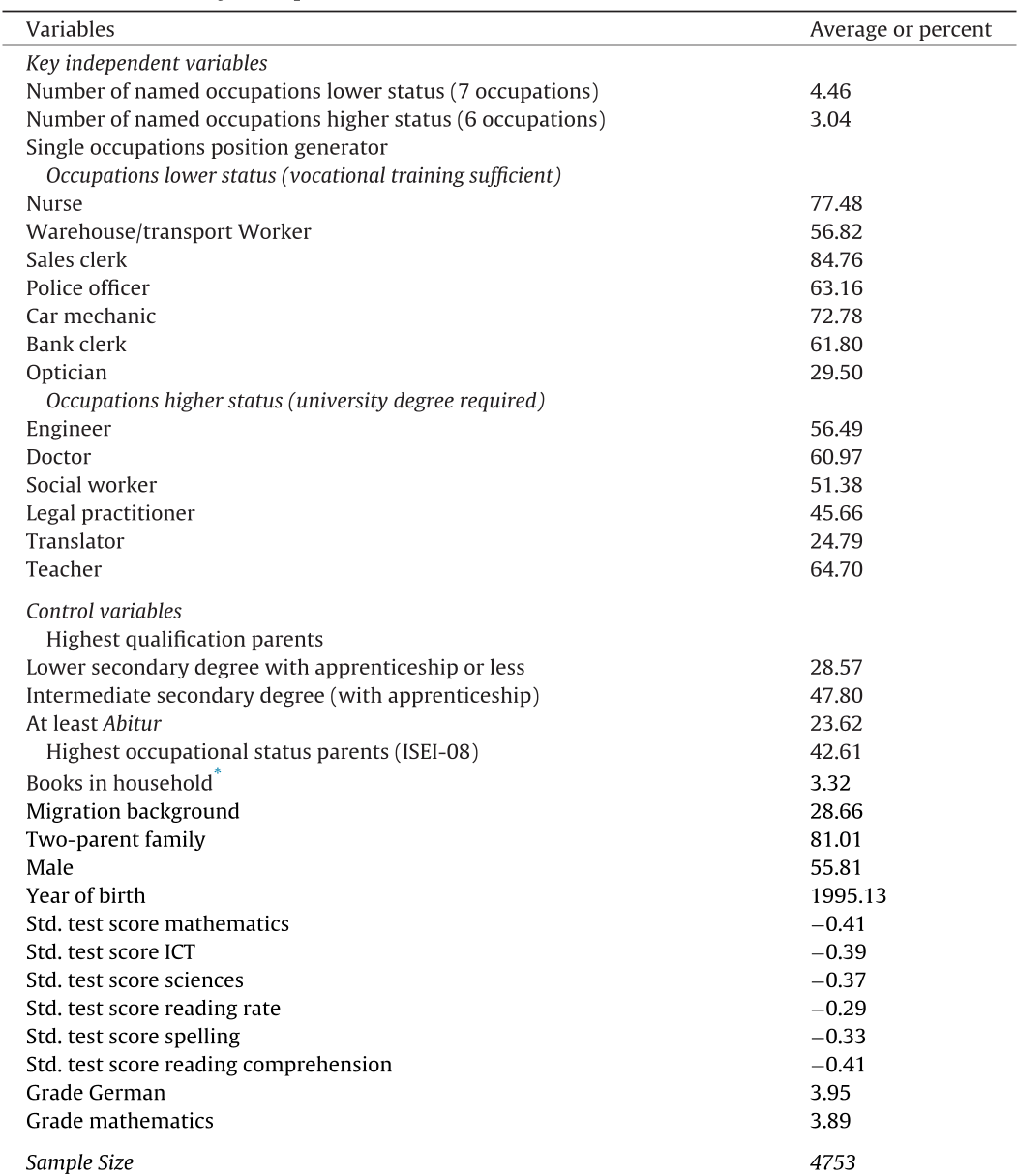
Instead of just asking "how many people do you know?", the study used a Position Generator. Parents were asked if they knew anyone in 13 specific occupations, split into:
- Lower-status: Nurse, Warehouse worker, Sales clerk, Car mechanic, etc.
- Higher-status: Engineer, Doctor, Legal practitioner, Teacher, etc.
Core Findings: The Power of Targeted Networks
1. The Right Tool for the Job
The results confirm that social capital is goal-specific. Adolescents whose parents knew many people in lower-status occupations for which vocational training is sufficient had a significantly higher success rate in finding dual apprenticeships.
2. The Efficiency of "Sales Clerks" and "Mechanics"
When looking at individual occupations, the study found that knowing a Sales Clerk or a Car Mechanic was twice as effective as knowing other lower-status professionals. This is because these roles represent the largest sectors of the German dual training system. They are "insiders" in the very market the children are trying to enter.

3. No Effect on Quality
Interestingly, while these networks help you get in the door, they don't necessarily lead to higher-quality apprenticeships (measured by salary or company size). They act as a "smooth transition" mechanism rather than a "status booster."
Critical Insight: The Transition System "Trap"
One of the most vital takeaways is the role of these networks in preventing adolescents from falling into the "transition system"—a state of "bridging" education that often leads to nowhere. Parents with vocational-heavy networks provide the specific information (vacancy details, "putting in a good word") that acts as a guardrail against post-school inactivity.
Conclusion & Future Outlook
Roth’s work challenges the vertical view of social mobility. For youth entering vocational paths, "horizontal" social capital is the true currency.
Future Research Directions:
- International Generalizability: Does this hold true in "internal labor market" countries like the US, where vocational pathways are less standardized than in Germany?
- Digital Networks: How do platforms like LinkedIn or local community groups replicate or replace these traditional parental networks?
This paper serves as a reminder to researchers and policy-makers alike: when helping the next generation, we need to match the type of social capital to the specific goal of the student.