
MEGCN: Capturing Partial Social Relationships via Multi-channel Encoding
Partial Relationship Aware Influence Diffusion via a Multi-channel Encoding Scheme for Social Recommendation
This paper introduces MEGCN (Multi-channel Encoding Graph Convolutional Network), a novel social recommendation framework that leverages channel-wise sparsity to model "partial relationships." It achieves state-of-the-art performance comparable to Graph Attention Networks (GATs) while being significantly more computationally efficient.
TL;DR
Social recommendation systems often assume that "friends share similar interests." However, real-world data shows users often maintain distinct personal interests while only sharing some preferences with friends—a concept the authors call Partial Relationships. MEGCN is a new GNN framework that models these nuances using a Multi-channel Encoding Scheme. It matches the accuracy of heavy-duty Graph Attention Networks (GAT) but runs 10x faster by replacing node-wise attention with sparse, channel-wise operations.
The Problem: The High Cost of "Friendship"
In social recommendation, we want to use a user's social circle to predict what they might buy or watch. Traditional Graph Convolutional Networks (GCNs) tend to average the features of all neighbors, leading to oversmoothing (where every user starts looking the same).
To fix this, researchers turned to Graph Attention Networks (GAT). While GATs can distinguish which friends are more "influential," they calculate a similarity score for every single pair of connected nodes. In a dense social network, this is a computational nightmare. Furthermore, GATs treat the relationship as a single weight, ignoring that you might share a friend's taste in movies but not in food.
Methodology: The "Partial Relationship" Insight
The authors argue that social influence doesn't happen globally; it happens across specific "channels" or dimensions of a user’s interest.
1. Channel-wise Sparsity
Instead of calculating one attention weight per friend, MEGCN splits the user embedding into channels. Each channel represents a latent interest. By assuming channel-wise sparsity, the model only lets information pass through the channels where the user and their friend actually overlap.
2. InfluenceNorm & ChannelNorm
To make this sparse propagation work, the authors introduced two critical components:
- InfluenceNorm: This applies a softmax-based mask to the element-wise product of a user and their neighborhood's influence. It identifies which interest "channels" should stay open.
- ChannelNorm: To prevent some channels from becoming "too loud" (gradient explosion) or "too quiet" (vanishing), this balances values across the dimensions. This effectively keeps users distinct from their neighbors, solving the GNN oversmoothing problem.
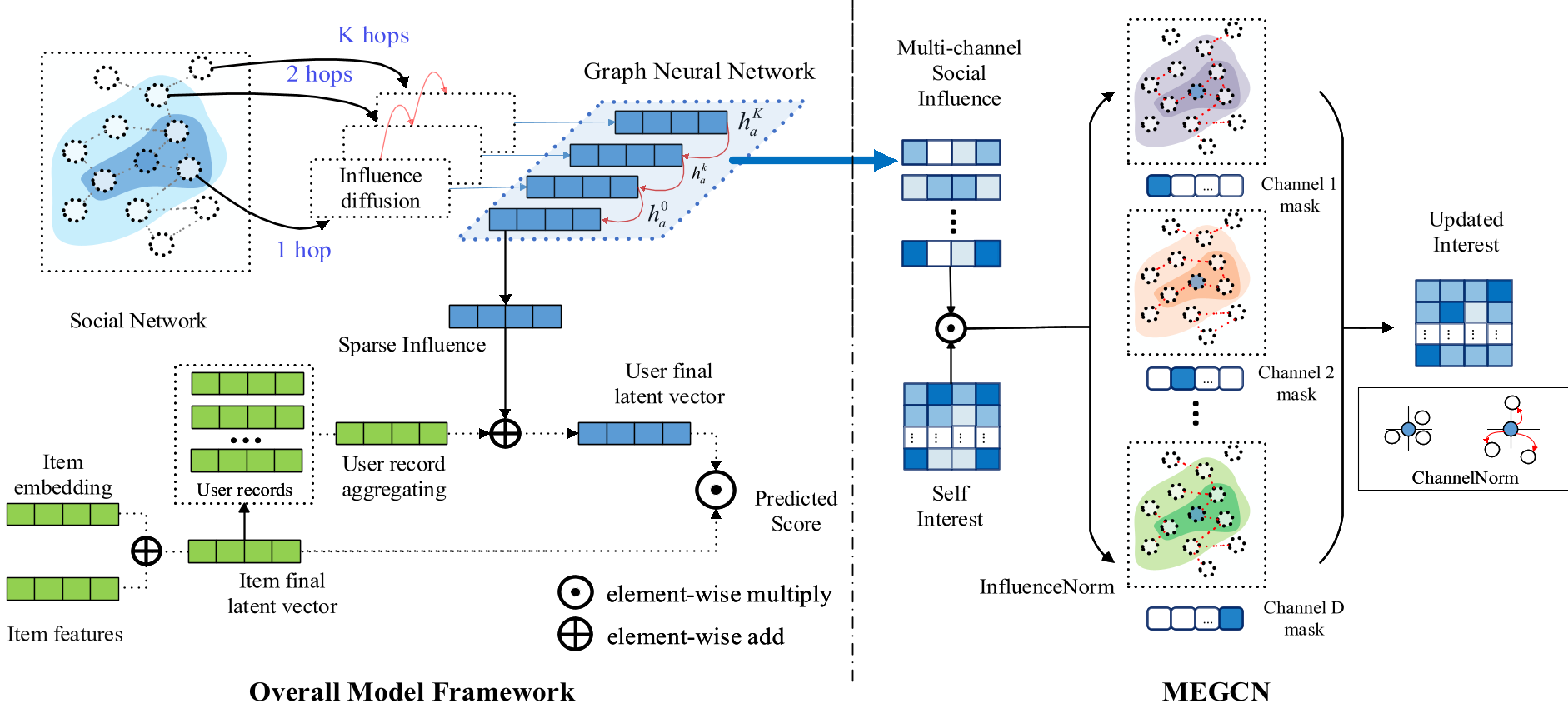 Figure 1: The MEGCN framework featuring the Multi-channel Encoding and Influence Diffusion Layer.
Experiments: Speed Meets Precision
The researchers tested MEGCN on the Yelp and Flickr datasets against heavyweights like DualGAT and DiffNet.
Key Performance Wins:
- Efficiency: MEGCN training time was ~0.98 seconds per epoch on Flickr, compared to ~11.03 seconds for DualGAT. That's an order of magnitude improvement in speed.
- Handling Depth: Most GNNs fail as they get deeper (more "hops" in the network). MEGCN maintained stable performance even at a diffusion depth of , thanks to ChannelNorm.
- Feature Independence: By analyzing the correlation matrix of user features, the authors showed that MEGCN produces much less redundant (more independent) features than standard GCNs.
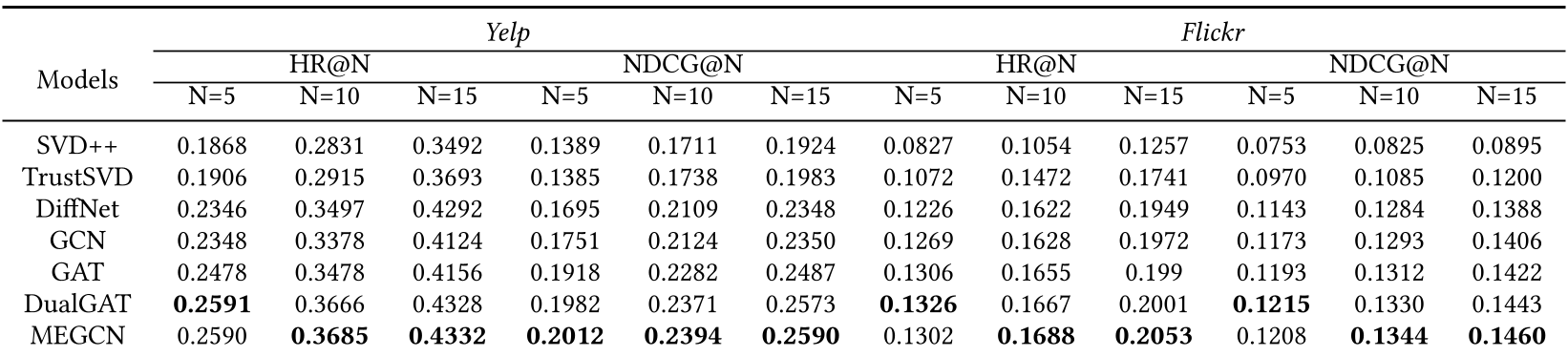 Table 1: MEGCN consistently ranks as a top performer across multiple evaluation metrics (HR@N, NDCG@N).
Critical Analysis & Conclusion
The brilliance of MEGCN lies in its "Compute After Aggregate" strategy. Traditional GAT computes messages before aggregating (expensive), whereas MEGCN aggregates first and then applies a channel-wise mask. This mathematical "shortcut" provides the benefits of attention without the pairwise overhead.
Limitations: While highly efficient, the model relies on the assumption that latent interests can be decomposed into independent channels. In cases where interests are highly entangled, the channel-wise sparsity might be too restrictive.
Final Takeaway: MEGCN proves that you don't need complex, node-wise attention mechanisms to build a smart social recommender. By designing for "Partial Relationships," we can build systems that are both faster and more reflective of human social dynamics.
Future Directions
The authors suggest exploring graph sub-structures more deeply and applying this multi-channel encoding to other graph-based tasks like node classification or link prediction in non-social domains.