
PRML: The Communication Theory Insight that Revolutionized the Hard Drive Industry
6733_Partial-response coding, maximum-likelihood decoding capitalizing on the analogy between communication and recording [History of Communications].
Summary
Problem
Method
Results
Takeaways
Abstract
This paper reviews the historical development and impact of Partial-Response Maximum-Likelihood (PRML) technology in digital magnetic recording. It details the transition from peak detection to a communication-theoretic approach, establishing PRML as the industry standard that enabled a 17-million-fold increase in areal density in Hard Disk Drives (HDDs).
## TL;DR
In the 1960s, magnetic recording faced a "brick wall" called pulse crowding. This paper recounts how Hisashi Kobayashi and his colleagues broke through this limit by reimagining a hard drive not as a simple peak-reader, but as a complex communication channel. By introducing **Partial-Response Maximum-Likelihood (PRML)**, they enabled the storage industry to transition from the 4.4MB RAMAC to the multi-terabyte drives of the modern era, increasing storage density by a factor of 17 million.
## The Wall: When Peaks Collapse
Before 1970, HDD heads worked like a simple eye looking for the highest point of a hill. This was **Peak Detection (PD)**. But as engineers squeezed bits closer together, the "hills" of magnetic flux began to bleed into one another—a phenomenon known as **pulse crowding**.
The consequences were fatal for data integrity:
1. **Peak Shift**: The summit of the hill moved because of pressure from the neighboring hill.
2. **Peak Collapse**: Two bits merged into a single indistinguishable blob.
3. **Signal-to-Noise Degradation**: The hill was no longer much taller than the surrounding grass (noise).
## The Insight: The Channel Analogy
While working at IBM Research, Hisashi Kobayashi noticed a striking similarity between pulse crowding in recording and **Intersymbol Interference (ISI)** in high-speed telephone data transmission.
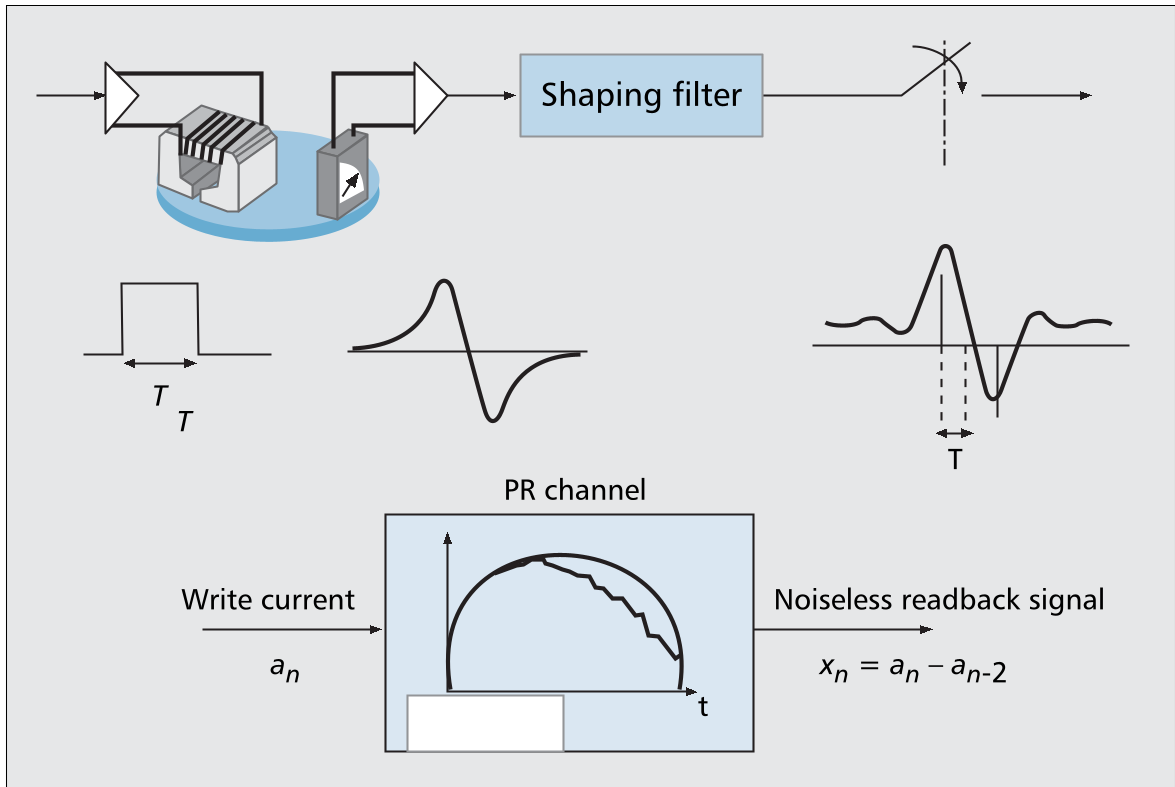
He realized that instead of fighting to eliminate interference (which was physically impossible at high densities), we could **shape** it into a predictable form. This is the essence of **Partial-Response (PR)** signaling. By allowing a bit to "partially respond" across multiple clock cycles, the system creates a controlled redundancy.
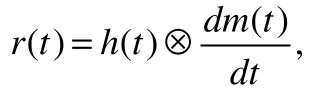
In his 1970 paper with Donald Tang, Kobayashi argued that the readback process $r(t)$ was a linear operation. If you could model the channel with a polynomial like $G(D) = 1 - D^2$ (Interleaved NRZI), you could transform a chaotic mess of overlapping pulses into a structured multi-level signal.
## Methodology: Enter the Viterbi Algorithm
The second half of the breakthrough was **Maximum-Likelihood (ML) Decoding**. During a sabbatical at UCLA, Kobayashi studied Andrew Viterbi’s new algorithm for decoding convolutional codes. He realized that a partial-response channel looks exactly like a convolutional encoder—both are **Linear Finite State Machines**.
By applying the **Viterbi Algorithm** to the readback signal, the drive could look at an entire sequence of samples and determine the most likely sequence of bits that generated them, rather than making a risky "bit-by-bit" guess. This "soft" decoding provided a **3 dB gain** in Signal-to-Noise Ratio (SNR) over previous methods.
## Results: A 17-Million-Fold Leap
The industry was initially skeptical; in 1970, Analog-to-Digital converters and the logic required for the Viterbi algorithm were too expensive for a consumer product. However, by 1990, silicon caught up.
IBM’s introduction of the first PRML-based 5.25-inch HDD triggered a revolution:
- **Density Growth**: The Compound Growth Rate (CGR) of areal density jumped from 25% to **60% or higher**.
- **Ubiquity**: PRML spread from HDDs to tape drives, MP3 players (like the early iPod), and eventually optical media (CDs/DVDs).
- **NPML Evolution**: By 2000, Noise-Predictive ML (NPML) further refined the technique to handle media noise, facilitating densities we take for granted today.
## Critical Analysis & Future Outlook
The legacy of PRML is a testament to the power of **interdisciplinary cross-pollination**. By bringing "Communication Theory" into the world of "Magnetic Storage," Kobayashi solved a hardware physics problem with a software/mathematical solution.
**Limitations and Evolution**:
While PRML was the standard for decades, as we approach the atomic limits of magnetic grains, even MLSE is not enough. Today’s researchers are moving toward **Iterative (Turbo) Decoding** and **Hidden Markov Models**, as mentioned in the paper's conclusion, to extract the last remaining bits of capacity from the magnetic medium.
**Takeaway**: Innovation often hides in the analogies between fields. If your current "sensor" is failing, stop trying to sharpen the sensor and start modeling the "channel."