
Strategizing Social Graph Disclosure: Balancing Privacy and Utility against Crawlers
Partial Social Network Disclosure and Crawlers
The paper investigates partial disclosure policies for online social networks to balance privacy protection against utility for crawlers. It proposes two main models—k-edge and m-node restriction—and demonstrates that the k-edge model, using specific edge-selection policies like low-mutual, achieves a superior tradeoff between graph reachability and privacy leakage.
Executive Summary
TL;DR: This paper tackles the fundamental tension in Online Social Networks (OSNs): how to keep user relationships private while allowing search engines and advertisers to "crawl" enough data to function. The authors propose and test various k-edge and m-node restriction policies across massive datasets (DBLP, LiveJournal, Facebook), concluding that edge-based filtering is significantly more effective and scalable than simply hiding user profiles.
Background Positioning: This work bridges the gap between graph theory and data privacy. It moves beyond simple "random" data masking to provide a systematic framework for OSN owners to manage data disclosure as a strategic tradeoff.
The Core Conflict: Privacy vs. Utility
In an OSN, the social graph is the "crown jewel." However, its small-world nature—characterized by low diameter and high clustering—is a double-edged sword. While it makes services efficient, it also makes the graph incredibly easy to "leak." Even if a user sets their profile to private, their existence and connections can often be inferred from their public friends.
The authors identify a critical failure in prior logic: Closing a node is not enough. If a public user points to a private user, the private user is "seen." The challenge for the owner (e.g., Facebook) is to decide which edges/nodes to show to maximize service utility while minimizing this "leakage."
Methodology: Restricting the View
The researchers propose two primary transformation models:
1. The k-edge Restricted Graph
Instead of hiding a user, the owner limits the number of friends a user displays to . The "voodoo" lies in which friends are shown:
- Low-Mutual: Shows friends who have the fewest common connections with the user. This increases "diversity" and helps crawlers explore more of the graph.
- Hi-Degree: Shows the most popular friends. This "traps" crawlers in highly connected clusters, potentially protecting the "long tail" of the graph.
2. The m-node Restricted Graph
This model simply opens total nodes and closes the rest. It is a tougher, more global restriction but, as the results show, remarkably ineffective at stopping leaks.
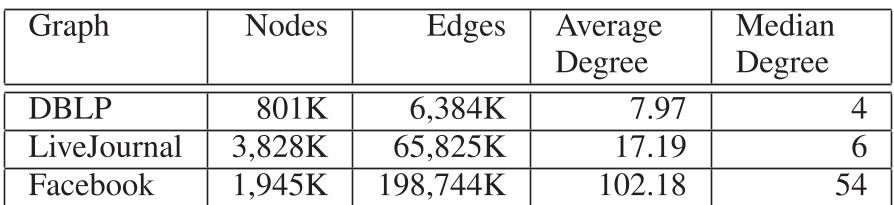 Table 1: Statistics of the datasets used, highlighting the massive scale (up to 65M+ edges) required for realistic testing.
Experimental Analysis: The Leakage Problem
The most striking finding involves the failure of node-based privacy. In the Facebook graph, if the owner makes only 10% of nodes public (Random Policy), a crawler can still discover a significant portion of the closed nodes.
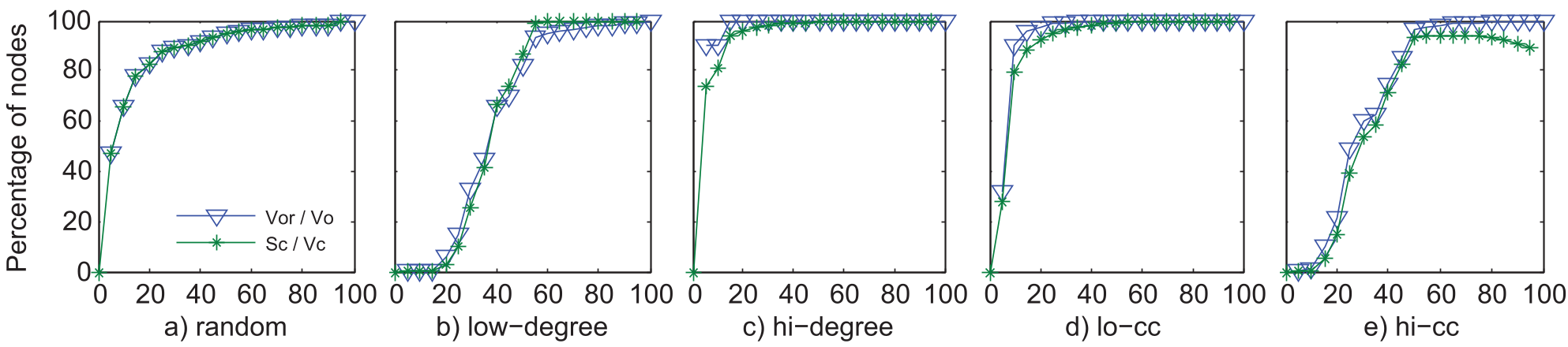 Figure 8: The "leakage" chart. In some scenarios (hi-degree), disclosing just 20% of nodes results in nearly 95% of private nodes being "leaked" to the crawler.
Conversely, the k-edge model proved highly resilient. By adjusting , the owner can precisely control "Reachability"—the percentage of the graph a crawler can eventually see. Interestingly, the Low-Mutual policy achieved high reachability even with a tiny edge budget (), making it the ideal choice for maximizing utility.
Deep Insights & Tactical value
The paper offers several key takeaways for developers and researchers:
- Lazy Computation is King: The k-edge policies are "local." You only need to look at a node's immediate neighbors to decide what to show. This allows for lazy evaluation, making it perfect for real-time systems where calculating global privacy metrics would be too slow.
- The Facebook Paradox: In the Facebook dataset, the "least-seen" crawler heuristic performed better than "most-seen." This is due to Facebook's high median degree; a node that hasn't been mentioned much often hides a massive, unexplored neighborhood.
- Policy over Anonymization: Unlike "graph anonymization" which adds fake edges or nodes (distorting the data), these restriction policies only show true information. This ensures that advertising and search results remain accurate, which is vital for the OSN's business model.
Conclusion
The study proves that simply "hiding profiles" is a naive privacy strategy. To truly control a social network's data perimeter, owners must manage edge visibility. By implementing a k-edge low-mutual policy, a platform can maintain a high-functioning search index while significantly reducing the footprint of the social graph revealed to unauthorized or aggressive crawlers.
Limitations: The study primarily focuses on topological discovery. Future work should integrate these policies with attribute protection (e.g., hiding age or location) to provide a holistic privacy solution.