
Beyond the Expert: Empowering Vulnerable Adults through 3D Printing
A Participant Observational Study with Immigrants and Low-Literate Older People
This paper explores the 3D Printing (3DP) and modeling experiences of 12 vulnerable adults, including immigrants and low-literate older people, through a 3-month participant observational study. The research identifies key barriers to digital fabrication for these groups and proposes human-centric interventions to foster social and digital inclusion.
TL;DR
While the "Maker Movement" promises technology for everyone, marginalized groups—like immigrants and low-literate seniors—are often left behind. This study observes how 12 vulnerable adults in Barcelona broke through the "expert only" barrier to master 3D modeling, revealing that the true hurdles aren't just technical, but cognitive and psychological.
Positioning in the Field
This work acts as a socially-conscious intervention within the Human-Computer Interaction (HCI) space. It challenges the standard "techno-optimist" view of 3D printing by proving that "democratization" isn't just about making printers cheaper; it's about making the interaction metaphors (like 3D spatial mapping) accessible to those without a STEM background.
Problem & Motivation: The Myth of the "Universal Maker"
The research centers on a hard truth: "We are all makers" is a motto that doesn't currently apply to everyone. Most 3DP research focuses on medical applications, teachers, or tech-savvy hobbyists.
The authors identified a gap: immigrants and low-literate older people suffer from social exclusion and a lack of self-confidence. They perceive fabrication hubs as elite spaces. The goal was to see if 3DP could serve as a vehicle for digital inclusion—not just for the sake of making "things," but for reclaiming agency.
Methodology: Putting Observation into Practice
The researchers didn't just teach a class; they embedded themselves in it.
- The Setting: Àgora, an adult education center in a working-class Barcelona neighborhood.
- The Tools: Tinkercad (for its low barrier to entry) and CURA (for slicing).
- The Approach: Participant Observation (PO). A fieldworker spent 3 months tracking every frustration, "aha!" moment, and technical glitch.
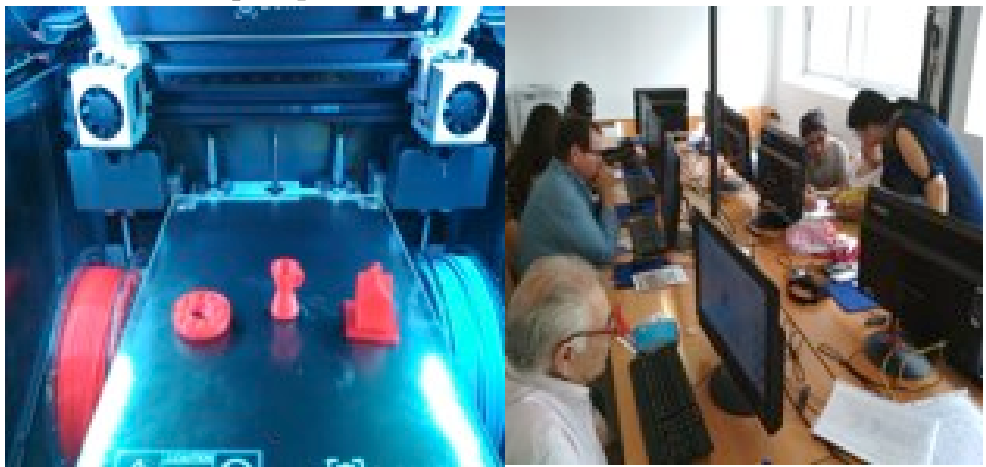 Figure 1: On the left, personalized objects (doll faces, decorative items) created by participants; on the right, the collaborative learning environment.
Core Findings: The Hidden Barriers
The team identified four primary themes through reflexive thematic analysis:
1. The Interaction Gap (Mouse Accuracy)
Many participants struggled with the physical dexterity required for fine mouse movements. Clicking the wrong vertex or failing to drag accurately led to "undesired changes" and a immediate drop in self-esteem.
2. The Spatial Visualization Wall
This was the most significant cognitive hurdle. Participants naturally thought in 2D. When they tried to widen a cube, they were baffled when it moved "up" into the 3D space instead. They lacked the mental "camera control" that digital natives take for granted.
3. Slicing as a "Complex Workflow"
Even after a model was finished, the "slicing" process (converting 3D models to printer instructions) was viewed as a daunting, multi-step barrier that was hard to memorize.
4. Psychological Empowerment
Despite the struggle, the outcome was transformative. One participant noted, "I did not imagine I could do this, I’m really happy!" The value was intrinsic—it proved they could master the "modern world."
Critical Analysis & Future Outlook
The study concludes that to truly democratize 3DP, we must innovate in two areas:
- Voice-Driven Modeling: Replacing the "stressful" mouse interaction with natural language (e.g., "move the cube right") could lower the entry barrier.
- AR-Assisted Visualization: Using Augmented Reality to help users "see" the 3D space in their physical environment before they hit print.
Limitations
As a "Short Paper," the sample size (N=12) is small, and the study is qualitative. While it provides deep "thick description," the findings are context-specific to a particular neighborhood in Barcelona.
Conclusion
This paper serves as a vital reminder to the HCI community: Empowerment is not a feature of the hardware, but a result of the interface. By addressing spatial visualization and physical interaction issues, we can ensure that the "Digital Fabrication Revolution" includes the people who stand to benefit from it most.