
Beyond Usability: Capturing the "Unspoken" Emotions of Online Shopping through Participatory Design
Using Participatory Design Methods to Study Users' Emotional Experiences
The paper introduces a low-cost, qualitative approach to capture user emotions during online shopping using Participatory Design (PD) methods. By employing "making tools" like collages and posters, the researchers successfully extracted latent emotional experiences and mental models that traditional HCI methods often fail to measure.
TL;DR
While "usability" is easy to measure, "emotional experience" remains the "dark matter" of Human-Computer Interaction (HCI). This paper demonstrates a simple, economical participatory method—using posters and collages—to map the emotional highs and lows of the online shopping journey, revealing mental models that traditional surveys miss.
The "Experience" Gap: Why Traditional Metrics Fail
In the world of HCI, we are great at measuring how fast a user clicks a button, but terrible at understanding how they feel while doing it. Traditional methods like depth interviews or questionnaires face a "vocabulary wall": users often lack the precise language to describe subjective feelings or tend to self-censor in formal settings. This creates a data gap for designers trying to build emotionally resonant products for complex tasks like online shopping.
Methodology: The Power of "Making"
The authors argue that to understand experience, users must become co-designers. They adopted Liz Sanders' "making tools" approach, shifting the user's role from a passive subject to an active creator.
The Toolkit
Participants were provided with:
- Collage papers and imagery: Visual triggers to bypass verbal limitations.
- Emotion word lists: To help label feelings precisely.
- Posters: A canvas for the user to reconstruct their "mental narrative."
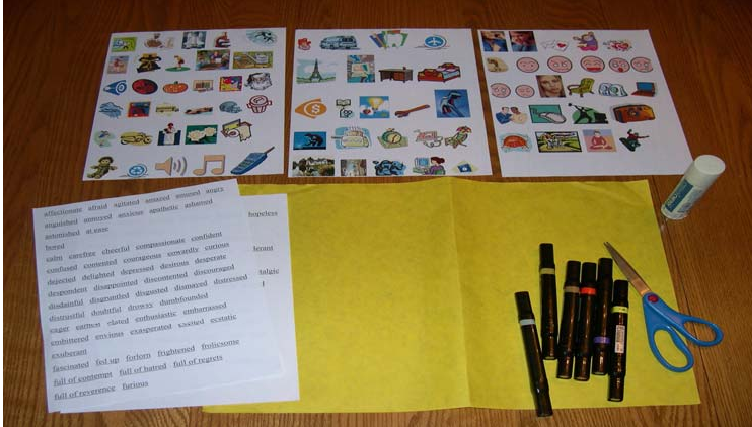
The logic is elegant: tools that resemble everyday life act as triggers for imagination rather than just reflections of reality. By "making" a poster, users externalize their internal mental models and emotional trajectories.
Deep Dive: Mapping the Mental Model
By analyzing 12 participant posters, the researchers decoded the standard mental model of an online shopper into a five-step sequence:
- Idea Generation: Getting the shopping spark.
- Product Search: The most emotionally volatile stage.
- Evaluation: Comparing and decision-making.
- Ordering: Finalizing the transaction.
- Conclusion: The post-purchase state.
Key Emotional Insights
- The Frequency Paradox: High-frequency users are "emotionally flat"—they care more about efficiency and device comfort (like mouse sensitivity) than the interface's aesthetic "vibe."
- The Search Trap: While most users start excited, the "Search" phase is a high-risk zone for negative emotions. If the search fails, frustration spikes immediately, particularly in inexperienced users.
- The "Cart" Metaphor: Users have a universal mental association between the "Cart" icon and the checkout function, confirming the strength of this specific UI archetype.
Structured Visual Analysis
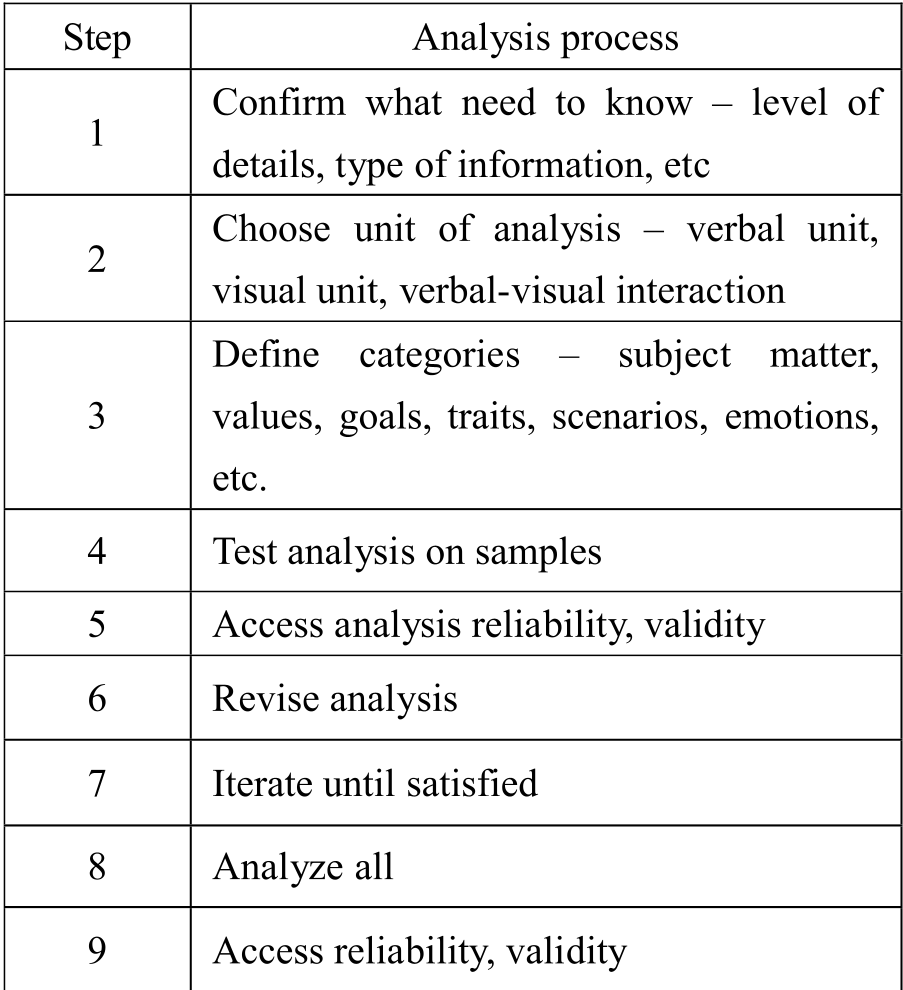
To turn subjective posters into objective design data, the authors used a structured 9-step analysis process (based on Sanoff's methods) to ensure reliability and validity.
Critical Insight: Why This Matters
This research highlights that emotional experience is not a monolith. It is a dynamic curve that fluctuates through different stages of a task. For designers, the takeaway is clear:
- For experts: Focus on "invisible" utility (speed, ergonomics).
- For novices: Provide "emotional safety nets" (guidance, quick navigation, rapid feedback) during the high-stress search and evaluation phases.
Conclusion
The study successfully moves the needle from "User-Centered Design" toward "Participatory Design." By asking users to create rather than just answer, designers can tap into the unspoken psychological layers of HCI. While the sample size was small (12 participants), the methodology provides a scalable, low-cost blue-print for any design team wanting to move beyond basic usability metrics into the realm of true experience design.
Future Outlook: The next step for this research is to refine the "visual vocabulary" provided to users and perhaps integrate these qualitative visual maps with quantitative data like eye-tracking to build a 360-degree view of the user's soul.