
Empowering Communication: A Participatory Approach to Robotic Sign Language Tutors for ASD
A Participatory Design Process of a Robotic Tutor of Assistive Sign Language for Children with Autism
This paper details the participatory design of a robotic tutor based on the InMoov platform, specifically engineered to teach assistive sign language to children with Autism Spectrum Disorder (ASD). By integrating a multidisciplinary team of roboticists and therapists, the authors developed five core design guidelines that led to a successful pilot study where 70% of participants successfully imitated the robot’s signs.
TL;DR
Researchers have developed a specialized robotic tutor using the open-source InMoov platform to teach assistive sign language to children with Autism Spectrum Disorder (ASD). By co-designing with clinical experts, the team established a framework that prioritizes predictability and simplicity. The result? High levels of child engagement and a proven ability to prompt successful sign imitation, marking a significant step forward in Augmentative and Alternative Communication (AAC) technology.
Context: Why Robots for Autism?
Children with ASD often find human social interaction overwhelming due to the unpredictability of facial expressions and social cues. Robots, however, offer a "safe" middle ground: they are socially evocative yet follow consistent, repeatable patterns. This study carves out a niche by applying this logic to assistive sign language, the primary communication tool for many non-verbal individuals with ASD.
The Problem & Design Motivation
Traditional therapy is effective but labor-intensive. Previous robotic interventions often focused on general social play rather than specific skill acquisition like sign language. The core challenge was: How do we design a robot that is human-like enough to teach gestures, but simple enough not to cause sensory overload?
The authors identified three primary barriers:
- Impaired Social Flexibility: Unexpected robot behavior can cause distress.
- Overstimulation: Complex human features can be distracting.
- Safety & Ethics: The risk of a child "de-humanizing" the interaction or getting physically injured by the hardware.
Methodology: The Participatory Design (PD)
This wasn't just built by engineers. A multidisciplinary team (roboticists, speech therapists, and neuropsychologists) worked together to define Five Design Guidelines:
- Simple Form: Avoiding "Uncanny Valley" triggers.
- Consistent Behavior: Repeating prompts exactly to aid learning.
- Positive Environment: Using sensory rewards (lights/sounds).
- Modular Complexity: Scaling the challenge to the child's level.
- Personalization: Adjusting for individual sensory preferences.
The Platform: Modified InMoov
The team used the InMoov robot but made critical hardware adjustments for this specific task.
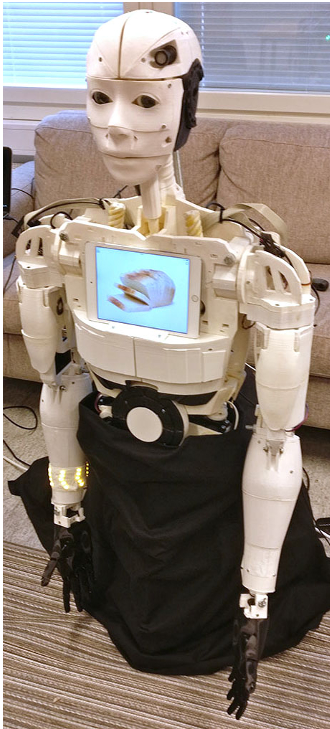 The modified InMoov robot featuring Ada hands for smoother movement, a chest screen for visual aids, and a simplified neutral face.
One of the most innovative technical choices was replacing the standard InMoov hands with Open Bionics' Ada hands, which allowed for the delicate articulation required for sign language.
Experimental Insights
The pilot study focused on nine specific signs under three conditions: "Sign only," "Image + Sign," and "Light + Sign."
Key Findings:
- Engagement: Children looked at the robot nearly 74% of the time, a massive success for a population that often avoids eye contact.
- Imitation: 7 out of 10 children successfully imitated the robot, proving it functions as an effective tutor.
- Preference: Companions (parents/caregivers) strongly preferred the Image condition, noting that visual representations on the robot's chest screen helped the child link the sign to its meaning.
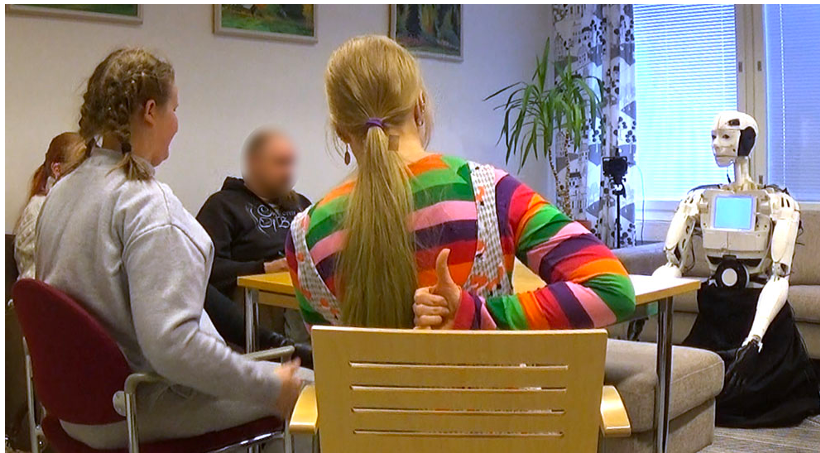 The experimental setup: A structured environment with a speech therapist present to facilitate the interaction and ensure safety.
Critical Analysis & Future Directions
While the study is a success, it highlights the "mechanical" limitations of current hardware.
- Acoustic Sensitivity: The noise from the robot's servos was "scary" for some children. Future iterations need quieter actuators.
- Stiffness: The "machine-like" movement led children to imitate stiff signs. Improving fluid motion is vital for linguistic accuracy.
- Beyond Imitation: The next phase must determine if children are actually learning the meaning of the signs for use in real-world contexts, or simply mimicking a fascinating machine.
Takeaway
This research underscores that for vulnerable populations, Design is as important as Engineering. By involving therapists early, the authors transformed a 3D-printed robot into a clinically relevant tool that could one day assist in giving a voice to those who are functionally mute.