
Beyond Keywords: Leveraging Social Roles for Precision Recommendation in SNS
Participatory information search and recommendation based on social roles and networks
This paper introduces a participatory information search and recommendation framework based on users' social roles and connection networks within Social Network Services (SNS). By mapping real-world social hierarchies and relationships onto digital environments, the system achieves highly personalized information filtering, drastically reducing noise in large-scale social data.
TL;DR
With the explosion of user-generated content, finding the "signal" in the "noise" of social media has become a monumental challenge. This paper argues that the secret to better search and recommendation lies not just in content analysis, but in understanding the social roles of users. By modeling relationships and roles (like hub users or specific group positions), the authors demonstrate a system that can reduce thousands of irrelevant search results into a handful of high-value insights.
The Missing Link: Social Intuition in Digital Networks
Most recommendation algorithms treat social networks as flat graphs of "friends" and "interests." However, human society is structured. We listen differently to a colleague, a mentor, or a news anchor—even if they all use the same keywords.
Existing systems suffer from:
- Information Overload: Keyword matches return thousands of low-quality messages.
- Redundancy: Multiple users tweeting the same viral link without adding value.
- Context Blindness: Failing to recognize that a user’s "role" (and thus their information value) changes depending on which group they are interacting in.
Methodology: The Participatory Framework
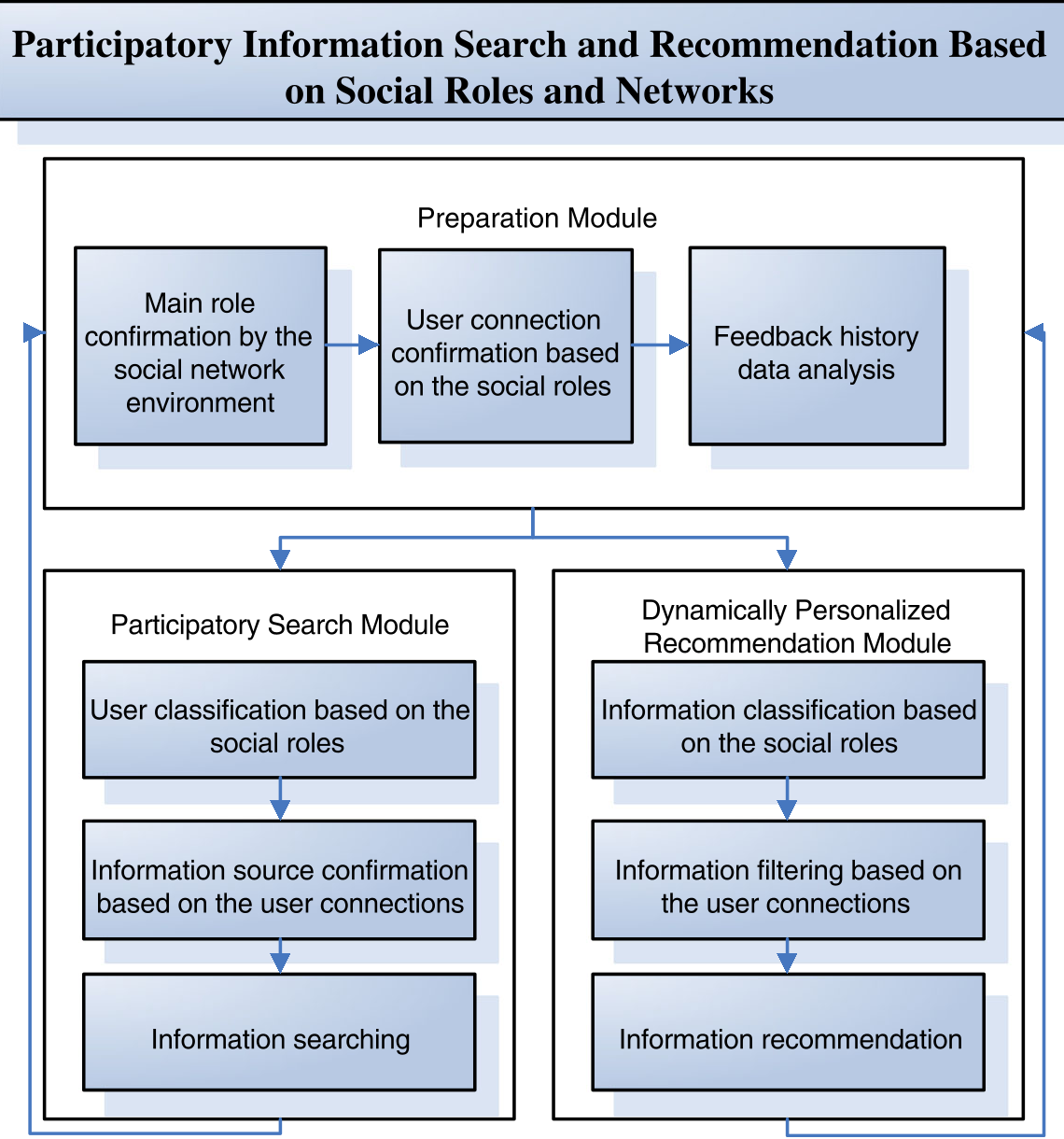
The core of this research is a "Participatory System" that treats users as active sensors and filters. The architecture is divided into three critical stages:
1. Preparation & Role Confirmation
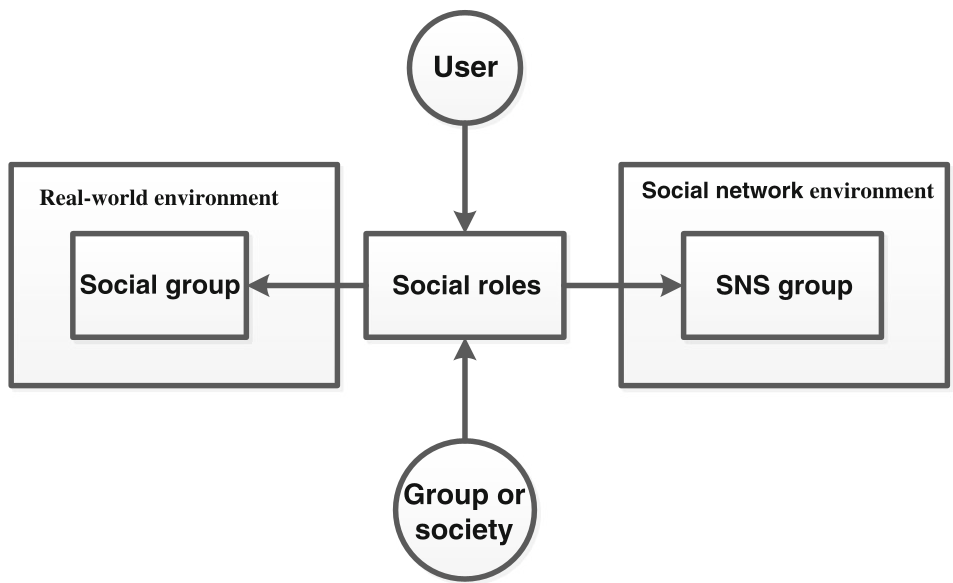
Before a search even happens, the system identifies the Main Role (a user's primary position in a group) and Secondary Roles. This mimics real-world sociology where expectations are bound to positions.
2. Participatory Search Module
Unlike a cold search engine, this module classifies users into importance levels based on the searcher's relationship schema. It doesn't just look for "friends"; it identifies "suitable users" who play similar or authoritative roles in related SNS groups.
3. Dynamic Recommendation
This module performs Redundancy Filtering and Supplemental Merging. If ten people in your network share the same video, the system identifies the "Hub User" (the most active/initiating source) and presents that primary source while hiding the echoes.
Evidence: The 99% Noise Reduction
To prove the efficacy of the "Social Role" approach, the authors ran a simulation on a dataset of 400,122 tweets.
For a target user "@jack" searching for "video":
- Standard Method: 2,230 related messages (unstructured and overwhelming).
- Proposed Method: The system identified a relationship schema with a "hub user" (@laurelbeaton). By prioritizing messages from high-position roles and filtering out retweets (redundancy), the result set was narrowed to 6 relevant messages.

Critical Insight & Future Outlook
The genius of this work lies in its Inductive Bias: the assumption that digital networks should mirror the hierarchical and functional roles of physical society.
Takeaways for Developers & Researchers:
- Role-Based Weighting: When building recommenders, give higher weights to "Hub Users" for discovery and "Similar Peers" for validation.
- Dynamic Adaptation: Roles are not static. A "follower" in one group might be a "leader" in another. Systems must track these transitions in real-time.
Limitations: The current study relies heavily on registration data and manual keyword triggers. Future iterations would benefit from LLM-based intent extraction to automatically define these "social roles" without requiring explicit user inputs.
Conclusion
This paper serves as a blueprint for the next generation of "Human-Centric" search. By moving from a "What you know" (keywords) to a "Who says it" (roles) model, we can finally conquer the chaos of the social web.