
Participatory Heritage: How Social Media is Redefining the Chinese Urban Landscape
Participatory Management for Cultural Heritage: Social Media and Chinese Urban Landscape
This paper explores the integration of the Historic Urban Landscape (HUL) approach within the Chinese context, specifically focusing on how social media acts as a participatory management tool. It highlights the transition of Chinese heritage conservation from a top-down material focus to a "bottom-up" inclusive model utilizing digital community engagement.
TL;DR
Heritage conservation in China is shifting from a state-led material focus to a participatory, digital-led "living heritage" model. This paper argues that social media (ICT) is the key bridge for the Historic Urban Landscape (HUL) approach, allowing grassroots citizens to collaborate with professionals through digital mapping, storytelling, and collective memory building.
Context: From Materiality to Social Value
For decades, heritage conservation was viewed through a "top-down" lens, focused on preserving physical structures. However, as globalization accelerates, the focus is shifting toward the Historic Urban Landscape (HUL)—a framework that views the city as a dynamic layering of values. In China, this transition is particularly complex due to the Hukou system and unique state-civil relationships, making "community" a contested and evolving term.
The Problem: The Participation Gap
Traditional methods of engagement often fail for two reasons:
- Scale and Speed: In rapidly urbanizing Chinese cities, face-to-face consultation is often too slow or elitist.
- Contextual Misalignment: Western "doctrinal" models of civic engagement don't always translate to the Chinese socio-political environment where the line between public and private is blurred.
Methodology: The Rise of "Communities Online"
The paper identifies social media as a game-changer for Participatory Management. Unlike traditional media, social media facilitates "affective engagement"—a way for people to document and experience heritage through their daily digital lives.
Key Digital Tools for Engagement:
- Digital Mapping: Allowing ethnic minorities or local residents to define their own spatial boundaries and cultural significance.
- Augmented Reality (AR): Breaking time and space constraints to provide immersive historical context (e.g., the Carpano Museum case).
- Crowdsourcing: Using platforms like WeChat or Facebook to gather collective narratives and alternative memories.
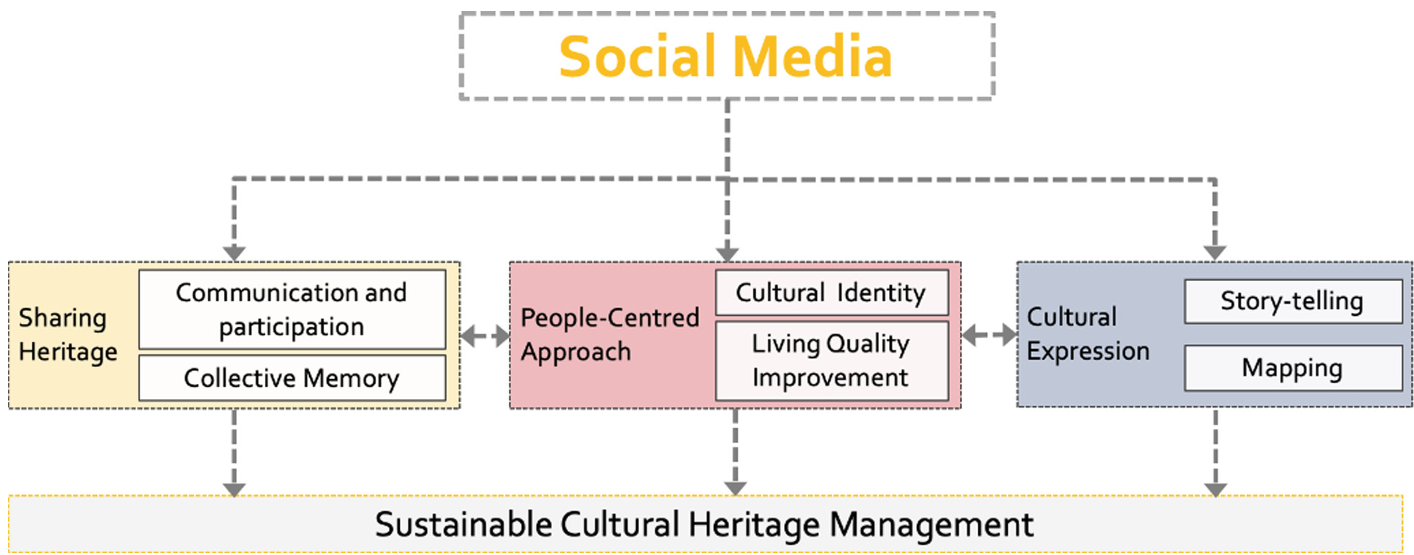 Figure 1: Conceptual framework of digital products facilitating people-centered heritage.
Analysis: A Shift in Power Dynamics
The core insight of the paper is that social media redistributes the power to "represent the city." In the Bell and Drum Tower project in Beijing, activists utilized social media to contest large-scale relocation. By presenting scientific arguments and personal stories online, civic groups forced a transition from "passive agents" to "active stakeholders."
SOTA Comparison: Traditional vs. Digital
The author notes that while traditional broadcast media is a "one-way" street, digital community participation enriched archives with interactive media. This creates a "Digital Community" that can supervise planning and construction phases in real-time.
Critical Insight & Conclusion
While social media is a powerful democratic tool, the paper warns of its potential to become an "elitist tool" if accessibility is not universal. However, the takeaway is clear: Sustainable heritage management in the 21st century is inseparable from the digital footprints of the people who live within it.
The "core community" is no longer just those living in a physical location, but anyone who contributes to the digital narrative of that place. Future research must look at how to formalize these online voices into official urban planning policy.
Author Bio: Xiaoxu Liang is a researcher at the Polytechnic University of Turin, focusing on the intersection of inclusive cultural heritage and digital urbanism.