
VSSE: Bridging the Gap Between Math and Reality in Mobile Social Network Simulations
Participatory Mobile Social Network Simulation Environment
The paper introduces the Virtual Social Simulated Environment (VSSE), a participatory simulation framework for Mobile Social Networks (MSN) built within Second Life (SL). By combining automated SL bots with real-user avatars and a state-driven Markov mobility model, it achieves a "close-to-real-life" simulation that moves beyond traditional random-waypoint models.
TL;DR
Researchers have long struggled to simulate Mobile Social Networks (MSN) because humans don't move randomly, yet most simulators do. This paper introduces VSSE (Virtual Social Simulated Environment), which leverages the virtual world of Second Life to create a participatory simulation. By mixing real human avatars with scripted bots following a daily-routine Markov model, they achieved a simulation that mirrors real-world mobility patterns with 79% accuracy.
Context: The Randomness Problem
In the world of mobile networking, protocols for "opportunistic" connections (where phones swap data as people pass each other) are usually tested using Random Waypoint models. The problem? Humans aren't billiard balls. We have homes, offices, and social circles.
Existing models like "Encounter-based" or "Community-based" models captured fragments of this, but they remained static. The authors argue that a truly valid simulation requires human-in-the-loop dynamics—actual social actors making unpredictable decisions.
Methodology: The Virtual Living Lab
The core of the VSSE is its hybrid architecture. It doesn't just run a script; it creates an ecosystem.
1. The Markov Mobility Model
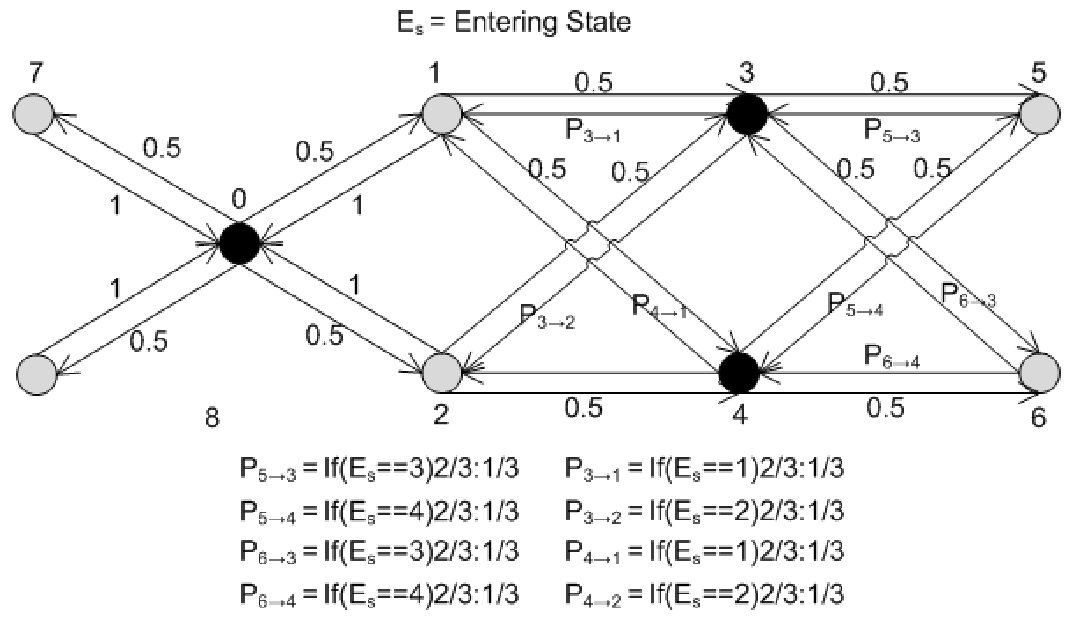
Instead of random movement, bots follow a Finite State Machine (FSM). As shown in the model below, bots transition between 9 states (representing locations like Home, Office, or Shop) based on probabilities that evolve over "days" to simulate habit formation.
2. Participatory Architecture
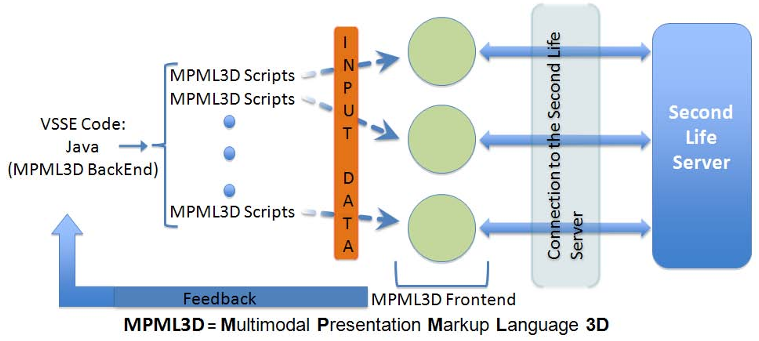
The system uses MPML3D (an XML-based scripting language) to control bots within Second Life. Real users login as avatars, carrying a virtual "mobile device" (programmed in LSL). When an avatar gets close to a bot, the "Send/Receive" protocol triggers, simulating a real-world Bluetooth or Wi-Fi encounter.
Experiments: Virtual vs. Reality
To prove this wasn't just a "game," the authors compared VSSE data against a real-world field study involving GPS/WLAN logs from office employees and students.
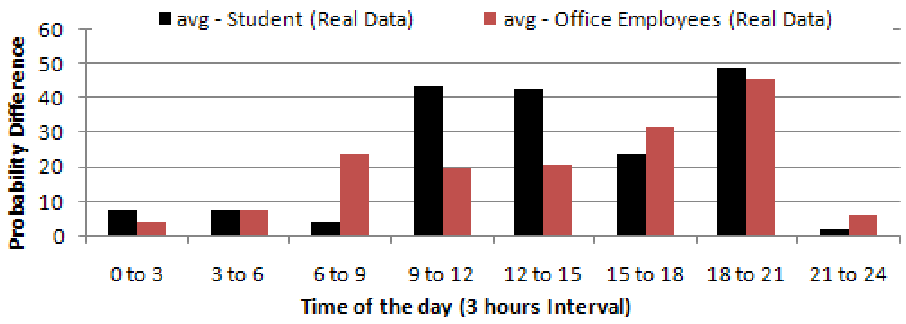
The evaluation focused on Pattern Prediction Probability—how likely a user is to be in a specific "cell" at a specific time.
- Finding: Real-world patterns show high predictability at night (Home) and midday (Office), with chaos during commute times.
- VSSE Performance: The simulation successfully mimicked these trends. While the real-world data was more volatile, the VSSE bots maintained an average probability difference of just 21% compared to physical humans.
Critical Insight & Future Outlook
The brilliance of VSSE lies in its Inductive Bias. By constraining movement to a "Working Day" logic but allowing real humans to break those rules via avatars, the environment captures the "long tail" of social behavior that math formulas often miss.
Limitations: The 2010-era implementation is limited by the number of states (9) and the manual scripting of bots. Modern AI (like LLM-driven agents) could theoretically replace these scripts to create even more nuanced social interactions.
Conclusion: VSSE represents a pivot in networking research—from pure mathematical abstraction toward sociological simulation. It proves that if we want to build better mobile networks for humans, we have to let humans play in the simulation.