
P-DQL: Combating Twitter Spam Bots via Swarm Intelligence and Reinforcement Learning
13260_Particle Swarm Optimization on Deep Reinforcement Learning for Detecting Social Spam Bots and Spam-Influential Users in Twitter Network.
This paper introduces a Particle Swarm Optimization-based Deep Q-Learning (P-DQL) framework alongside a Spam-Influential User Identification and Community Detection (SIU-ICD) algorithm. The proposed system aims to detect malicious social bots and their influential communities on Twitter by optimizing the reinforcement learning policy through swarm intelligence.
TL;DR
Malicious social bots have evolved beyond simple profile-scraping tools; they now dynamically mimic human temporal behaviors to bypass static security filters. This paper presents a novel approach: P-DQL, a Deep Q-Learning model optimized by Particle Swarm Optimization (PSO). By focusing on temporal behavioral patterns and influential community structures, the model achieves a significant 15% improvement in precision over conventional deep learning methods.
Background: The Moving Target Problem
Traditional supervised learning treats bot detection as a classification problem based on static features (e.g., account age, bio length). However, modern bots are adversarial. They manipulate training datasets and alter their posting schedules.
The authors argue that Reinforcement Learning (RL) is the solution because it learns through interaction. Yet, standard Deep Q-Learning is too slow for the scale of Twitter. To bridge this gap, they utilize Particle Swarm Optimization (PSO) to guide the RL agent toward optimal detection policies faster than ever before.
Methodology: The P-DQL Architecture
The core innovation lies in the transition from simple Q-value updates to a swarm-driven optimization.
1. Temporal State Vectors
Instead of easily spoofed profile details, the model uses nine temporal features, including:
- Average time between consecutive tweets.
- Longest session time without a break.
- Percentage of dropped followers (a key indicator of "follower churn" common in botnets).
2. Belief-Based Rewards
The reward function is not just a binary "bot/not-bot" signal. It incorporates a belief value—a probability that a state is malicious based on the behavior of neighboring nodes in the social graph.
3. PSO Integration
Traditional DQL stores every state-action pair in a replay memory. In P-DQL, the PSO component maintains a population of particles (potential detection strategies). It updates their velocity and position based on "local best" and "global best" positions, ensuring the agent converges on the most effective detection path with minimal iterations.
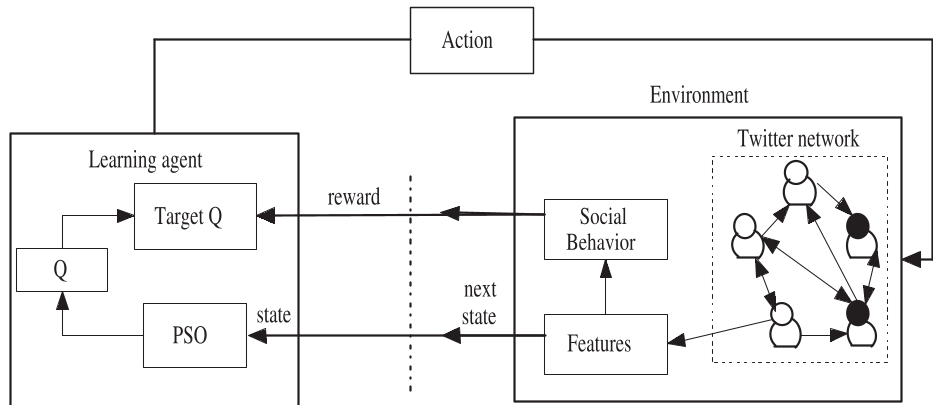 Figure 1: The P-DQL architecture showing the interaction between the Twitter environment, the PSO optimizer, and the Deep Q-Network.
Identifying the Infleuntial Spammers (SIU-ICD)
Identifying a single bot is insufficient; we must find the Spam-Influential Users (SIU). These are legitimate-looking accounts heavily influenced by bots that act as "super-spreaders."
The authors propose the SIU-ICD algorithm, which utilizes an influence propagation model to find communities with high modularity. By calculating the "closeness" between users and malicious nodes, the algorithm can surgically isolate parts of the network that are compromised by spam campaigns.
Experimental Results: SOTA Performance
The researchers tested their model against two prominent datasets: the Social Honeypot and The Fake Project.
Key Findings:
- Precision: P-DQL consistently maintained around 94% precision, while Feed-Forward Neural Networks (FFNN) dropped to 73%.
- Recall: The model achieved a 15% higher recall rate than FFNN on different testing timeframes.
- Convergence Speed: Thanks to PSO, the agent reached optimal performance with significantly fewer iterations compared to standard DQL.
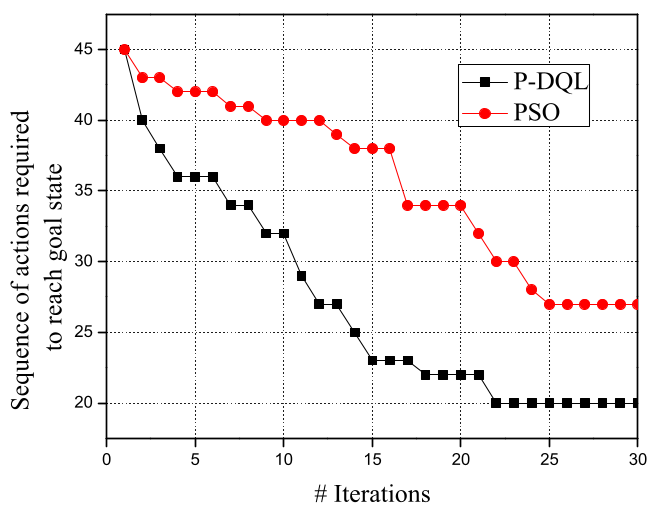 Figure 2: Performance comparison in terms of Precision across different timeframes.
Conclusion and Future Outlook
The P-DQL model represents a sophisticated shift in social network security. By combining the exploration/exploitation capabilities of RL with the global search efficiency of PSO, it creates a defense mechanism that is as dynamic as the bots it seeks to destroy.
Takeaway for Practitioners: When dealing with high-dimensional, adversarial social data, don't rely on static classifiers. Incorporating temporal behavioral features and swarm-based optimization can provide the necessary robustness to stay ahead of the "arms race."
Limitations: The current study focuses on offline datasets. The next frontier will be deploying this in an active, online environment to observe real-time bot-agent interactions.