
PSO for Social Balance: Bridging Community Detection and Structural Stability
A particle swarm optimization approach for handling network social balance problem
This paper proposes a single-objective optimization model to address the Social Balance Problem in signed networks by integrating network balance and community properties. Using a Discrete Particle Swarm Optimization (DPSO) algorithm, the approach identifies optimal community structures and achieves structural balance through minimal edge flips.
TL;DR
Social Balance Theory suggests that "the friend of my friend is my friend" and "the enemy of my enemy is my friend." However, achieving this state in complex, real-world networks is computationally difficult. This paper treats social balance as an optimization problem, using Discrete Particle Swarm Optimization (DPSO) to find the most natural "communities" in a network and then making surgical edge flips to bring the entire system into harmony.
Problem & Motivation
In a signed network (where links are either positive/friendly or negative/hostile), a state of "balance" means there is no social tension. Heider’s original theory was restrictive: it assumed networks were complete and could only be split into two groups.
Real social networks are sparse and often form multiple clusters (Weak Balance). The authors identified two major gaps in prior work:
- Lack of Flexibility: Most models couldn't handle more than two groups.
- Cost of Transformation: It isn't enough to know a network is imbalanced; we need to know the most efficient way to make it balanced.
Methodology: The Core Optimization Model
The authors propose a "Single Objective Optimization Model" that balances two competing forces:
- Signed Modularity (): This rewards structures where positive links are inside communities and negative links are between them.
- Energy Function (): This measures the "frustration" or imbalance.
By maximizing , the algorithm looks for a partition that is both a strong community structure and very close to being balanced.
Algorithm Framework
The process follows a Discrete Particle Swarm Optimization (DPSO) logic:
- Particles represent potential network partitions.
- Movement is guided by the particle's own best-found partition and the global leader's partition.
- Post-processing: Once the optimal partition is found, the algorithm flips the remaining "inconsistent" edges (e.g., a negative edge found inside a community) to reach a state of absolute balance.
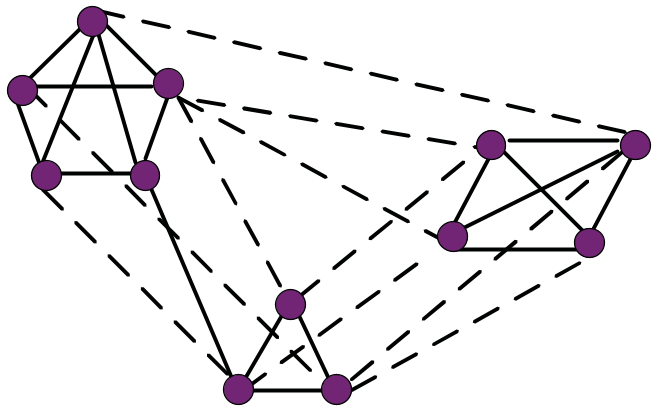 Fig 1: Signed graph representation—Solid lines for friends (+), dashed for enemies (-).
Experiments & Results
The researchers tested their model on several datasets:
- Synthetic Networks: The model achieved an NMI of 1.0, meaning it perfectly recovered the intended community structures.
- Real-World Data: In the GGS (Gahuku-Gama Subtribes) network, the algorithm identified three distinct communities and localized exactly which inter-tribal relations were causing structural tension.
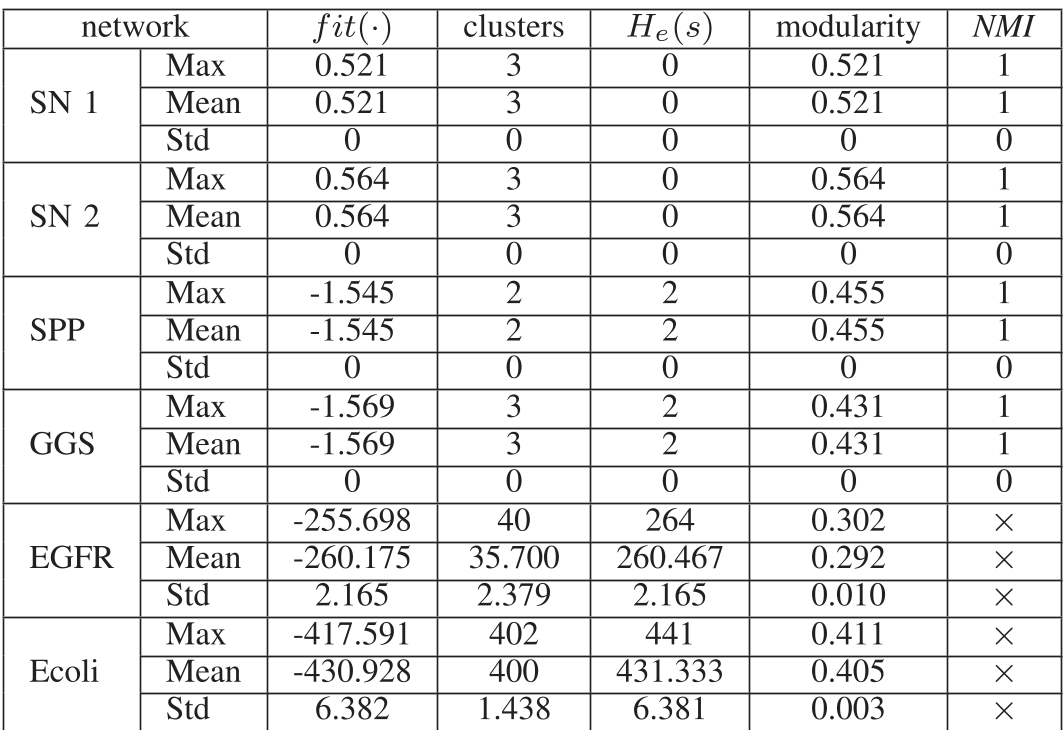 Table 1: Performance metrics across various signed networks. Note the high modularity and low energy (He(s)) values achieved.
For larger biological networks like EGFR and Ecoli, the model successfully scaled to hundreds and thousands of nodes, maintaining strong modularity even as the number of clusters increased.
Critical Analysis & Conclusion
Takeaway
The genius of this approach lies in combining Social Balance Theory with Community Detection. Instead of just looking for balance, the authors assume that balance naturally emerges from a well-defined community structure.
Limitations
While PSO is powerful, it is a heuristic. For extremely large networks (millions of nodes), the computational cost of updating particle velocities and positions might become a bottleneck. Additionally, the model currently assumes an undirected graph, whereas many social interactions (like "following" on Twitter) are directed.
Future Work
The next frontier is applying this optimization to dynamic networks, where friendships and enmities change over time. How does a network "re-balance" itself after a new conflict emerges? This paper provides the mathematical foundation to answer that question.