
PSO-Trust: Optimizing Trust Path Selection in Social Networks via Swarm Intelligence
An Algorithm for Selecting Optimal Trust Path in Online Social Networks Using Particle Swarm Optimization
This paper introduces a nature-inspired optimization approach for selecting the optimal trust path in Online Social Networks (OSNs). By leveraging Particle Swarm Optimization (PSO) on a trust graph with reciprocal edge weights, the method successfully identifies high-trust, low-hop paths, achieving over 98% accuracy across real-world datasets like Advogato and Zachary.
TL;DR
In the vast and often anonymous landscape of Online Social Networks (OSNs), determining whether to trust a stranger is a critical challenge. This paper proposes a Particle Swarm Optimization (PSO) based algorithm to find the "Optimal Trust Path." By treating potential paths as particles in a search space and utilizing a reciprocal weight transformation, the system identifies the most reliable connection between two users with high accuracy (up to 99%) across real-world social datasets.
Problem & Motivation: Beyond the Shortest Path
In a world where we share confidential information and services online, a direct connection is rare. We rely on "transitive trust"—trusting someone because a friend trusts them. Traditional algorithms like Dijkstra’s or Bellman-Ford are the "gold standard" for static graphs, but they fail in modern OSNs for three reasons:
- Dynamic Nature: Social networks change every second; re-calculating global shortest paths is computationally expensive.
- Negative Edges: Traditional Dijkstra cannot handle negative trust ratings (distrust).
- Path Diversity: Traditional methods find the single best path, whereas users often benefit from knowing multiple sub-optimal but highly reliable alternative routes.
The authors' insight was to move away from rigid deterministic search toward Swarm Intelligence, which naturally handles complex, non-linear optimization spaces.
Methodology: The Swarm Logic
The core of the methodology involves two primary steps: Weight Transformation and PSO Navigation.
1. The Reciprocal Strategy
To use a "shortest-path" logic for "maximum trust," the authors perform a mathematical inversion. If is the trust value: This ensures that a high trust rating (e.g., 5.0) becomes a small "distance" (0.2), and a low trust rating (e.g., 2.0) becomes a large "distance" (0.5).
2. Particle Swarm Optimization (PSO)
The algorithm initializes a population of "particles," where each particle represents a candidate path from the source to the target. These particles "fly" through the graph's solution space, influenced by:
- pBest: Their own best previous experience (the most trusted path they found).
- gBest: The best path found by any particle in the entire swarm.
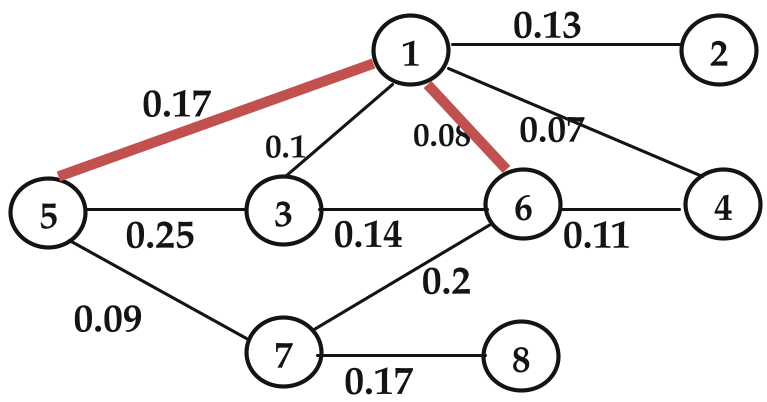 Fig 1: The transformation of trust ratings into reciprocals allows the PSO to treat the problem as a minimization task.
The velocity update equation is standard but effective: where are acceleration coefficients (set to 2.0) and are random factors.
Experiments & Results
The authors tested their approach on three primary datasets:
- Zachary’s Karate Club: A small social network (34 nodes).
- Freeman: A mid-sized dataset (48 nodes).
- Advogato: A large-scale trust-based community (6,542 nodes).
Performance Highlights
| Dataset | Accuracy vs. Dijkstra | Nodes |
|---|---|---|
| Zachary | 99% | 34 |
| Freeman | 98.5% | 47 |
| Advogato | 98% | 6542 |
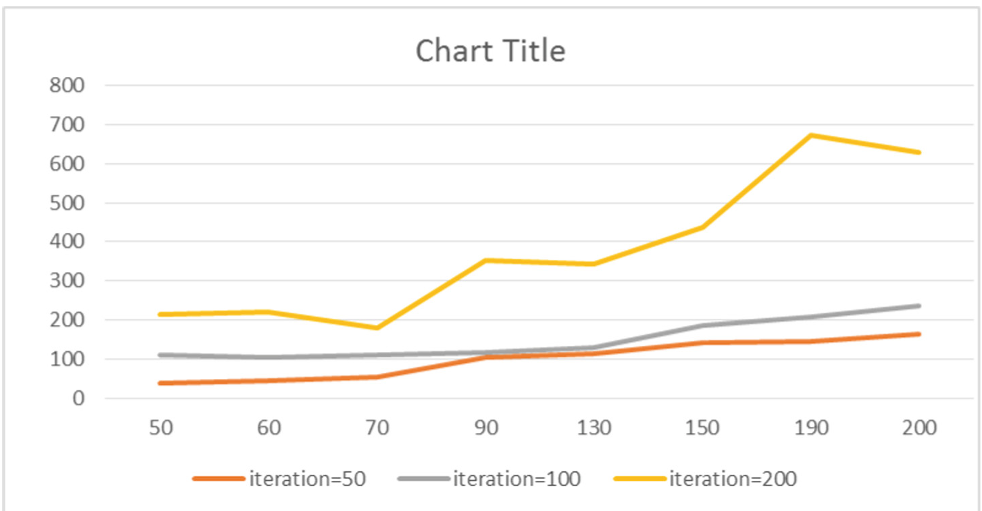 Fig 2: Execution time trends on the Advogato dataset relative to particle size and iterations.
The results indicate that while the PSO approach is slightly slower than Dijkstra on small graphs, its accuracy remains remarkably stable even as the network scale increases significantly.
Critical Analysis & Conclusion
Takeaway
The integration of PSO into trust path selection successfully bridges the gap between biological social behavior (flocking toward a goal) and digital social safety. It provides a flexible framework that can be tuned by adjusting the number of particles and iterations to balance speed and accuracy.
Limitations
A notable drawback mentioned by the authors is that the execution time is heavily dependent on the number of particles and iterations. In its current form, it may still struggle with real-time requirements in ultra-large-scale networks (millions of nodes) without further hardware acceleration or hybrid optimization.
Future Work
The authors aim to refine the algorithm to improve runtime efficiency and potentially integrate more complex trust dimensions (such as time-decaying trust or context-specific trust) into the fitness function.