
Task-on-the-Floor: Turning Pedestrian Traffic into a Sustainable Workforce
Passerby Crowdsourcing: Workers' Behavior and Data ality Management
The paper introduces "Task-on-the-Floor" (ToF), a novel crowdsourcing paradigm that recruits workers by projecting microtasks onto thoroughfare floors. By "diving into personal spaces," the system achieves long-term engagement, outperforming traditional kiosk-based methods, and utilizes machine learning (SVM/RF) to filter out unintended results from passersby.
TL;DR
Recruiting workers for physical crowdsourcing is notoriously difficult because "novelty bias" wears off quickly. This paper introduces a system that projects tasks directly onto the floor, allowing people to work "while walking." To solve the resulting noise from people just passing through, the authors developed a machine learning model that reads walking behavior to filter out unintentional answers, creating a high-quality, long-term sustainable crowdsourced workforce.
Background: The "Death Valley" of Public Displays
Most crowdsourcing systems placed in public (like kiosks or tablets) follow a predictable decay curve: high interest on day one, a 50% drop by day two, and near-zero participation after two weeks. The "Task-on-the-Wall" experiment conducted by the authors confirmed this, showing that when tasks require people to stop and deviate from their path, engagement is not sustainable.
The Insight: Diving into Personal Space
The authors suggest that instead of trying to attract people to a task, the task should go to the people. By projecting tasks onto the floor—a space walkers are already looking at—participation becomes almost unavoidable. However, this creates a unique technical challenge: How do you tell the difference between someone who intentionally stepped on a "Yes" button and someone who just happened to walk over it?
Methodology: Behavioral Intent Classification
The core contribution of this work is the use of context-aware behavioral features to manage data quality. Using Kinect sensors, the system tracks 38 dimensional features for every passerby.
The Four Pillars of Intent:
- Head Angle: Does the walker look down at the task?
- Walking Speed: Does the walker slow down to process the information?
- Lateral Direction: Does the walker deviate from a straight line to hit a specific button?
- Route/Coordinates: The specific spatial path taken across the projected interface.
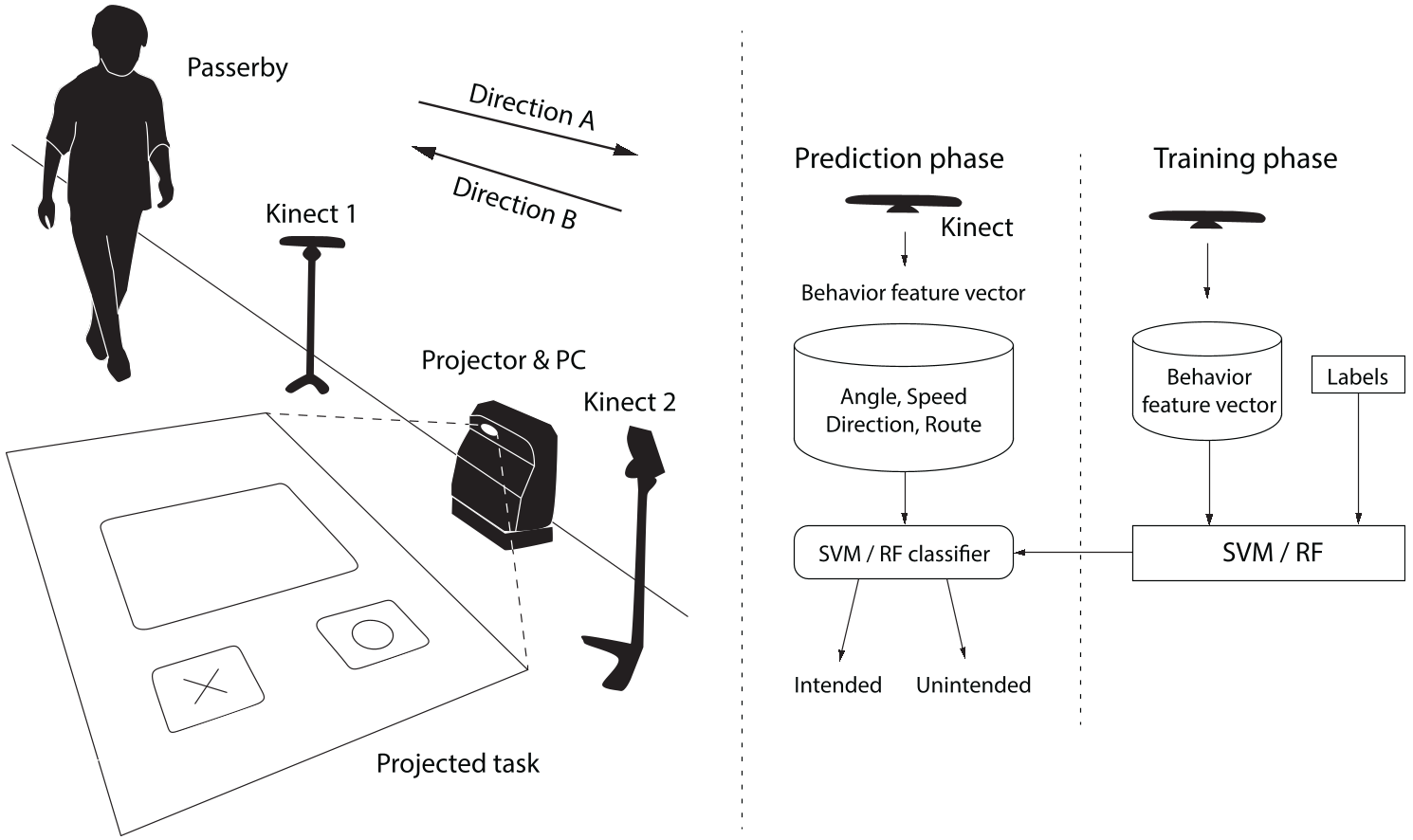
The researchers found that while "unintended" walkers usually walk straight and look ahead, "intended" workers exhibit distinct deceleration and head-tilt patterns.
Experimental Evidence: Success in the Wild
The system was deployed across five universities. In a library setting, only 36.7% of walkers intended to perform the task, meaning nearly 2/3 of the raw data was junk.
Key Metrics:
- Easy Tasks: High accuracy (92.3%) for intended walkers, but "Easy" tasks didn't cause people to slow down much, making speed a poor classifier.
- Hard Tasks: Intended workers significantly slowed down, but surprisingly, their accuracy was lower (61.0%) than in PC-based settings, suggesting that "walking-while-working" has a low cognitive ceiling.
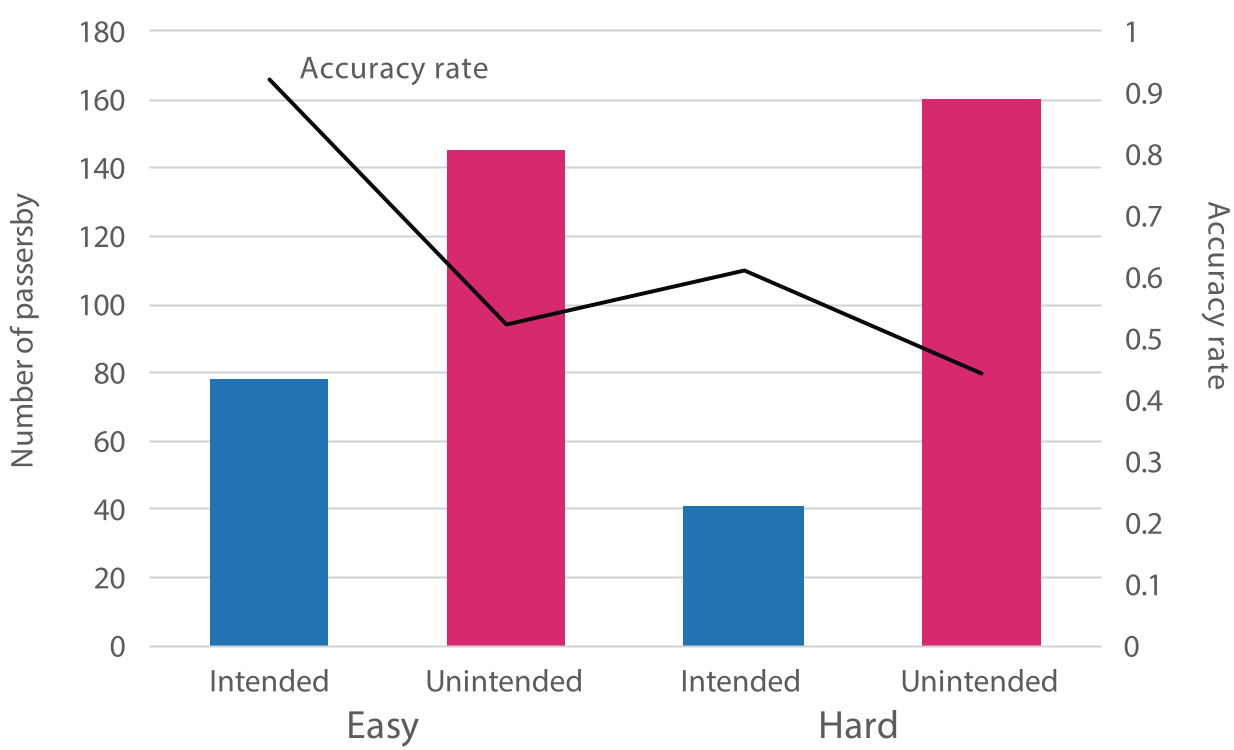
The paper proves that a classifier (SVM or Random Forest) can effectively filter these populations. Notably, the authors provide a mathematical model to determine when to use a classifier: if the classifier's precision is higher than the natural ratio of intended walkers (Precision > q), data quality will improve even if some good workers are accidentally filtered out.
Deep Insight: The Future of Passive Labor
This work signals a move toward Passive Crowdsourcing. By leveraging the physical "footprint" of human movement, we can solve micro-tasks (like image labeling or disaster site verification) without requiring the worker to "log in" or even "stop walking."
Limitations & Outlook
- Complexity Ceiling: Hard tasks fail in this format. The "floor" is best for binary or ternary choices.
- Environment Constraints: Current models require narrow corridors with two-way traffic. Crowded plazas remain a challenge for individual tracking.
Ultimately, "Passerby Crowdsourcing" demonstrates that the most valuable resource isn't just people's time—it's their existing, everyday movement patterns.
Conclusion
The Task-on-the-Floor system maintains engagement where others fail by removing the "effort" of participation. By treating human behavior as a data-validation signal, it transforms a noisy public environment into a reliable data-processing engine.