
[March 2026] PathMoE: Solving the Combinatorial Explosion of Expert Paths in MoE
Path-Constrained Mixture-of-Experts
This paper introduces PathMoE, a novel Mixture-of-Experts (MoE) architecture that constrains the combinatorial expert path space by sharing router parameters across blocks of consecutive layers. PathMoE achieves state-of-the-art results on language modeling and downstream tasks, reaching +2.1% average accuracy on 0.9B models and outperforming independent routing on 10 out of 12 tasks at the 16B scale.
TL;DR
Sparse Mixture-of-Experts (MoE) models are the current standard for scaling LLMs like Mixtral and DeepSeek, but they suffer from a "path explosion" problem where the number of possible routing combinations () far exceeds the training data. PathMoE simplifies this by sharing router parameters across consecutive layers. This simple inductive bias leads to better accuracy, eliminates the need for messy load-balancing losses, and makes models significantly more robust to routing noise.
The "Path Explosion" Problem: Why Independent Routing Fails
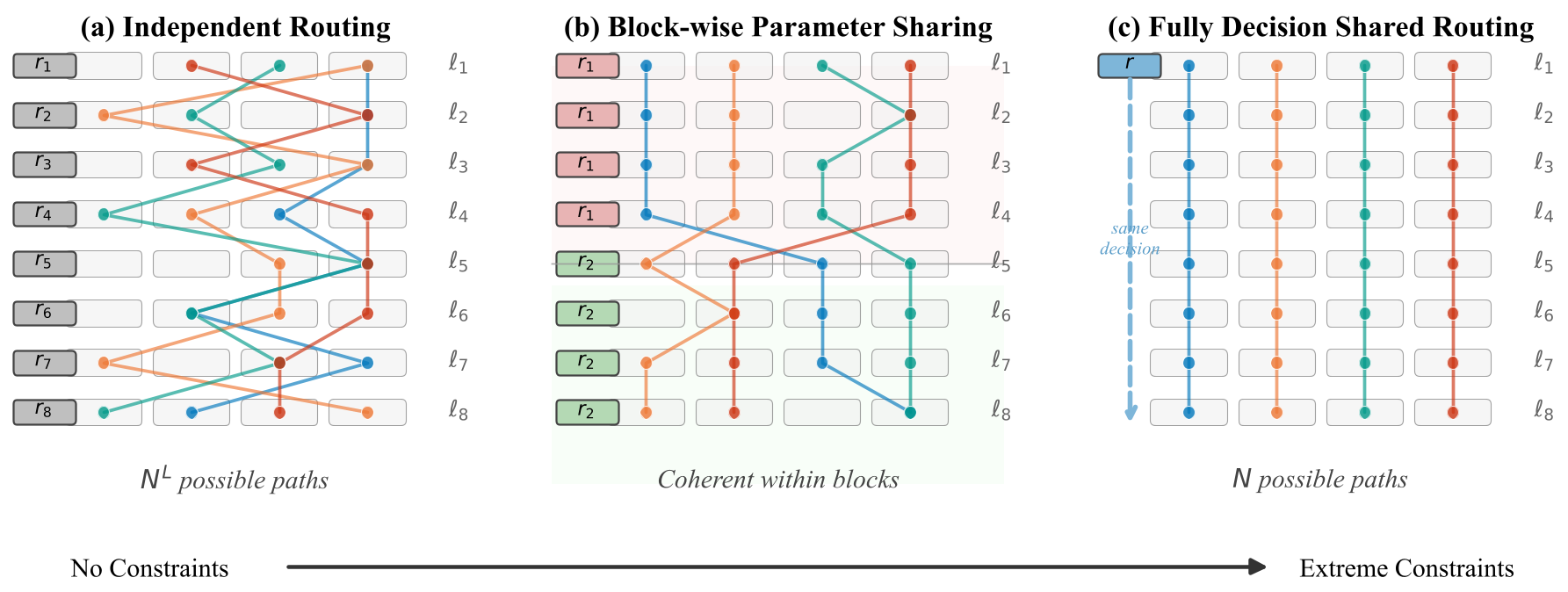
In a standard MoE, every layer has its own router. If you have 16 experts and 24 layers, there are possible paths a token could take. This is mathematically astronomical—larger than many training sets.
The authors argue that this leads to statistical inefficiency. When every layer acts as an independent "gatekeeper," the model struggles to form a coherent strategy for specific types of data. Current SOTA models "hack" this using auxiliary load-balancing losses, but these are difficult to tune and don't address the underlying lack of coordination.
Methodology: The Power of Block-wise Sharing
PathMoE introduces a "middle ground" in the spectrum of routing constraints:
- Independent Routing (Standard): Too much flexibility, leading to chaotic paths.
- Fully Shared Routing: Too rigid; doesn't allow the model to adapt as representations deepen.
- PathMoE (Block-wise): Routers are shared within blocks (e.g., every 4 layers).
Because of residual connections (), using the same router weight across consecutive layers naturally encourages tokens to stay on a consistent path without strictly forcing them to.
Theoretical Insight: Entropy and Mutual Information
The paper provides a beautiful mathematical intuition: PathMoE increases the Mutual Information between consecutive routing decisions. By reducing the Routing Entropy, PathMoE ensures that tokens concentrate into fewer, higher-quality expert paths. Each path thus receives more training samples, leading to better expert specialization.
Experimental Results: Scaling and Robustness
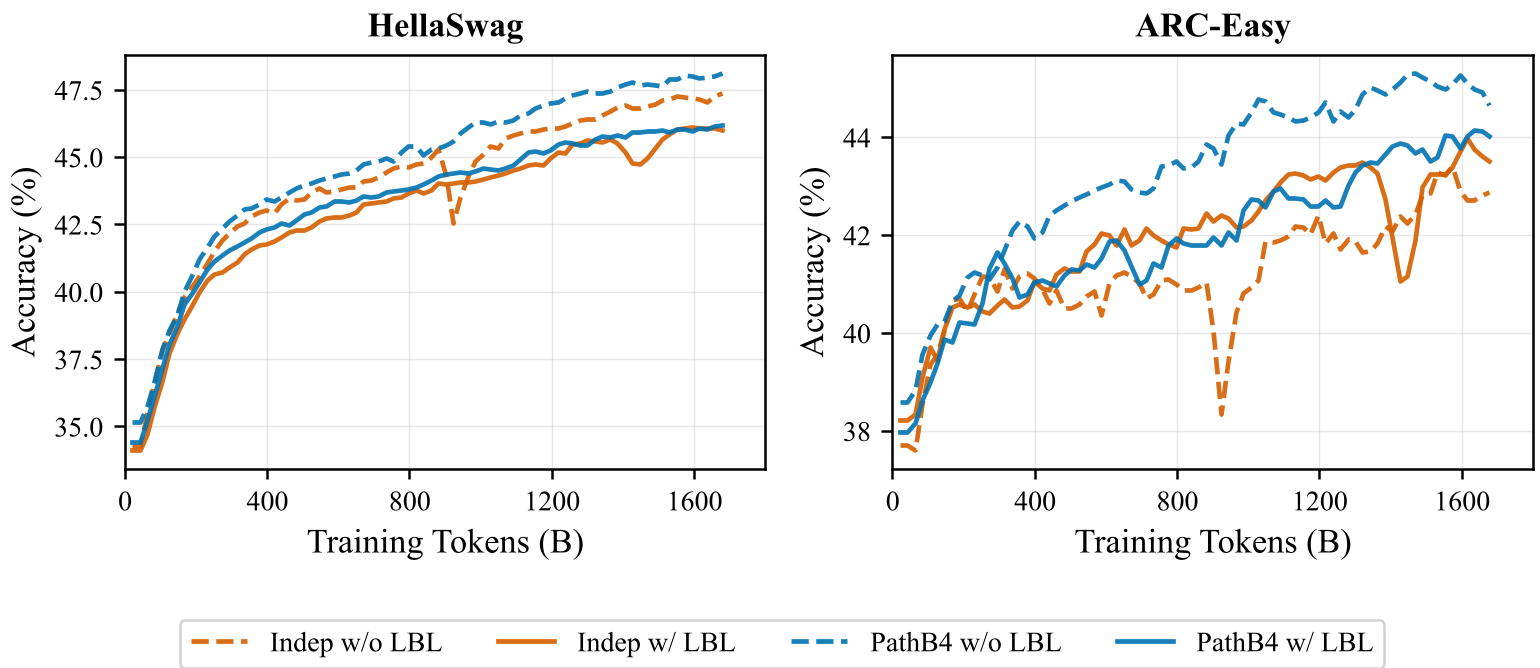
The performance gains are consistent across scales. On a 16B parameter model, PathMoE outperformed standard MoE on almost every benchmark, particularly in knowledge-intensive and commonsense tasks.
Key Breakthroughs:
- No More Load Balancing Loss: PathMoE naturally maintains balanced experts. This removes a painful hyperparameter from the training loop.
- Robustness: When authors randomly "jiggled" the routing decisions, PathMoE's performance stayed relatively stable, while standard MoE plummeted (22.5x difference in robustness).
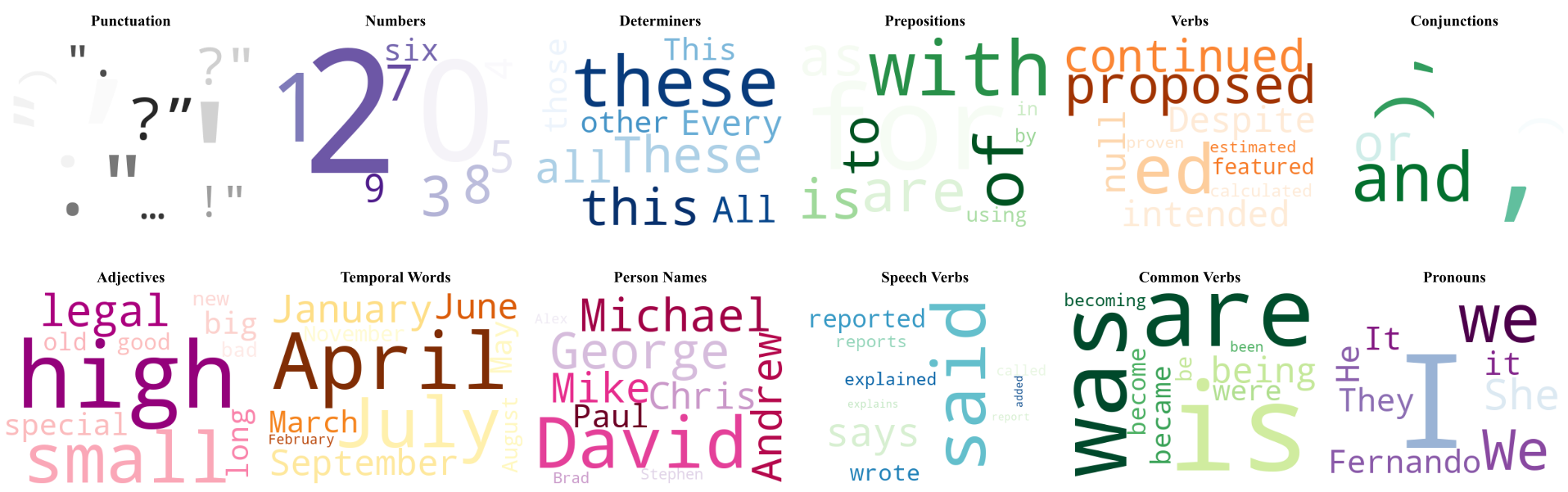
- Interpretability: Tokens naturally cluster by linguistic function (e.g., Names, Punctuation, Verbs) into specific paths.
Deep Insight: Is "Expert Path" the New Unit of Analysis?
The most profound takeaway from PathMoE is the shift in perspective. Instead of viewing MoE as a collection of isolated experts, we should view it as a collection of paths.
By constraining the path space, we allow the model to build "computational highways" for specific data distributions. This not only improves performance but suggests that future MoE models could be much more efficient by learning the path structure explicitly rather than discoverying it through independent random initialization at each layer.
Conclusion & Future Work
PathMoE proves that "less is more" in MoE routing. By restricting the freedom of individual layers, we force the model to develop more robust, specialized, and coordinated experts. Future research might explore dynamic block sizes or learning the path predictors jointly with the transformer backbone.
Limitations
The authors note that PathMoE is currently optimized for token-choice routing. Initial tests on expert-choice routing didn't show the same level of improvement, likely because expert-choice already achieves a form of stability.