
Beyond Fixed Templates: Unsupervised Pattern Discovery in Physiological Signals
Pattern Analysis in Physiological Pulsatile Signals: An Aid to Personalized Healthcare
The paper introduces an unsupervised pattern analysis system for physiological pulsatile signals (like PPG) that identifies and quantifies signal repetitions through hierarchical extrema detection and Shannon entropy. By analyzing the "dominance" of specific morphological patterns, the system achieves over 90% accuracy in distinguishing regular physiological states from irregular/anomalous phenomena.
TL;DR
Researchers have developed a novel, unsupervised framework that "learns" the unique pulse morphology of an individual to detect anomalies. By moving away from supervised labels and domain-specific rules, the system uses Hierarchical Extrema and Shannon Entropy to distinguish between stable physiological rhythms and irregular artifacts with over 90% accuracy.
Context: Why "One-Size-Fits-All" Fails in Healthcare
In the world of wearable tech and clinical monitoring, the Photoplethysmogram (PPG) is a staple. However, identifying "normal" vs. "abnormal" is notoriously difficult. Why? Because a "normal" pulse for a marathon runner looks nothing like a "normal" pulse for a patient with hypertension. Traditional supervised models often fail because they are trained on rigid definitions of abnormality.
This paper argues that the signal should speak for itself. Instead of telling the computer what a "bad" signal looks like, the authors ask: "How consistent is this signal with its own past?"
Methodology: The Hierarchical Approach
The core innovation lies in how the signal is decomposed and quantified.
1. Dynamic Windowing
Unlike filters that use fixed time windows, this system uses K-means clustering on the rise and fall edges of the signal (sampling points vs. amplitude difference). This makes the feature detection agnostic to sampling frequencies (working equally well at 60Hz or 300Hz).
2. Hierarchical Extrema (The "P-S-T" Model)
The system identifies three levels of peaks (maxima) and valleys (minima):
- Primary (P): Major beats.
- Secondary (S) & Tertiary (T): Finer morphological details representing dicrotic notches or minor perturbations.
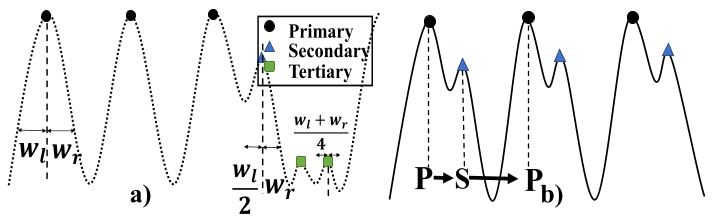 Fig 1: Identifying hierarchical features (Primary vs Secondary) and combining them into dual-patterns.
3. From Patterns to Entropy
By looking at pairs of consecutive features (e.g., a Primary peak followed by a Secondary peak, or 'PS'), the system builds a transition matrix ().
- High Stability: One pattern (usually 'PP') dominates. The distribution is unimodal, and Shannon Entropy is low.
- Anomaly/Noise: Many different patterns (PS, ST, TT) appear with similar frequency. The distribution becomes multimodal, and Shannon Entropy spikes.
Results: Validation Across the Board
The researchers didn't just test this in a lab; they used five disparate datasets, including the well-known Physionet and Capnobase repositories.
| Dataset | Status | Avg. Entropy | Accuracy |
|---|---|---|---|
| PPGLabC | Clean | 1.129 | 100% |
| PPGPhysionet | Mixed | 1.559 (Reg) / 2.29 (Irreg) | 79.2% |
| PPGCAP | Very Noisy | 2.522 | 96.1% |
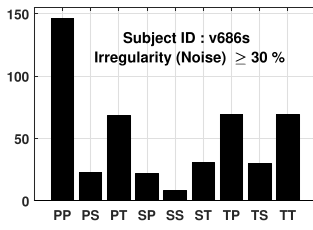 Fig 2: The clear contrast between a unimodal "Clean" signal (left) and a multimodal "Irregular" signal (right).
The "Significance Score" () derived from entropy successfully flagged motion artifacts and physiological instabilities that would normally require manual expert review.
Critical Insight: The Future of Personalized Care
This approach treats every patient as their own baseline. By quantifying the Significance of Regularity, we can create "Patient-Specific Stability Scores."
Limitations & Outlook
While the system is excellent at detecting that something is wrong (anomaly detection), it currently struggles to distinguish what is wrong (e.g., is it a loose sensor or a heart arrhythmia?). The authors suggest that adding domain knowledge in a tiered fashion—using the unsupervised score as a first-pass filter—could solve this in future iterations.
Summary Takeaway
By leveraging the fundamental physics of "rise and fall" in pulsatile signals and the mathematical rigor of Shannon Entropy, this framework provides a robust, hardware-agnostic path toward truly personalized health analytics.