
Cracking the Sarcasm Code: A Pattern-Based linguistic Approach for Twitter
A Pattern-Based Approach for Sarcasm Detection on Twitter
This paper proposes a supervised, pattern-based approach for sarcasm detection on Twitter, using a multi-dimensional feature set including sentiment, punctuation, and syntactic structures. Leveraging a novel Part-of-Speech (PoS) based pattern extraction method, the system achieves a state-of-the-art accuracy of 83.1% and a precision of 91.1% using a Random Forest classifier.
TL;DR
Detecting sarcasm is the "Final Boss" of Sentiment Analysis. This paper introduces a robust framework that doesn't just look at what people say, but how they structure their sentences. By converting tweets into Part-of-Speech (PoS) patterns, the authors achieved a precision of 91.1%, outperforming standard n-gram models and specialized rule-based systems.
The "Why": Why Computers Struggle with "Oh Great!"
In the world of Natural Language Processing (NLP), sarcasm is a nightmare. A sentence like "I love being ignored all the time" contains the word "love," which traditional sentiment engines flag as positive. However, the contextual incongruity—the contrast between a positive sentiment and a negative situation—is what defines sarcasm.
Prior works often required deep "historical knowledge" of a user (knowing if they are constant trolls) or massive datasets. The authors of this paper wanted a system that works in real-time, focusing on the linguistic DNA of the tweet itself rather than the user's bio.
Methodology: The Four Pillars of Sarcastic Intent
The core innovation lies in the categorization of features into four distinct families, designed to capture different "vibes" of sarcasm: Wit (humorous exaggeration), Whimper (annoyance), and Evasion (ambiguity).
- Sentiment-Related: Beyond just words, it looks for "Contrasts." Do the hashtags (e.g., #ihateyou) contradict the message?
- Punctuation & Behavioral: Excessive exclamation marks, capitalization, and "vowel stretching" (e.g., "looooove").
- Syntactic & Semantic: Use of interjections, uncommon words, and laughing expressions.
- The Secret Sauce: Pattern-Based Features:
The researchers transformed tweets into structural templates. For example, "You are incredibly funny" becomes a pattern:
[PRONOUN be ADVERB JJ]. By comparing unknown tweets to a library of "Sarcastic Patterns," the model can identify the structure of irony even if the specific words are new.
 Table: Identifying highly emotional PoS tags used to weight sentiment scores.
Experiments: Random Forest Takes the Lead
The team tested several machine learning classifiers, including SVM and k-NN. While SVM showed extreme precision (it was almost never wrong when it called a tweet sarcastic), it missed many instances (low recall). Random Forest proved to be the most balanced "all-rounder."
- Accuracy: 83.1%
- Precision: 91.1% (Incredibly high for irony detection)
- Baseline Comparison: Neatly beat Riloff’s "Positive Sentiment vs. Negative Situation" model by over 20% in accuracy.
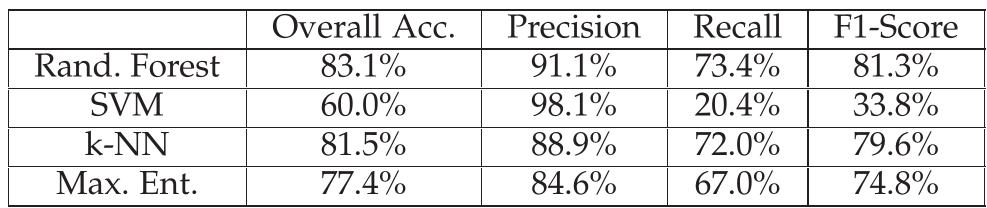 Key Performance Indicators (KPIs) showing Random Forest as the superior classifier for this task.
Deep Insight: Pattern Length and "The Enrichment"
A critical discovery was that pattern length matters. As shown in the study's optimization process, patterns of length 3 to 10 tokens provided the best signal-to-noise ratio. To solve the problem of small training sets, the authors used a "Self-Enrichment" technique, using hashtags like #sarcasm to automatically pull and verify new patterns from the web.
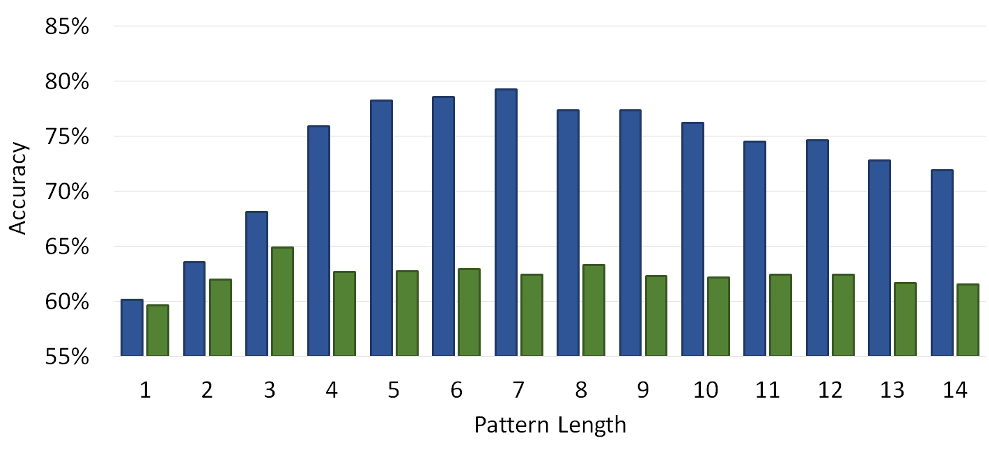 The study shows how accuracy plateaus and peaks based on pattern length, with 3-10 being the "Goldilocks zone."
Critical Analysis & Future Outlook
Takeaway: This research proves that sarcasm is not just about "what" is said but "how" it’s patterned. For developers and researchers, this means that feature engineering should focus on syntactic structure (PoS sequences) rather than just sentiment lexicons.
Limitations: The model still struggles with "Level 3" sarcasm—statements so subtle that even human annotators disagree on them. It also relies on a high-quality PoS tagger; if the tagger struggles with Twitter's "slangy" nature, the pattern detection breaks down.
Future Work: The logical next step is integrating these pattern features into a broader Sentiment Analysis pipeline to rectify the false-positives that plague modern brand-monitoring tools.