
Four Million Faces: Why Data Scale Trumps Model Complexity in Gender Classification
Pattern Recognition Letters
The paper presents a large-scale gender classification system trained on a massive dataset of 4 million web-collected images (4MWLFW) using an ensemble of online linear classifiers. By leveraging "the unreasonable effectiveness of data," the authors achieved a SOTA accuracy of 96.86% on the LFW benchmark, outperforming more complex models.
TL;DR
Is a complex model with a little data better than a simple model with a lot of it? This paper argues the latter. By training an ensemble of simple linear classifiers on 4 million weakly-labeled images from the web, researchers achieved a record-breaking 96.86% accuracy on the LFW benchmark, proving that "data volume" is a feature of its own.
Context & Motivation: The Unreasonable Effectiveness of Data
For years, the computer vision community focused on designing increasingly intricate kernels and feature selection algorithms. However, these methods often struggled when moved from the laboratory to the "wild." The authors of this study embrace the philosophy of "The Unreasonable Effectiveness of Data"—the idea that simple models based on massive datasets routinely outperform elaborate models trained on scarce data.
The primary bottleneck has always been the cost of human annotation. To solve this, the authors built the 4MWLFW (4 Million Weakly Labelled Faces in the Wild) dataset entirely through automated queries (e.g., using "John" for male and "Mary" for female labels).
Methodology: High Dimensions and Robust Solvers
To handle 4 million samples without the "kernel trick" (which would require a computationally impossible matrix), the authors turned to the Primal Representation.
1. Multi-scale Local Binary Patterns (LBP)
Instead of relying on deep learning (which was in its early "Big Data" infancy during this era), the authors used 65,136-dimensional feature vectors based on multi-scale LBP. This captured fine-grained texture information across different resolutions, ensuring the linear classifier had enough "descriptive power" to compensate for its lack of non-linear kernels.
2. The C-Pegasos Algorithm
Training on web-scraped data introduces Label Noise. If a query for "John" returns an image of a woman, a standard solver might over-correct. The authors introduced C-Pegasos, a modification of the Pegasos algorithm that clips the influence of individual training points.

Above: The pipeline highlights the use of massive data and high-dimensional features to achieve high accuracy without manual alignment or cleaning.
Experiments and Results
The authors tested their model on the Labeled Faces in the Wild (LFW) dataset. Unlike previous competitors who manually cleaned their test sets, this work included all detections (side faces, false positives, and babies) to maintain the most "stringent" conditions.
Key Performance Indicators:
- Final Accuracy: 96.86% (New SOTA).
- Impact of Scale: Performance didn't saturate at 1 million images; it continued to climb as more data was added, as shown in the ensemble results.
- Robustness: The C-Pegasos variant consistently outperformed standard Pegasos by roughly 1%, proving that handling label noise is critical in big-data regimes.
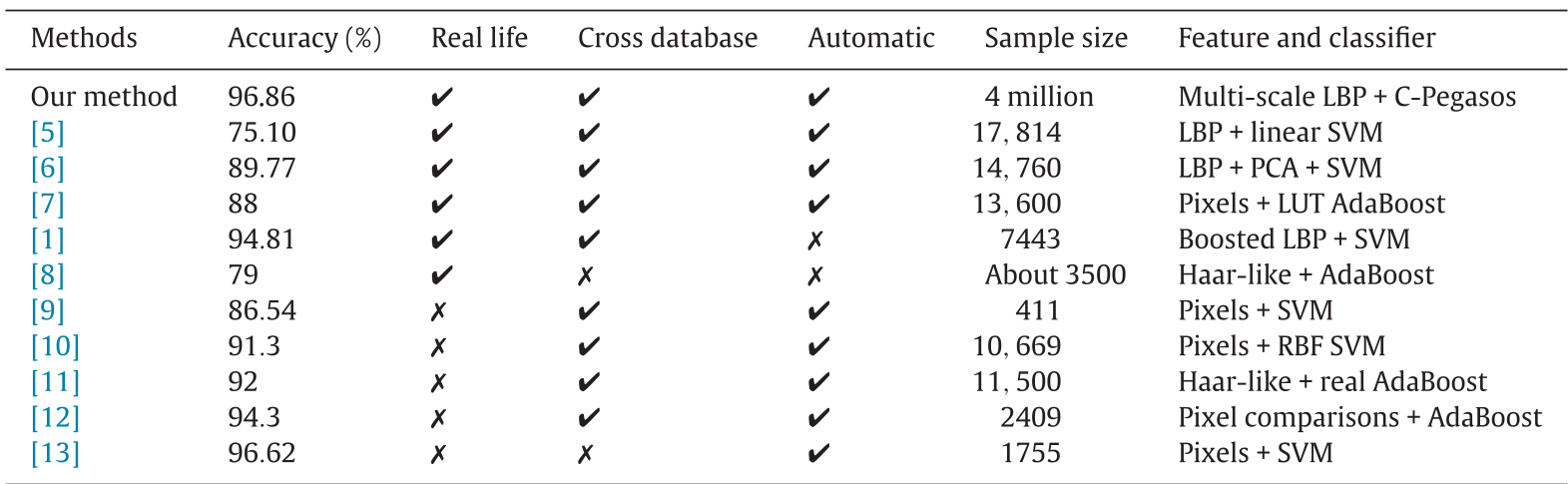
Table 1: The proposed method (top row) versus historical benchmarks. Note the massive jump in sample size (4 million vs. a few thousand).
Critical Insight & Conclusion
The success of this approach is a precursor to the modern "Pre-train on Web Data" paradigm. It proves that:
- Weak labels are sufficient: You don't need perfect labels if you have enough of them and a robust solver like C-Pegasos.
- Linearity works in high dimensions: When the feature space is large enough (60k+), the "blessing of dimensionality" makes linear separation highly effective.
Limitations: While the performance is stunning, the method relies on a fixed feature extractor (LBP) which may not generalize as well as learned features (CNNs) across different lighting and occlusions. However, as an exploration of the power of "Big Data," this paper remains a cornerstone of the transition to web-scale machine learning.