
Lexicon-Based Feature Extraction: Mastering Emotion Classification in Dynamic Text
Pattern Recognition Letters
This paper introduces a novel approach for emotion text classification by leveraging Domain Specific Emotion Lexicons (DSELs) generated via a Generative Unigram Mixture Model (UMM). The method captures fine-grained word-emotion associations to outperform traditional General Purpose Emotion Lexicons (GPELs) and common supervised baselines like sLDA and PMI across multiple domains.
TL;DR
The paper presents a methodology to bridge the gap between static, formal emotion lexicons and the messy, evolving world of social media. By using a Generative Unigram Mixture Model (UMM), the authors create Domain Specific Emotion Lexicons (DSELs) that quantify the intensity of word-emotion associations. This approach leads to dramatic performance gains—up to 22%—over standard methods in identifying complex emotions across tweets, blogs, and news.
Problem & Motivation: The Failure of Static Dictionaries
Traditional emotion analysis often relies on General Purpose Emotion Lexicons (GPELs). While valuable, these are built on formal language and suffer from two major flaws:
- Vocabulary Mismatch: They don't understand that "good!!" or ":))" are powerful emotional markers.
- Binary Limitations: They often treat emotion as an "on/off" switch for a word, ignoring that a word like "beautiful" might strongly signal "joy" but only "moderately" signal "love."
The authors argue that in dynamic environments like Twitter, we need lexicons that are adaptive and quantitative, capturing the specific "emotional signature" of a domain.
Methodology: The Generative Unigram Mixture Model (UMM)
The core of the paper is the UMM, which treats an emotional document as a mixture of two language models:
- (The Emotion Model): Captures words specific to a target emotion.
- (The Background Model): Captures neutral, frequent words (e.g., "the," "is") that dilute the emotional signal.
By using Expectation-Maximization (EM), the model learns to filter out the noise and assign an "intensity score" to each word for specific emotions.
From Lexicon to Features
Unlike previous works that just count occurrences, the authors propose five ways to represent a document:
- TEI (Total Emotion Intensity): Summing up the probabilistic intensity scores of all words in a document.
- MEI (Max Emotion Intensity): Focusing only on the most emotionally charged word.
- GEI (Graded Emotion Intensity): Only considering words that pass an "intensity threshold" (e.g., top 25%), filtering out weak associations.
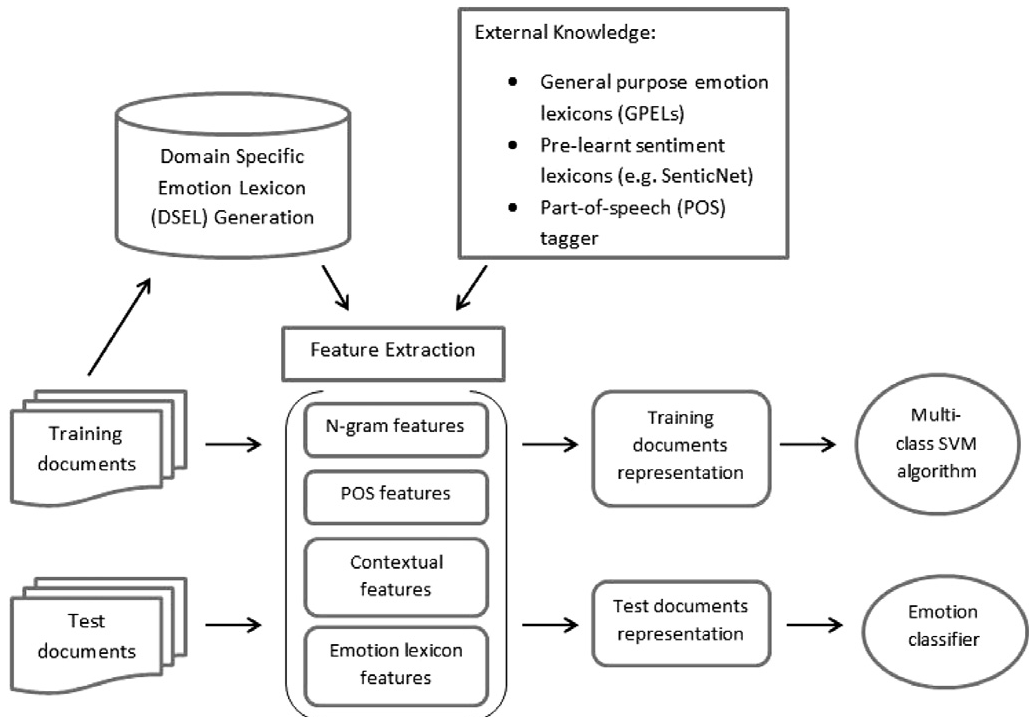 Figure 1: The feature extraction pipeline using DSELs.
Experiments & Results
The authors tested their method across four distinct datasets: SemEval-2007 (News), Twitter, Blogs, and ISEAR (Incident Reports).
SOTA Comparison
The UMM method was pitted against competitive baselines including PMI (Point-Wise Mutual Information) and sLDA (supervised Latent Dirichlet Allocation).
- On the Twitter dataset, the DSEL approach achieved an F-score of 64.24, significantly higher than the standard n-gram baseline of 49.55.
- On ISEAR, which contains balanced but complex social emotions like "shame" and "guilt," the UMM features outperformed general lexicons by 19%.
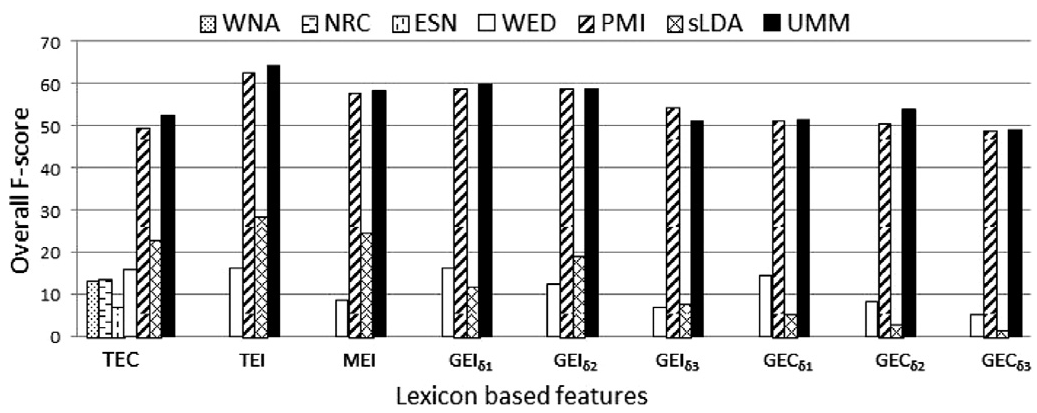 Figure 2: Performance gains on Twitter using different lexicon-based features.
Deep Dive: Handling "Hard" Emotions
One of the paper's most impressive findings is its ability to classify emotions that are historically difficult for machines, such as Fear and Surprise. By using intensity-based features, the model captures the subtle lexical shifts that simple Bag-of-Words models miss.
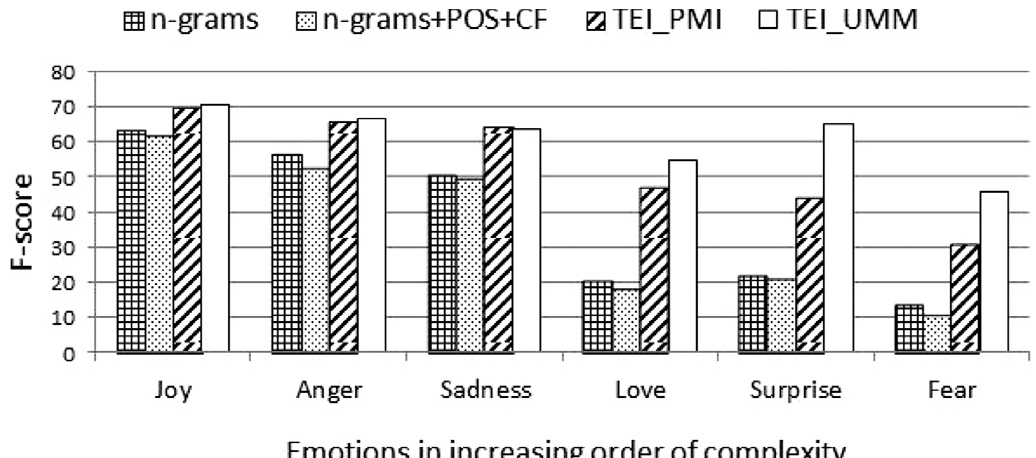 Figure 3: Detailed F-score breakdown for individual emotion classes.
Critical Analysis & Conclusion
The Takeaway: High-quality, domain-aware lexicons are a force multiplier for machine learning classifiers. The ability to quantify how much emotion a word carries, rather than just which emotion, is key to handling informal text.
Limitations: While the UMM is powerful, it still operates on a unigram (single word) basis. It may struggle with complex linguistic phenomena like heavy sarcasm or long-range dependencies where the emotion shifts mid-sentence.
Future Outlook: Transitioning these probabilistic intensity scores into neural architectures (like Attention mechanisms) could potentially provide the "interpretability" of lexicons with the "horsepower" of Deep Learning.