
Machine Learning for Cultural Heritage: Beyond the Black Box
Pattern Recognition Letters
This survey provides a comprehensive analysis of Machine Learning (ML) applications within Cultural Heritage (CH), spanning from classical statistical methods to modern Deep Learning. It evaluates the shift from "black-box" usage to domain-specific algorithmic modifications, highlighting key SOTA achievements in artwork classification, archaeological prospection, and digital preservation.
TL;DR
This seminal survey explores the intersection of Machine Learning (ML) and Cultural Heritage (CH), tracing the evolution from simple linear regressions to sophisticated Deep Neural Networks. It argues that while ML has revolutionized artifact analysis and archaeological prospection, the field suffers from a "black-box" dependency and a critical shortage of open-access data.
Positioning: This work serves as a foundational "state-of-the-union" for Digital Humanities, mapping the transition from classical statistical toolboxes to domain-specific AI architectures.
Problem & Motivation: The Data Desert
The primary hurdle in applying AI to Cultural Heritage is not the lack of algorithms, but the scarcity of structured data. Unlike Medicine or Autonomous Driving, CH suffers from:
- Acquisition Barriers: Digitizing 3D artifacts and medieval manuscripts is expensive and requires bespoke equipment.
- Labeling Paradox: Expert annotation (e.g., by archaeologists or art historians) is time-consuming and often subjective, leading to small, biased datasets.
- Domain Gap: Models pre-trained on natural images (like ImageNet) often fail when applied to stylized artworks or low-resolution LiDAR scans due to a massive shift in visual distribution.
Methodology: Bridging the Gap
The survey categorizes ML interventions into three core paradigms, with a heavy emphasis on how researchers adapt these to the CH context:
1. Supervised Learning & Transfer Learning
Since CH datasets (like IconArt or PrintArt) are small, the dominant strategy is Transfer Learning. Researchers take models pre-trained on millions of natural images and "fine-tune" them on specific artistic domains.
- Multi-Instance Learning (MIL): One standout methodology is the use of MIL to recognize iconographic elements without needing pixel-level labels—essentially teaching the model to find "needles in a haystack."
2. Semi-Supervised Learning (SSL)
SSL is highlighted as the "middle path," leveraging a small amount of labeled data paired with vast amounts of unlabelled digital archives. This is particularly useful for Domain Adaptation, allowing models to "translate" knowledge from photographs to sketches or paintings.
3. Unsupervised Discovery
Clustering (e.g., K-Means, hierarchical clustering) is used to find "hidden signatures" in archaeological materials—such as determining the firing temperature of ancient ceramics or group membership of stone tools based on 3D morphometrics.
Experiments & Results: SOTA Comparison
The paper reviews performance across several benchmark datasets:
- Artistic Classification: Models like VGG19 and ResNet50 have become baselines for the Rijksmuseum Challenge, achieving significant success in style and author attribution.
- Archaeological Remote Sensing: The use of Random Forests (RF) and CNNs on LiDAR data has automated the detection of buried structures, reducing the manual survey area for archaeologists by over 80%.
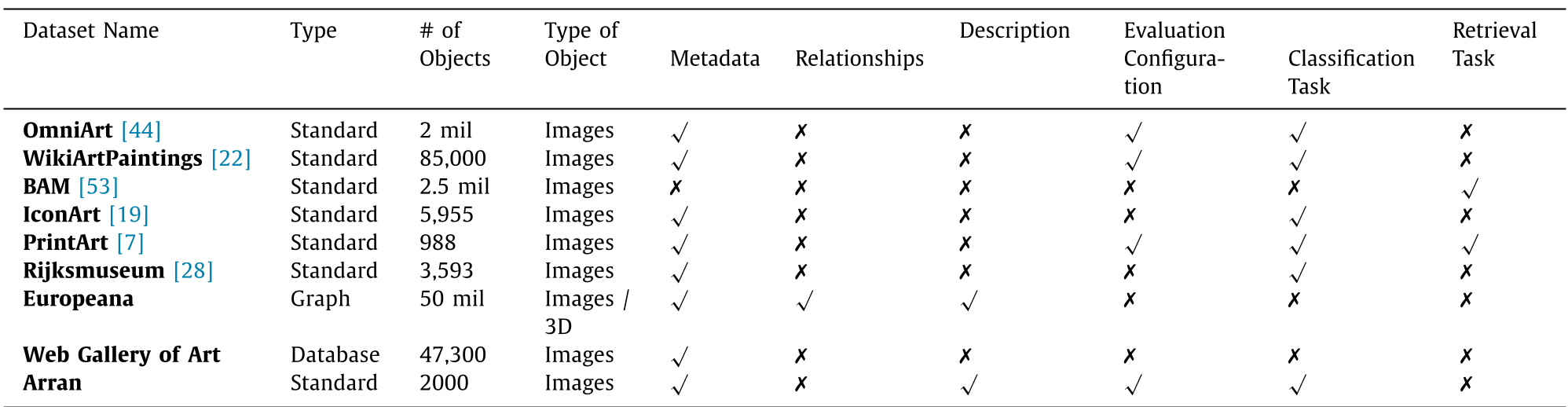
Table 1: Comparison of major CH datasets, highlighting the recent push towards large-scale repositories like OmniArt (2M objects).
Critical Analysis & Conclusion
The "Black Box" Critique
The authors offer a stinging critique: too many CH practitioners use ML as a "black box" without understanding the underlying inductive biases. This lead to "Blind AI"—models that achieve high accuracy but offer zero interpretability for historians.
Future Outlook
- Multi-Modal Integration: The next frontier is the joint optimization of visual features (images) and textual metadata (historical records).
- 3D Centricity: Moving from 2D image analysis to true 3D understanding of architecture and sculptural fatigue.
- Algorithmic Fairness: Addressing the historical bias inherent in museum collections to ensure AI doesn't perpetuate colonial or Eurocentric narratives.
Takeaway: ML is no longer just a "tool" for Cultural Heritage; it is becoming the very infrastructure through which we preserve and interpret human history.