
Beyond the Lag: Mastering Multimodal Emotion Recognition with Context-Aware LSTMs
Pattern Recognition Letters
This paper introduces a robust framework for continuous emotion recognition using the RECOLA multimodal database. It leverages Long Short-Term Memory (LSTM) Recurrent Neural Networks to predict asynchronous arousal and valence dimensions from audiovisual and physiological (ECG, EDA) data, achieving SOTA results with a Concordance Correlation Coefficient (CCC) of 0.804 for arousal and 0.528 for valence.
Executive Summary
TL;DR: This seminal paper addresses the "human delay" in emotion annotation by using Long Short-Term Memory (LSTM) Recurrent Neural Networks. By integrating audio, video, and physiological data (ECG, EDA) from the RECOLA database, the researchers demonstrate that context-aware models can automatically compensate for rater reaction lags. The study achieves impressive performance (CCC of 0.804 for arousal), highlighting that decision-level fusion and modality-specific window sizes are crucial for capturing the nuances of human affect.
Positioning: This work is a cornerstone in the transition from segment-level "utterance" classification to quasi-continuous dimensional regression, setting a benchmark for multimodal fusion in affective computing.
The Problem: The "Human Lag" and Subjective Noise
In a perfect world, an emotion recognition system would map a facial expression to a label instantly. In reality, human raters take time to process what they see and hear before adjusting a slider. This reaction lag creates a temporal misalignment between the raw data (features) and the ground truth (labels).
Existing methods attempted to fix this with manual shifts or correlation-based alignment. However, these methods are often "one-size-fits-all" and ignore the fact that different raters have different latencies. Furthermore, most systems ignored physiological signals (heart rate, skin conductance), which offer an objective "inside view" of emotion that audio or video might miss.
Methodology: Context is King
The authors argue that we shouldn't manually shift the data. Instead, we should use a model that has a memory.
1. The Power of LSTM
Unlike standard Feed-Forward Neural Networks (FF-NN), LSTMs use "memory blocks" and "gates" to store information over time. This allow the network to "wait" for the label to appear after the cue has passed.
- Bidirectional-LSTM (BLSTM): These models look at both the past and the future of a sequence simultaneously, making them ideal for handling the de-synchronization between different modalities and asynchronous ratings.
2. Multi-Task Learning from All Raters
Instead of just training on the "average" rating, the authors experimented with a Multi-task approach where the network tries to predict the individual tracks of all six raters simultaneously. This forces the model to learn a more robust representation of the underlying emotional variability.
 In the figure above, the LSTM block's gating mechanism allows it to regulate the flow of temporal context, effectively absorbing rater latency.
Experiments and Key Findings
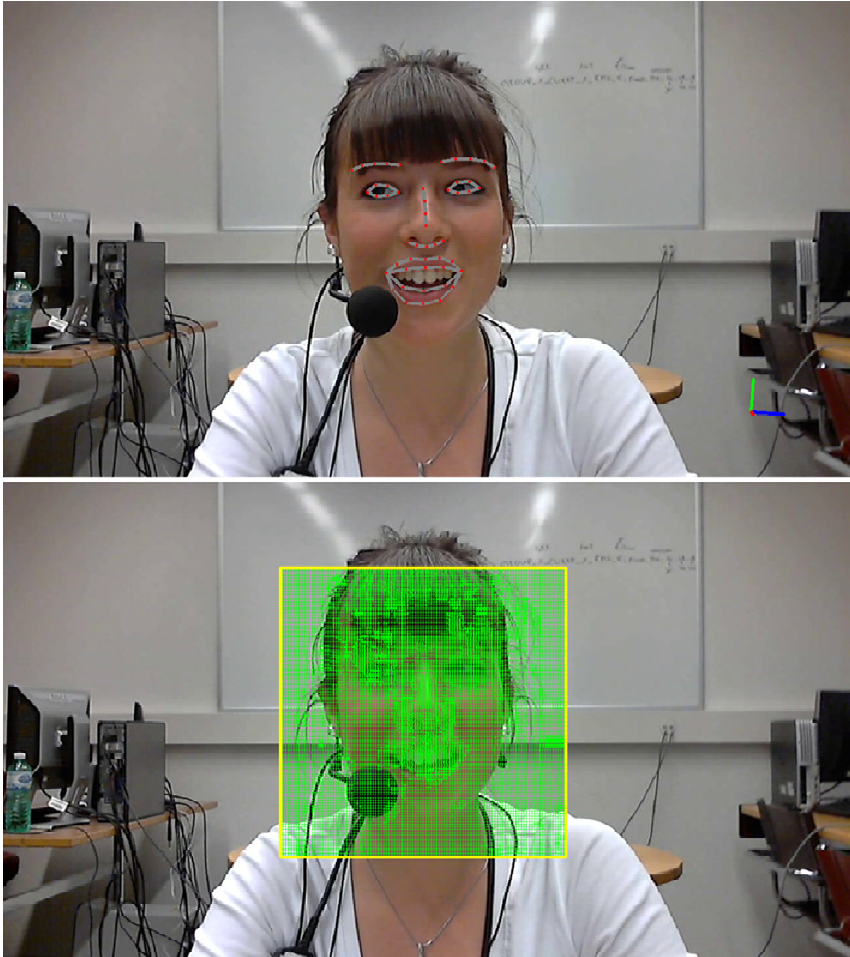
The experiments were conducted on the RECOLA database, featuring spontaneous interactions. The team extracted features using openSMILE (audio) and SDM face tracking (video), alongside complex physiological indices (NSI, NLD).
Arousal vs. Valence: A Temporal Divide
A major contribution of this study is the discovery of "optimal window sizes":
- Arousal (Excitement): Changes rapidly. It was best captured using shorter windows (~1.44s) and audio data.
- Valence (Positivity/Negativity): More subjective and slower to change. It required much longer windows (~3.72s) and was most accurately predicted via video data.
Fusion Strategy: Features vs. Decision
Should we mix all data at the start (Feature-level) or combine the predictions of separate models (Decision-level)? The results were clear: Decision-level fusion won. By training separate experts for audio, video, and physiology and then merging their "opinions," the system achieved far higher accuracy.
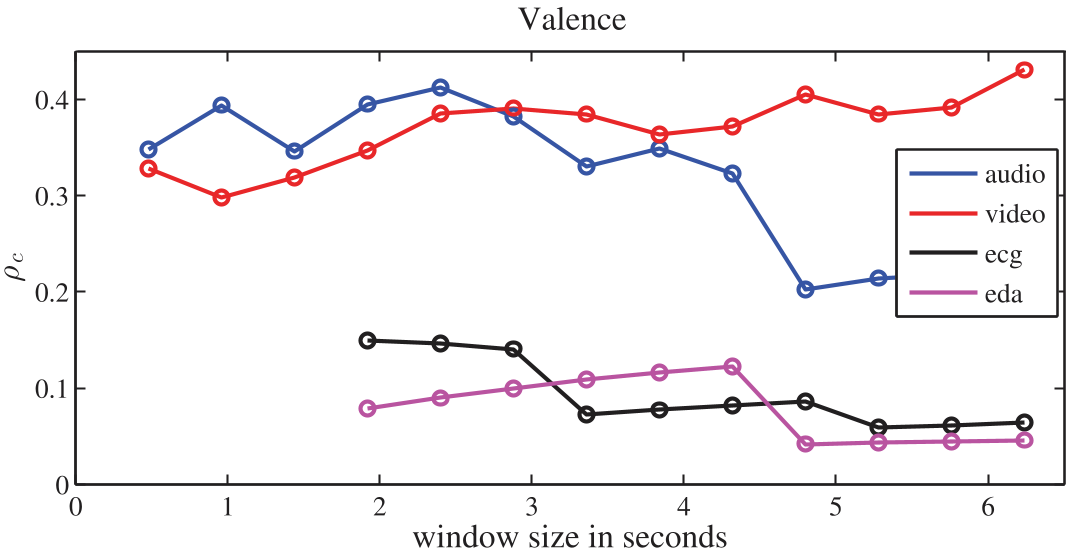 As shown, performance peaks at different window lengths depending on the modality, emphasizing the need for multi-time resolution analysis.
Deep Insights & Critical Analysis
Why does it work? The success of this approach lies in its Inductive Bias. By using LSTMs, the researchers embedded a physical intuition into the model—that emotion is a process with "inertia" and "latency."
Limitations:
- The physiological signals (ECG/EDA) showed relatively low performance individually (CCC < 0.2). This was likely due to physical movement noise (subjects taking notes).
- Audio data didn't benefit from multi-task learning on individual raters as much as video did, suggesting that audio features might require even higher model capacity to decouple rater-specific noise.
Future Outlook
This paper paves the way for truly unimodal-independent emotion recognition. As we move toward 2026, the industry is seeing these LSTM-based foundations evolve into Multimodal Transformers. However, the core takeaway remains: to understand human emotion, a machine must understand context and time.
Takeaway for Practitioners: When building affect-sensing products, don't just concatenate your features. Use decision-level fusion and account for the fact that valence and arousal operate on different "clocks."