
From Virtual Tours to Real-World Guidance: Solving Museum Localization with Synthetic Data
Pattern Recognition Letters
The paper introduces a synthetic data generation and automatic labeling tool built on the Unity engine for egocentric visitor localization and artwork detection in cultural heritage sites. Using a virtual agent to navigate 3D museum scans, the authors provide the "Bellomo" dataset and demonstrate that models trained on synthetic data achieve high accuracy in image-based localization and object detection tasks.
TL;DR
To overcome the bottleneck of data collection in cultural sites, this paper introduces a Unity-based tool that generates automatically labeled synthetic egocentric data. By simulating virtual agent navigations in 3D-scanned museums, the research demonstrates that models can learn to localize visitors and detect artworks with high precision (Localization Accuracy ~88%, Detection mAP ~94%) without requiring thousands of manually annotated real-world images.
Background: The Data Scarcity in Cultural Heritage
Deploying Computer Vision in museums—for applications like Augmented Reality guides or visitor behavior analysis—requires solving two core problems: Where is the visitor? (Localization) and What are they looking at? (Artwork Detection).
However, the "manual" way of solving this is a nightmare. Collecting egocentric (first-person) data requires visitors to wear cameras, raising privacy issues, while labeling 6DoF (6 Degrees of Freedom) poses for every frame is technically complex and non-scalable. This work shifts the paradigm from "collect and label" to "simulate and generate."
Methodology: The Synthetic Pipeline
The authors developed a tool using the Unity game engine that imports 3D scans of real cultural sites (like the Galleria Regionale di Palazzo Bellomo in Italy).
1. Automatic Labeling & Navigation
The tool simulates a virtual agent (a "digital visitor") walking through the site. Because the environment is digital, the tool knows the exact coordinates and orientation (quaternions) of the camera at every millisecond.
- Semantic Masks: The system renders specific IDs for artworks, allowing it to export perfect pixel-level masks for object detection training.
- Look-at Behavior: To mimic real visitors, the agent performs "look-at" actions when near an artwork, ensuring the training data contains realistic viewpoints.
 Figure 1: The proposed pipeline—from 3D scan to synthetic egocentric data generation.
2. Localization via Metric Learning
Instead of simple classification, the authors treat localization as an Image Retrieval problem. They use a Triplet Network (InceptionV3 backbone) to learn a feature space where images taken from nearby locations are mathematically close to each other.
- Triplet Loss: The model is trained to minimize the distance between an "anchor" image and a "positive" (nearby) image, while maximizing the distance to a "negative" (faraway) image.
Experiments and Performance
The researchers tested their approach on two primary datasets: the Bellomo Dataset (Museum) and the Stanford Dataset (Office).
Key Breakthroughs:
- The Power of Large Search Spaces: Even if the metric is learned on a subset of data (e.g., 25%), localization accuracy remains high as long as the "search space" (the gallery of reference images) is large.
- Temporal Smoothing: Real visitors move in sequences, not isolated frames. By applying a Trimmed Mean Filter over the last predicted poses, the team significantly reduced "jitter" and improved accuracy.
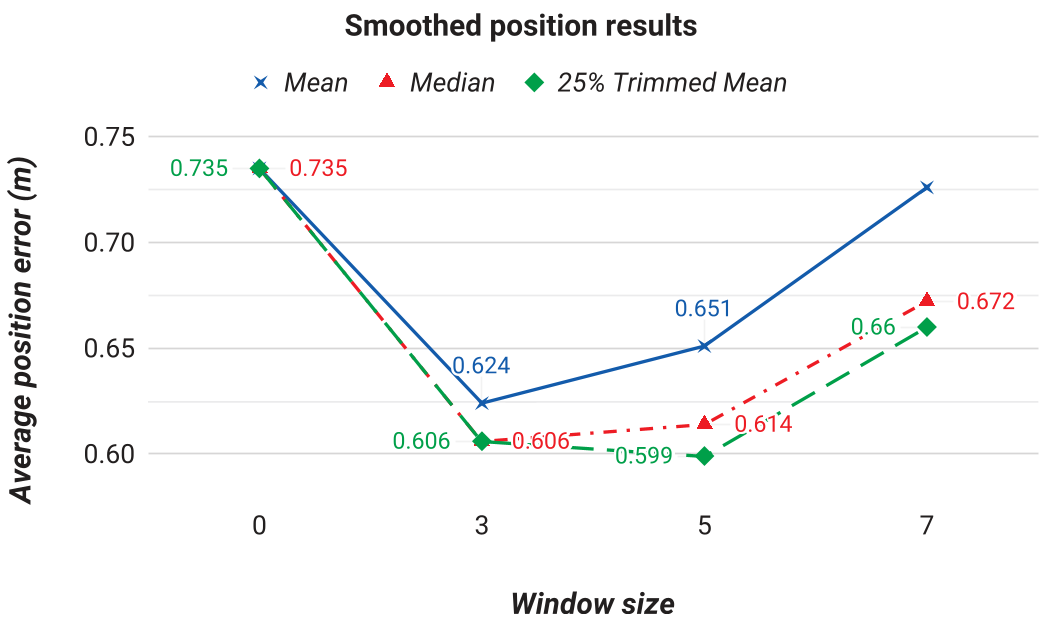 Figure 2: Impact of Temporal Smoothing—Trimmed Mean (Green) consistently provides the lowest error across both museum and office environments.
Artwork Detection SOTA Comparison:
The synthetic data proved excellent for training object detectors. Mask R-CNN achieved a mAP of 94.58%, proving that synthetic silhouettes and textures are sufficient for high-stakes artwork recognition.
Critical Insight: Sim-to-Real Potential
One of the most valuable findings is the Generalization Experiment. The authors found that a model pre-trained on the Stanford (Office) dataset could be fine-tuned with synthetic Bellomo (Museum) data to achieve better results than standard ImageNet pre-training. This suggests that the "intrinsic geometry" of indoor navigation can be partially transferred across different locations.
Conclusion & Future Work
This paper provides a robust blueprint for scaling AI in cultural heritage. By leveraging 3D scans—increasingly common in the "Digital Twin" era—museums can deploy sophisticated visitor aids without the massive overhead of manual data collection.
Future Outlook: The next step is validating the "Sim-to-Real" gap—measuring exactly how much performance degrades when the model trained on these "clean" Unity renders meets the "noisy" reality of a smartphone or HoloLens camera in a crowded museum.