
Pay It Backward: Why Paying in Bulk Beats Piecework in Crowdsourcing
Pay It Backward: Per-Task Payments on Crowdsourcing Platforms Reduce Productivity
This paper introduces "Pay It Backward," a behavioral economic approach to crowdsourcing incentives. By comparing traditional piecework payment (Per-Task) with alternative schemes like bulk payments, coupons, and material goods, the authors demonstrate that paying in 10-task increments significantly boosts worker participation.
TL;DR
The dominant "pay-per-task" model in crowdsourcing platforms like Amazon Mechanical Turk might actually be hindering productivity. This CHI'16 paper reveals that by simply shifting to Bulk Payments (rewards every 10 tasks) and utilizing Material Goods, platforms can increase task completion rates by 16% and significantly improve long-term worker retention.
The Piecework Problem
Since the inception of platforms like MTurk, the industry has operated on a simple piecework logic: do one task, get one payment. However, this model ignores a fundamental human trait: the need for milestones. Without specific goals, workers are prone to fatigue and rapid drop-off. Current research has mostly explored "how much" to pay, but this paper explores the "how" and "what" of payment.
The Behavioral Insight: Goals and Sunk Costs
The researchers drew on two powerful concepts from behavioral economics:
- Goal-Setting Theory: Specific, ambitious goals (like completing a set of 10) lead to higher performance than "do your best" prompts.
- Sunk Cost Effect: Once a worker has invested effort into a partial set of tasks, the psychological "cost" of quitting before the reward milestone becomes too high, driving them to finish.
Methodology: The Field Experiment
The study utilized a mobile app that sent notifications for "Quality of Service" surveys. 300 participants were split into five incentive conditions:
- PT (Pay Per Task): Control group.
- PB (Pay in Bulk): Rewards unlocked every 10 tasks.
- CT/CB (Coupon per task/bulk): Reducing monthly phone bills.
- MG (Material Goods): Unlocking items from a gift catalog.
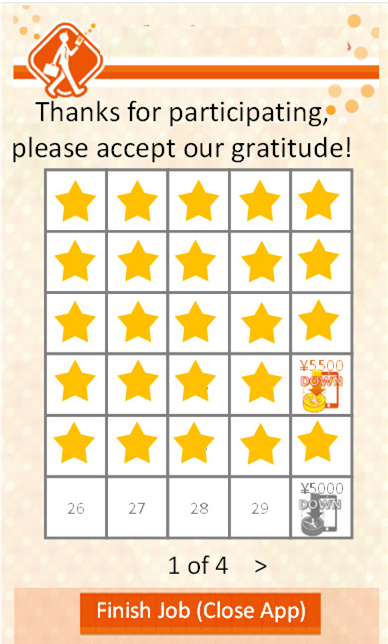 Incentive visualizations: (a) Per-task vs (b) Bulk progress bars/stamps.
Key Findings: The Bulk Advantage
The results were clear: Bulk payment is a productivity powerhouse.
- Efficiency: Bulk payment increased the odds of a task being completed by 1.4x.
- The Retention Miracle: While task completion usually drops as novelty fades, the Material Goods (MG) group showed incredible resilience. The rate of decline for material goods was significantly slower than cash-based methods.
- The Subjective Paradox: Interestingly, workers said they preferred Pay-per-task, yet they performed better under Bulk and Material Good conditions.
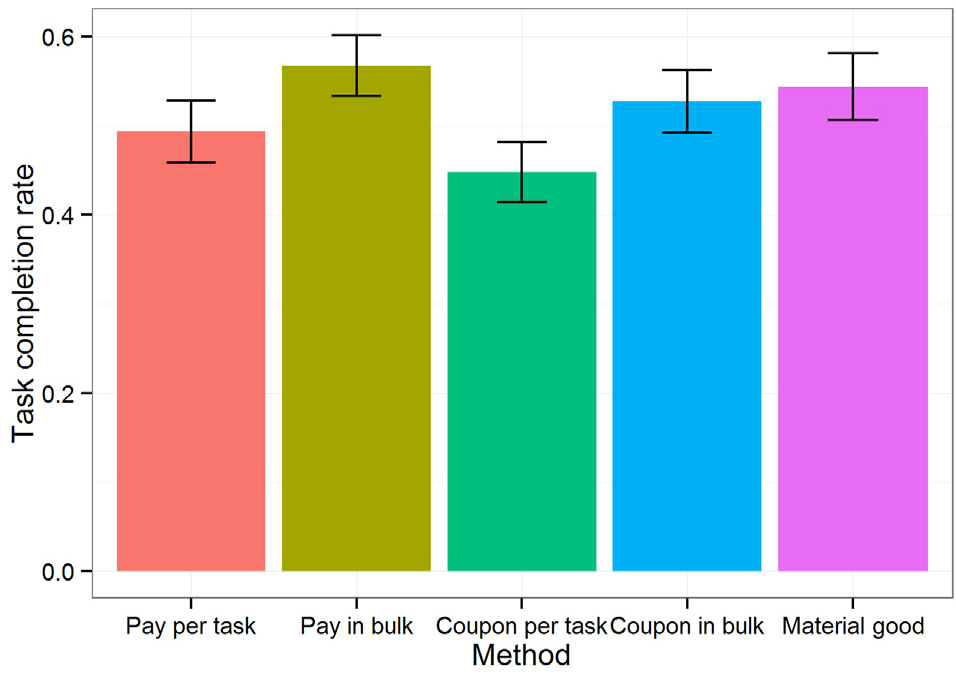 Quantitative proof: Bulk payments consistently outperformed the industry-standard per-task model.
Critical Analysis & Future Outlook
While Bulk Payment drives productivity, it introduces a "Risk of Loss" for workers who might complete 9 out of 10 tasks and receive nothing. This suggests that future platforms should balance psychological milestones with "safety nets" (e.g., partial payouts).
The takeaway for platform designers is profound: Stop thinking only about the dollar amount. By framing work as a journey toward a milestone or a tangible gift, you can build a more engaged and persistent workforce.
Conclusion: This study proves that "paying it backward"—forcing a longer look at a goal rather than immediate gratification—is the key to scaling human computation.