
Pay or Perish: Decoding the Economic Gravity of Premium Peering
18360_Pay or Perish The Economics of Premium Peering.
This paper introduces a novel game-theoretic choice model to analyze "Premium Peering" (paid prioritization) in the Internet ecosystem. It characterizes the economic interactions between Content Providers (CPs) and Access Providers (APs), identifying the "Intrinsic Value of Premium Peering" (VoPP) as the fundamental determinant of peering decisions.
TL;DR
In the evolving Internet, "Best Effort" is no longer enough for giants like Netflix. This paper provides a mathematical blueprint for why CPs choose to pay APs for direct access. By introducing the Intrinsic Value of Premium Peering (VoPP), it proves that peering is not just a technical choice, but a strategic defense against "peer pressure" and user churn.
The "Broken" Settlement Model
The Internet was built on the gentleman's agreement of settlement-free peering. But when Netflix began consuming 34% of downstream traffic, the status quo shattered. APs (like Comcast) began demanding payment from CPs. The FCC exempted these deals from Net Neutrality rules due to a lack of "background." This paper fills that void, moving beyond simple traffic ratios to analyze the Economic Choice Model of users.
Methodology: The Complementary Choice Model
The author rejects the idea that CPs and APs are independent. Instead, they are Complementary Services. A user needs both to watch a video.
The Core Equation: User Stickiness
The model assumes users have "stickiness" ( for CPs, for APs). If a peering link is slow (θ=0), whether a user leaves depends on how much they love the content versus how many other ISPs they can switch to.
 Figure 1: The Weighting Factor (ρ) that determines how market shares shift when a peering agreement is established or terminated.
The "VoPP" (Value of Premium Peering)
The paper defines an Intrinsic VoPP ():
- : The per-user value of the content.
- : Preservation factor (how much value remains if the connection is slow).
- : User stickiness to the CP.
If the AP’s price () is higher than , the CP will refuse to peer. If , peering is a go.
Strategic Insights: The High-Value CP Dilemma
One of the paper's most fascinating findings is the concept of Peer Pressure.
- High-Value CPs (Netflix): They peer because if they don't, and a low-value CP does, the high-value CP loses its "elastic" (non-sticky) users to the better-performing competitor.
- Low-Value CPs: They behave like "contrarians." They peer only if the big players haven't already saturated the quality expectation at that price point.
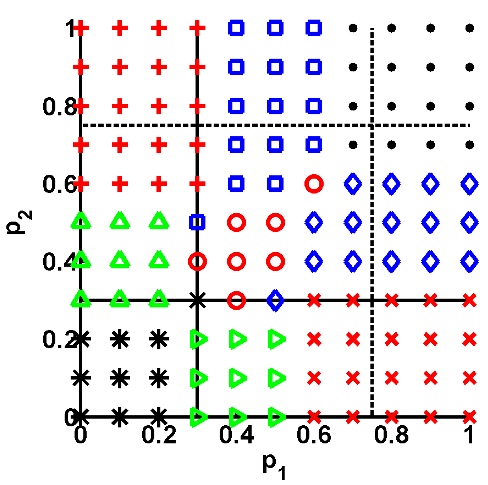 Figure 2: Analysis of Nash Equilibria. Notice how the peering strategy of one CP (ϑ₁) is fundamentally altered by the price and decision of the other.
Critical Insight: Market Baseline vs. Stickiness
- AP Baseline Share: Surprisingly, an AP's current size () matters less than the stickiness () of its users. An AP with a 5% market share but 99% sticky users can still act like a "local monopoly" and demand high peering fees.
- CP Baseline Share: For CPs (), size matters more. A larger CP has more "to lose" in terms of non-sticky users, driving them into peering agreements faster than smaller niche providers.
Conclusion and Future Outlook
The paper concludes that transparency—making it easier for users to switch ISPs—is a more effective regulatory tool than capping peering prices. If (AP stickiness) decreases, APs are forced into a "price war," naturally lowering the premium peering costs for CPs.
Takeaway: In the "Pay or Perish" world of the modern web, your economic value is determined not by how much traffic you send, but by how easily your users can leave you.