
Beyond the Intent: What Actually Drives Users to Pay for Social Networks?
A study of the paying behavior for subscribing social network sites
This study investigates the conversion of paying intention into actual paying behavior on Social Network Sites (SNS) using a decomposed Theory of Planned Behavior (TPB). By tracking 577 users of a popular Taiwanese SNS over five months, the researchers validated a structural model that links website quality and satisfaction to actual subscription actions.
Executive Summary
TL;DR
Why do some users click "Subscribe" while others remain perpetual free-riders? This study moves past the "intention" of paying and tracks the actual behavior of 577 SNS users over five months. It reveals that while satisfaction and loyalty are prerequisites, the real bridge between "wanting to pay" and "actually paying" is built on tenure (experience) and financial stability.
Background Positioning
In the landscape of SNS business models, this work serves as an empirical validation of the Subscription Model. While most studies stop at "Paying Intention," this paper identifies the specific moderating factors that turn mental desire into credit card transactions, making it a critical guide for freemium platform strategy.
Problem & Motivation: The "Free Mentality" Barrier
The digital economy suffers from a "free lunch" expectation. Even when users are satisfied with a service, they often resist paying due to low switching costs and the historical precedent of free information. Platforms like Facebook and Twitter have conditioned the world to expect social networking for free.
The authors' central insight was that Satisfied ≠ Paying. To understand why the gap exists, we must look at the external resources and internal commitment (tenure) that empower a user to cross the "paywall" threshold.
Methodology: The Decomposed TPB Framework
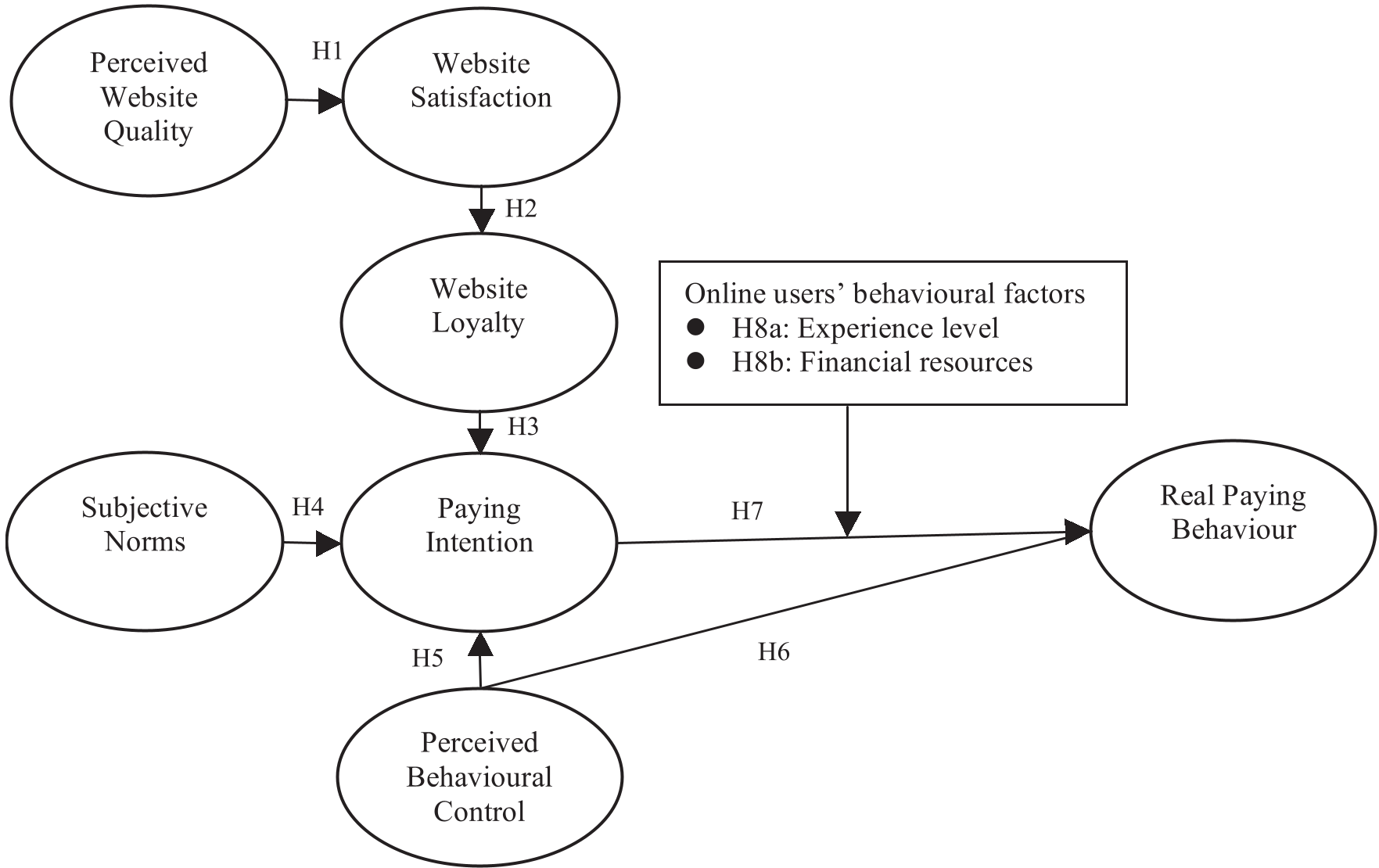
The researchers used a Decomposed Theory of Planned Behavior (DTPB). This breaks down the decision-making process into three pillars:
- Attitude: Driven by Website Quality Satisfaction Loyalty.
- Subjective Norms: Social pressure from peers who are already "VIP" members.
- Perceived Behavioral Control (PBC): The user's internal sense of whether they have the means and ability to subscribe.
Model Architecture
The study utilizes a multi-stage flow where service quality acts as the foundation for the eventual paying behavior.
Experimental Insights: Who Actually Pays?
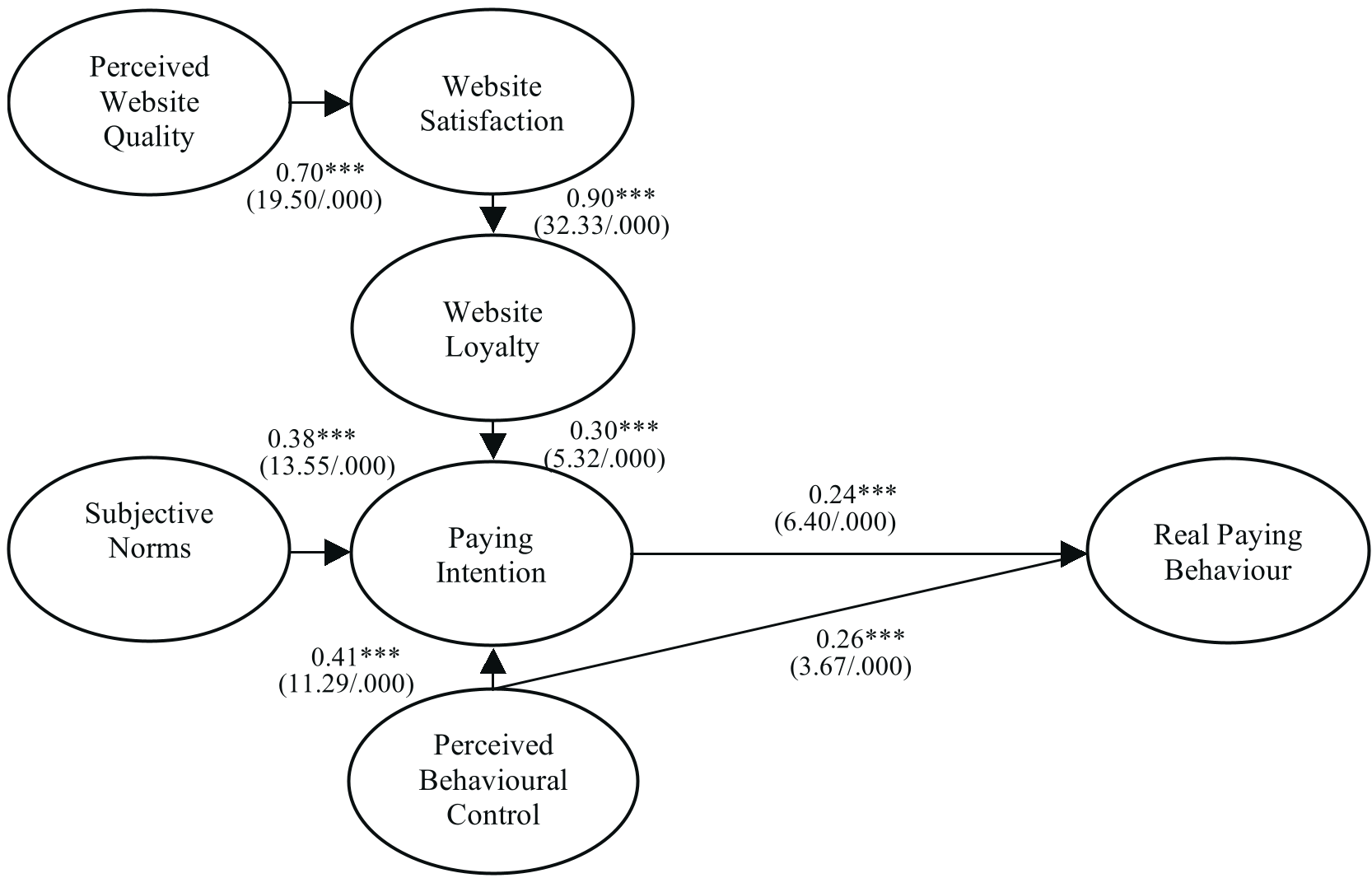
Using Partial Least Squares (PLS) analysis, the study confirmed that while satisfaction leads to intention, the moderators determine the final action.
1. The Tenure Effect (Experience Level)
Users who have been on the platform for more than 6 months have a much higher coefficient (0.412) in translating intention to action. This suggests that long-term social involvement creates a "lock-in" effect that makes a subscription feel like a valuable investment rather than a cost.
2. The Financial Resource Gap
Financial resources were a critical "gatekeeper." Users with full-time jobs were significantly more likely to follow through on their intention to pay. This highlights that "Subjective Norms" and "Satisfaction" mean little if the user lacks the disposable income to act.
3. Surprising Non-Factors
Interestingly, factors like gender, age, and usage frequency did not significantly moderate the link between intention and behavior. A "heavy user" who spends 5 hours a day on the site isn't necessarily more likely to pay than a moderate user, unless they have the tenure and the money.
Critical Analysis & Conclusion
Takeaway for Growth Hackers
If you are running a subscription-based SNS:
- Stop targeting new users for VIP upgrades. The conversion probability is highest for users with 6+ months of history.
- Segment by Job Status. Focus your premium ad spend on professional demographics rather than students, regardless of how much time students spend on the site.
- Quality is the Groundwork. Without perceived quality and satisfaction, the "Loyalty" chain never starts.
Limitations
The study was conducted on a single platform in Taiwan. While the DTPB framework is robust, cultural attitudes toward "paying for content" vary globally. Furthermore, the 5-month time lag between the survey and behavior measurement might have seen other ephemeral factors (like a sudden change in platform UI) impact the results.
Future Outlook
As more platforms (like X/Twitter and Meta) experiment with "Verified" subscription tiers, research into the Subjective Norm (the social status of having a badge) vs. Functional Value (extra features) will be the next frontier in understanding the paying behavior of the social web.