
UNICOAT: Synchronizing Heterogeneous Social Networks Through Partial Co-Alignment
PCT: Partial Co-Alignment of Social Networks
This paper introduces PCT (Partial Co-Alignment), a novel task for concurrently inferring multiple types of anchor links (e.g., users and locations) across heterogeneous social networks. The authors propose the UNICOAT (UNsupervIsed COncurrent AlignmenT) framework, which achieves state-of-the-art results in unsupervised network alignment by jointly optimizing for user and location correspondences using both link structures and heterogeneous attributes.
TL;DR
Social network alignment is no longer just about finding the same user on Twitter and Foursquare. The paper "PCT: Partial Co-Alignment of Social Networks" proposes UNICOAT, an unsupervised framework that simultaneously aligns multiple entity types (users and locations). By using a joint optimization strategy and a network flow-based matching algorithm, it achieves a massive performance boost over methods that treat these entities in isolation.
Background & Motivation: The Fragmentation of Digital Identity
The current social media landscape is fragmented. We use Foursquare for check-ins, Twitter for thoughts, and Yelp for reviews. While we (the users) are the primary "anchors" connecting these graphs, other entities like locations, products, and videos are also shared across platforms.
The Problem: Most prior work treats network alignment as a supervised, single-type task.
- Supervised Dependency: They need ground-truth labels (hard to get).
- Entity Isolation: They match users but ignore the fact that the locations those users visit are also valid anchors.
- One-to-One Constraints: They struggle to maintain the physical reality that one person usually has only one account per network.
Methodology: The Power of Co-Alignment
The core philosophy of UNICOAT is that everything is connected. If we know that two users are the same, their check-in locations should match. Conversely, if two locations are identical, the users frequenting them are likely the same.
1. Heterogeneous Feature Engineering
UNICOAT doesn't just look at who follows whom. it extracts:
- Users: Usernames (Jaccard similarity), Temporal activity (24-hour distribution vectors), and Text usage (TF-IDF bag-of-words).
- Locations: Names, Review content, and exact GPS coordinates (Euclidean distance).
2. Joint Optimization Framework
The paper formulates the alignment as a cost-minimization problem. It seeks transitional matrices (for users) and (for locations) that minimize the discrepancy between network structures.
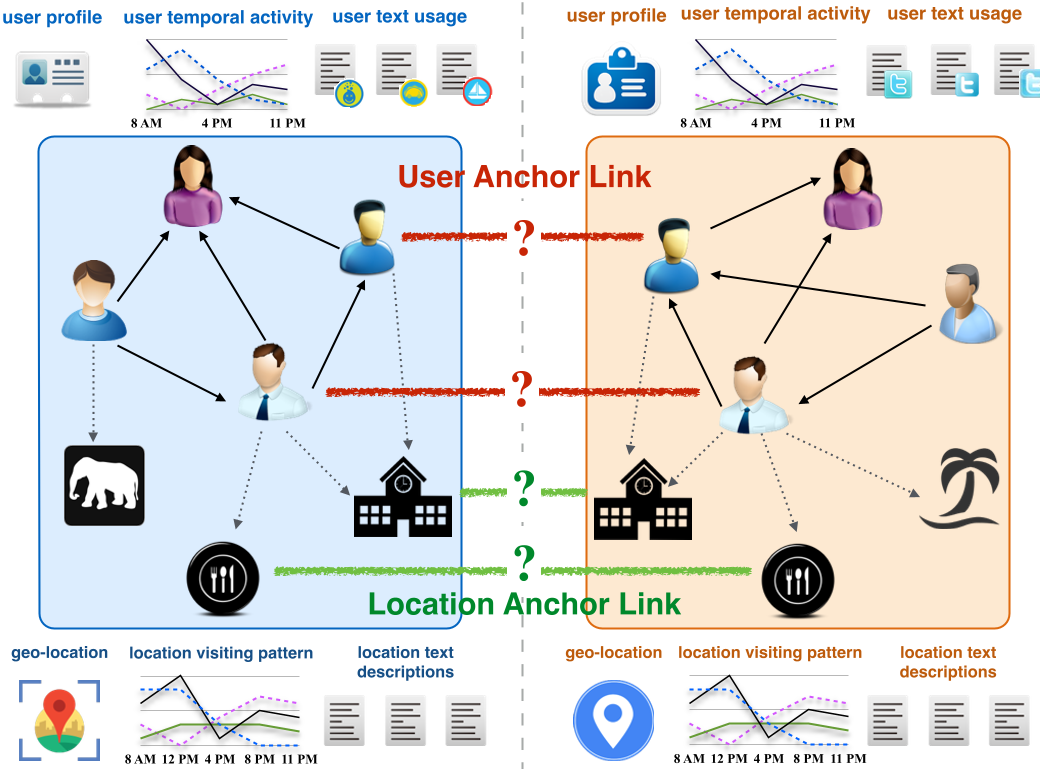 Figure 1: The PCT problem structure, showing how user and location anchor links bridge heterogeneous graphs.
3. Network Flow Co-Matching
Because the mathematical optimization relaxes constraints to the [0, 1] range (essentially giving "confidence scores"), the researchers use a Minimum Cost Network Flow model. This ensures that the final result is a strictly "one-to-one" or "one-to-zero" mapping, effectively pruning out the noise of partial alignment.
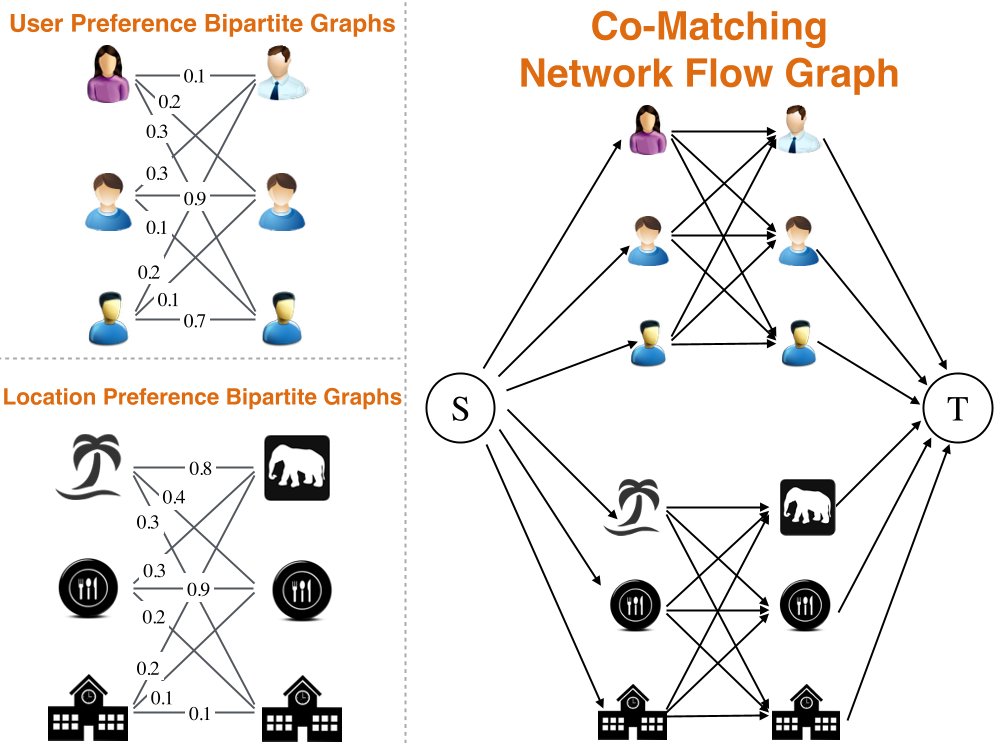 Figure 2: The bipartite preference graphs are transformed into an integrated network flow graph with Source (S) and Sink (T) nodes.
Experiments & Results
The authors tested UNICOAT on Foursquare and Twitter datasets.
SOTA Comparison
UNICOAT consistently outperformed BIGALIGN (link-only) and ISOEXT (attribute-only). In fully aligned networks, UNICOAT reached an AUC of 0.868. Even when the network became "noisy" (adding 800 non-anchor users, represented by ), UNICOAT maintained an AUC of 0.799, whereas other methods plummeted to near-random performance (0.5 - 0.6).

Convergence
One of the technical highlights is the efficiency of the Alternative Projected Gradient Descent. As shown in the study, the norm of the transitional matrices converges in fewer than 5 iterations, making it viable for large-scale social graphs.
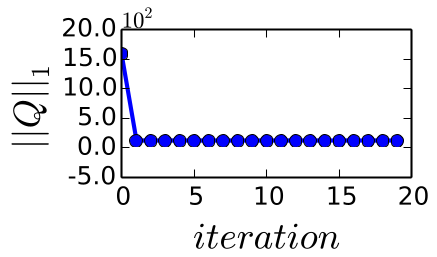 Figure 3: Fast convergence of the iterative updating schema.
Critical Insight & Conclusion
The true value of this paper lies in its holistic view of social networks. By moving from "Entity Alignment" to "Network Co-Alignment," UNICOAT acknowledges that social data is a multi-layered fabric.
Limitations: While powerful, the method assumes a somewhat static relationship between attributes. Future work could explore how these identities evolve over time—accounting for "concept drift" in user interests or profile updates.
This work is a cornerstone for anyone looking into Network Fusion and Cross-Platform Recommendation Systems, providing a robust, unsupervised way to bridge the gaps in our digital footprints.