
PEC: Balancing Life-Saving Speed and Data Privacy in Mobile Healthcare Networks
PEC: A privacy-preserving emergency call scheme for mobile healthcare social networks
The paper introduces PEC, a privacy-preserving emergency call scheme for Mobile Healthcare Social Networks (MHSNs) that uses Ciphertext-Policy Attribute-Based Encryption (CP-ABE) and Group Signatures. It enables decentralized, epidemic dissemination of emergency data to nearby helpers, achieving state-of-the-art efficiency in medical data access control and response time reduction.
TL;DR
In a life-threatening emergency, every second counts, but so does your medical privacy. This paper presents PEC (Privacy-preserving Emergency Call), a decentralized scheme that turns a neighborhood's mobile devices into an ad-hoc emergency response team. By using advanced cryptography (CP-ABE and Group Signatures), it ensures that only qualified medical professionals can access your sensitive health records while your location is broadcasted to anyone who can help.
Background & Motivation: The Centralization Bottleneck
When a heart attack or a car accident occurs, we typicaly rely on a Centralized Trusted Authority (TA)—the 911/Ambulance system. However, centralized systems face two major hurdles:
- Latency: The ambulance might be miles away while a doctor is just around the corner at a coffee shop.
- Stability: Centralized links (3G/LTE/5G) can fail in remote areas or over-congested scenarios.
The authors propose shifting the paradigm toward Mobile Healthcare Social Networks (MHSNs). Here, the patient's PDA (Personal Digital Assistant) acts as a beacon, epidemically spreading an emergency call through the local crowd to find the fastest help possible.
The Core Challenge: The Privacy-Availability Paradox
If you broadcast your medical status to everyone in the neighborhood, hackers or nosey neighbors might steal your identity or sensitive health history. If you encrypt it too heavily, the doctor who arrives might not have the decryption key or the time to use it.
PEC solves this by categorizing data into three sensitivity tiers:
- General Information (GI): Location and time. Accessible to all to guide them to the scene.
- Physiological Condition (PC): Real-time heart rate/blood pressure. Accessible to all paramedics/physicians.
- Health Record (HR): Personal history. Restricted to certified physicians only.
Methodology: High-Efficiency Cryptography
The technical brilliance of PEC lies in its implementation of Ciphertext-Policy Attribute-Based Encryption (CP-ABE) and Group Signatures.
1. Fine-Grained Access Control
Unlike standard encryption where you encrypt for a specific person, CP-ABE encrypts data for an attribute set. For example, the patient sets a policy: (Physician) OR (Paramedic AND Certified). Only a user whose digital credentials satisfy this logic can unlock the symmetric keys needed for the PHI (Personal Health Information).
2. Anatomizing the Emergency Call
An EmC (Emergency Call) packet in PEC contains:
LOC || INC || TIME: The "Where, What, and When".GS: A Group Signature that proves the sender is a legitimate member of the healthcare system without revealing their specific identity.AC: The ABE-encrypted keys.INF: The actual encrypted medical data.
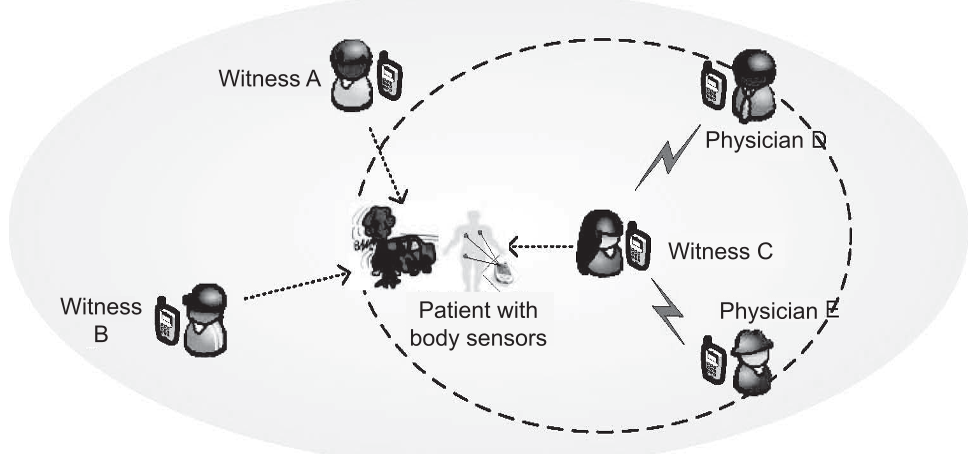 Figure 1: The decentralized MHSN architecture showing the interaction between patients, sensors, and nearby helpers.
3. Revocation (rPEC)
What if a physician turns malicious (an "inside attacker")? The authors introduce rPEC, which uses a binary tree structure to manage user keys. The TA can "prune" a malicious user from the tree, ensuring they can no longer decrypt new emergency calls in the next time period without affecting honest users.
Experimental Validation
The authors didn't just stop at math; they built a custom Java simulator to test real-world scenarios in a 1km x 1km area.
- Efficiency: The PEC decryption algorithm is roughly 2x faster in pairing operations compared to the classic Waters' CP-ABE scheme.
- Response Time: As the density of users increases, the response time drops sharply. In a network of 200 users with just 5 physicians, the help-arrival time is significantly lower than waiting for a distant ambulance.
- Mobile Practicality: On a 416MHz processor (standard for PDAs of the era), decryption takes less than 10 seconds—far less than the typical 100+ seconds it takes for a physician to physically run to the patient.
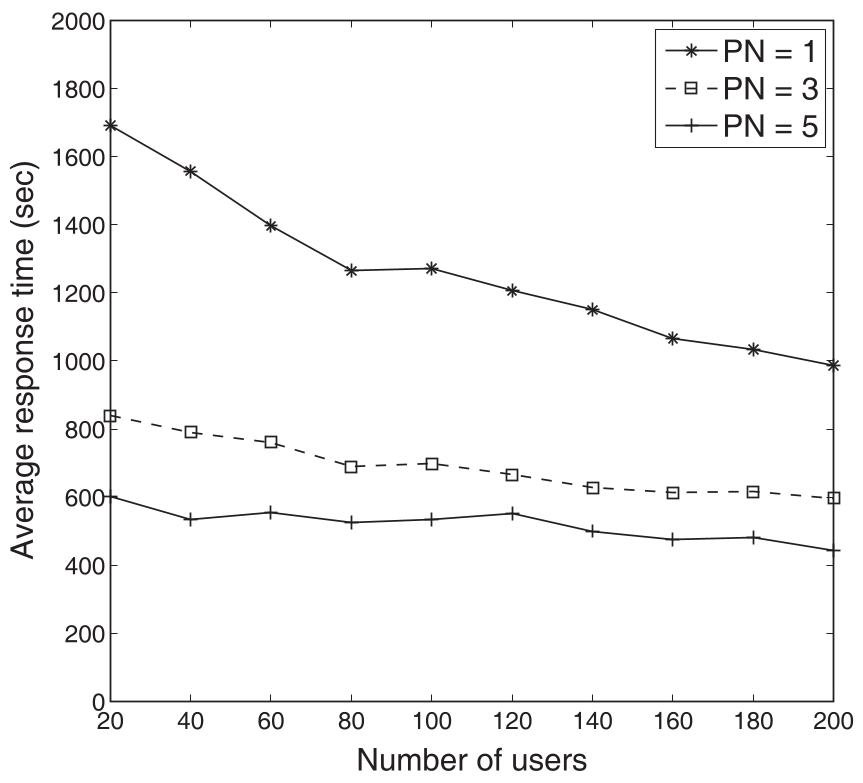 Figure 2: Response time vs. User density. More social "relay" nodes lead to faster medical intervention.
Critical Insight: Why This Matters
PEC represents a vital step in Patient-Centric Healthcare. It acknowledges that while we need professional help, we must remain the owners of our data.
Limitations: The scheme assumes a high enough density of users to act as relays (Epidemic Dissemination). In rural areas with low "social spotting," the epidemic model might fail, requiring a fall-back to centralized GSM/3G.
Conclusion
By combining the "social" aspect of mobile networks with "hard" attribute-based security, PEC provides a blueprint for a future where our devices don't just entertain us—they save us. It proves that privacy doesn't have to be the price we pay for rapid emergency care.