
The Attentive Avatar: Bridging the Gap Between Live Teachers and VR Bots
Pedagogical Agent Responsive to Eye Tracking in Educational VR
The paper introduces a responsive architecture for VR pedagogical agents that utilizes eye-tracking data to monitor student attention. By integrating a behavior-based AI with "generalized hotspots" and timeline-based metadata, the system enables teacher avatars to dynamically pause, replay, or redirect instruction based on real-time gaze shifts.
TL;DR
Researchers at the University of Louisiana at Lafayette have developed a sophisticated AI architecture that allows VR pedagogical agents to "see" what students are looking at. By leveraging eye-tracking data and a behavior-based AI framework, these virtual teachers can pause, repeat instructions, or prompt students if they get distracted, mimicking the natural responsiveness of a human educator.
Context & Motivation: The Scaling Paradox
In the world of Virtual Reality (VR) education, there is a persistent trade-off. Live, teacher-led virtual field trips yield high engagement and better test scores because humans can sense when a student is distracted. However, live teaching doesn't scale—it requires synchronized schedules and high bandwidth.
On the other hand, pre-recorded agents scale perfectly but are "blind." If a student is looking at their virtual shoes while the agent explains a complex turbine, the information is lost. The goal of this paper is to give these automated agents the "eyes" and the "brain" to react to student inattention.
Methodology: High-Level Sensing and Behavioral Logic
The authors propose a multi-layered system that transforms raw eye-tracking data into pedagogical decisions.
1. The Sensing Stack and Generalized Hotspots
Unlike traditional "hotspots" that simply trigger an action when clicked, the authors define Generalized Hotspots. These are high-level sensors that aggregate multiple inputs:
- Low-level sensors: Raw gaze coordinates and pupil dilation.
- Combiners & Mappers: Mathematical functions (like Sigmoid curves) that convert gaze angles into an Inattention Score (0 to 1).
- Temporal Filters: These prevent "jittery" responses by ensuring the student has been distracted for a set period before the agent reacts.
2. Timeline Metadata (The Script)
Using an extension of Unity’s Timeline, the researchers added "Annotation Tracks." This allows designers to mark:
- Critical Periods: Specific windows of time where the student must be looking at a specific object.
- Respond Markers: Points where the AI evaluates the inattention score to decide if it should deviate from the script.
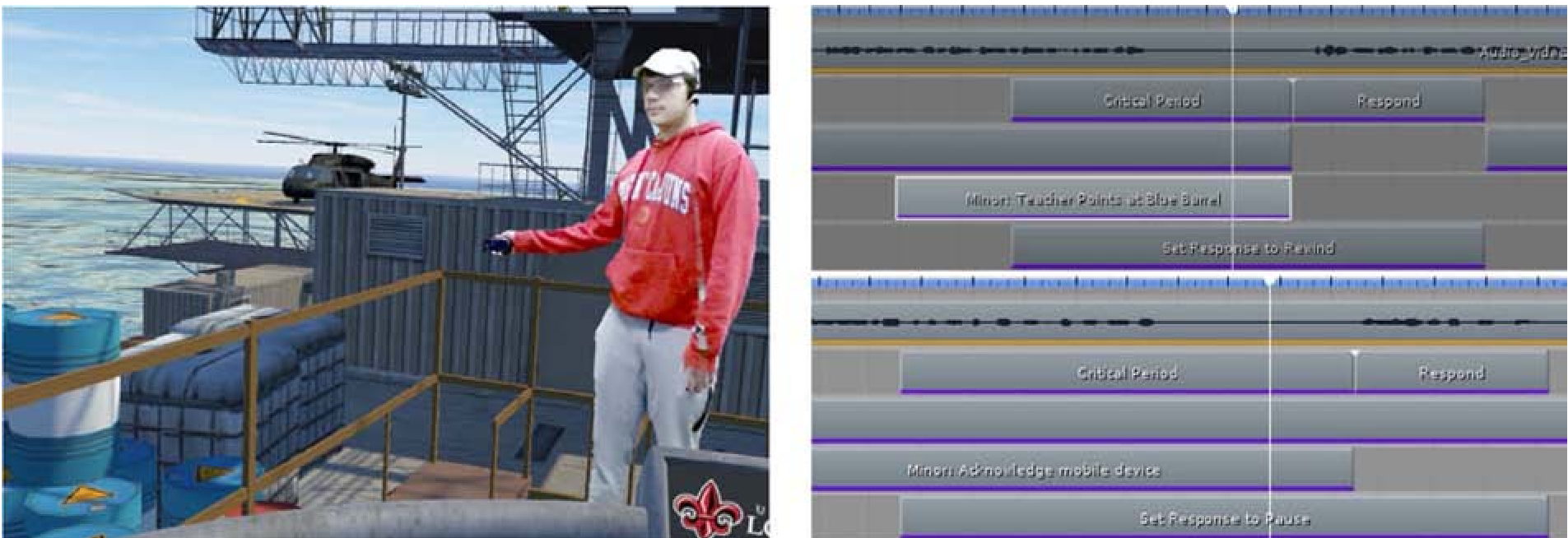 Figure 1: On the left, a VR teacher points to a barrel; on the right, the underlying timeline tracks specific "Critical Periods" to trigger agent responses.
Teacher Response Selection: The AI Core
The "brain" of the agent is built on a Subsumption Architecture (or Utility AI). Instead of a rigid "if-then" script, every possible agent action has a rank or utility score:
- Default Behavior: Continue the lecture (Rank 0).
- Pause/Replay: Promoted to a higher rank if the student's inattention score exceeds a threshold during a critical period.
- Cooldown Timers: Prevent the agent from repeating the same correction too rapidly, allowing the student time to adjust.
This design makes the agent extensible. Developers can add new responses (like an arrow pointing to the correct object) without rewriting the entire logic loop.
Experiments: Training on an Oil Rig
The system was tested in a VR oil rig simulation. In this environment, the agent points to specific machinery. If the system detects that the student's gaze is too far from the target (calculated via minimum gaze angles), the agent can:
- Pause and wait for the student to look.
- Replay the last sentence to ensure the context is grasped.
- Offer Help via a separate audio clip if the student remains lost.
Deep Insight & Future Outlook
This work represents a significant shift from "Trigger-Action" VR to "State-Aware" VR. By treating student attention as a continuous numerical value (Utility) rather than a binary switch, the agent's behavior becomes much more fluid and less robotic.
Limitations: Currently, the system relies on pre-recorded clips, which limits the flexibility of the dialogue. Future work aims to incorporate more diverse visual cues and analyze more complex eye patterns like scanpaths to detect specific types of cognitive load or confusion.
As eye-tracking becomes a standard feature in consumer VR headsets (like the Quest Pro or Apple Vision Pro), architectures like this will be fundamental to creating virtual tutors that feel truly present and attentive.