
From Steps to Structures: Reconstructing Floor Plans via Crowdsourced Walking Models
Pedestrian Walking Model for Floor Plan Building Based on Crowdsourcing PDR Data
The paper proposes a novel indoor walking model to reconstruct floor plans using crowdsourced Pedestrian Dead Reckoning (PDR) data from smartphones. By applying Erlang distribution modeling to trajectory points, the method accurately estimates hallway widths and builds building contours without prior maps or expensive SLAM equipment.
TL;DR
Building indoor maps usually requires expensive SLAM robots or manual surveying. This paper presents a smarter alternative: harvesting the "digital exhaust" of everyday pedestrians. By modeling walking habits using the Erlang Distribution, the authors can extract not just paths, but the actual width of hallways, allowing for the automatic generation of building floor plans from noisy smartphone PDR (Pedestrian Dead Reckoning) data.
Problem & Motivation: The "Empty Map" Problem
Indoor navigation is only as good as the underlying map. However, for most buildings, digital floor plans are either proprietary, outdated, or non-existent. Traditional SLAM (Simultaneous Localization and Mapping) is accurate but involves high labor and equipment costs.
While previous research used crowdsourced PDR to draw "skeleton" paths, they lacked spatial volume. They could tell you where a person walked, but not how wide the hallway was. The core insight of this paper is that pedestrian distribution—where people choose to step—is a direct function of the hallway's geometry.
Methodology: The Physics of a Walking Habit
The authors propose that pedestrians follow predictable patterns:
- Straightaways: People stay near the central axis.
- Corners: People "cut the corner," moving away from the center toward the inner turn.
To turn this intuition into math, they employed the Erlang Distribution. By segmenting the hallway into "Straight," "Transition," and "Rotation" areas, they can model the probability of a footprint appearing at any given cross-section.
The Model Architecture
The high-precision heading is first calculated using Quaternion-based integration to minimize the drift inherent in smartphone gyroscopes. Then, the PDR points are mapped to the Erlang model.
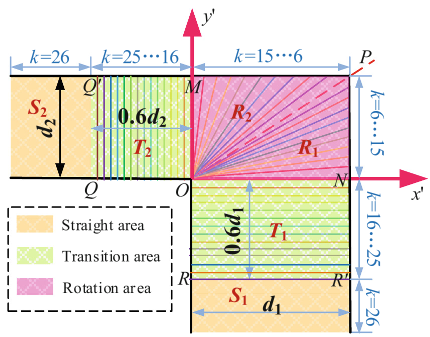 Figure 1: Using Erlang Distribution (k-coefficient) to model how trajectory points spread in different hallway segments.
The model defines the hallway width as a function of the standard deviation of trajectory points , adjusted by a "turning factor" and a "correction factor" . This accounts for the fact that PDR data becomes more "divergent" the further a person walks or the more they turn.
Hallway Width Estimation
Unlike previous methods that look at the whole trajectory, this method looks at point density. By clustering points in straight areas and fitting them to the probability model, the system works backwards to find the physical boundaries that would constrain such a distribution.
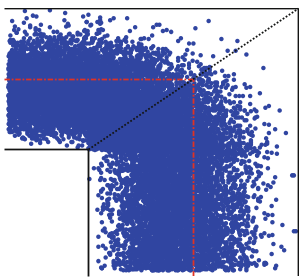 Figure 2: Real-world PDR points (blue) vs. the modeled hallway central axis (red dash).
Experiments & Results
The team tested the algorithm at the Harbin Institute of Technology using various smartphones (Google Pixel, Redmi 3). The environment included 5 turns and 6 straight hallway segments.
Key Performance Metrics:
- Width Accuracy: In 5 out of 6 segments, the estimated width was within a few centimeters of the ground truth (e.g., Part 1: Estimated 3.108m vs. Actual ~3.1m).
- Robustness: The use of the "turning factor" successfully mitigated the "divergence" error caused by cumulative gyroscope drift.
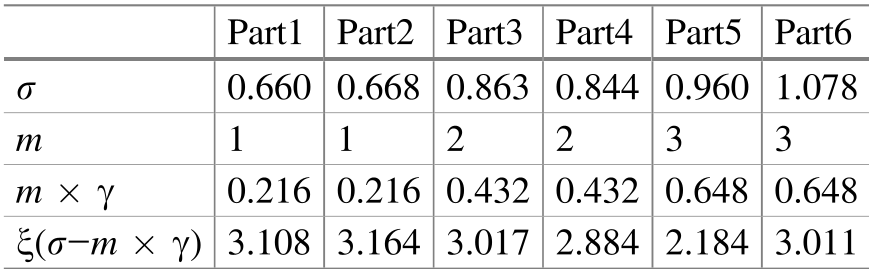 Table 1: Quantitative results showing the successful width estimation across different hallway parts.
Critical Insight & Conclusion
This work shifts the focus from cleaning noise to modeling behavior. It acknowledges that PDR data is inherently messy but argues that the "messiness" (the variance ) actually contains structural information about the environment.
Limitations: The current model assumes a standard "walking habit." In highly crowded environments or buildings with obstacles (like lobby furniture), the Erlang parameters might need dynamic adjustment. Furthermore, the model currently focuses on hallways; extending this to open-plan offices or complex lobbies remains a challenge for future work.
Takeaway: By understanding the "human factor," we can transform everyday smartphones into a distributed sensing web capable of mapping the world from the inside out.