
Empowering Social Games: Leveraging Reciprocity to Slash Server Costs
Peer-assisted online games with social reciprocity
The paper proposes a peer-assisted social game system that leverages social reciprocity to distribute game state updates. By introducing a Social Reciprocity Index (RI) based on both direct and indirect contribution ratios, the methodology achieves a high-quality multiplayer experience with minimal server costs, outperforming traditional P2P incentive mechanisms in balancing relay loads.
TL;DR
Deploying 3D Massively Multiplayer Online Games (MMOGs) is notoriously expensive due to high server bandwidth costs. This paper introduces a peer-assisted social game architecture that uses social reciprocity—the natural tendency to help friends—to incentivize players to share their upload bandwidth. By balancing direct friendship-based help with overall system contribution, the system achieves SOTA load balancing and low-latency state distribution with minimal server reliance.
The "Free-Rider" Bottleneck in P2P Gaming
In traditional P2P systems, the "tragedy of the commons" often occurs: players consume bandwidth but refuse to contribute their own (free-riding). While BitTorrent used "Tit-for-Tat" to address this in file sharing, gaming is different. It is latency-critical. If a relay helper is unstable or unmotivated, the game lags for everyone in the "Area of Effect" (AoE).
Existing P2P game designs lacked a way to tap into the social fabric of modern gaming. The researchers behind this paper realized that players are much more likely to help a social friend or a respected community contributor than an anonymous node.
Methodology: The Social Reciprocity Index (RI)
The core innovation is the Social Reciprocity Index (RI), a mathematical bridge between social closeness and resource history.
1. The Two Ratios
- Peer Contribution Ratio (PCR): A "give-and-take" balance between two specific friends.
- System Contribution Ratio (SCR): A global reputation score reflecting how much a peer has helped the entire network.
2. The RI Calculation
The RI is calculated as:
e_i(j) = (1 - f_ij) * w_j + f_ij * W_i(j)
Where f_ij represents social closeness. If you are close friends, the system prioritizes your direct history; if you are strangers, it looks at your global reputation.
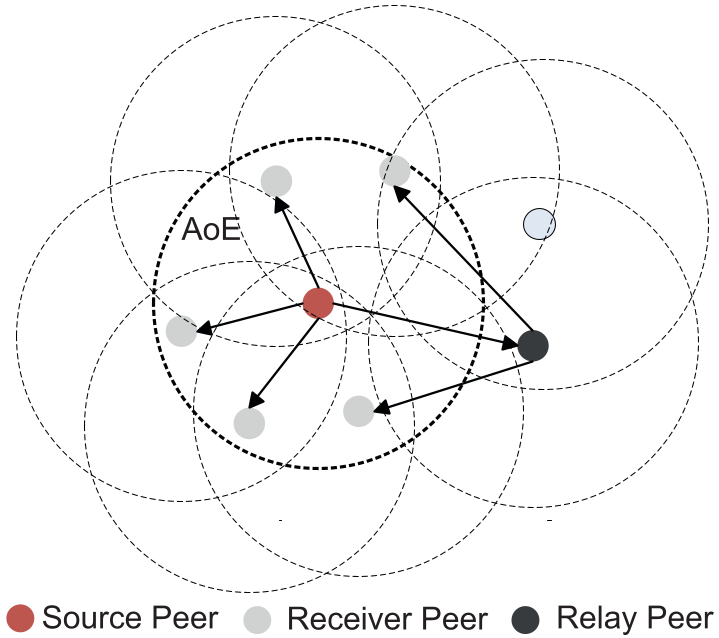 Fig 1: The model of peer-assisted avatar communication within an Area of Effect (AoE).
How it Works: Source and Relay Strategies
- The Source Peer: When a player’s upload speed is too slow to reach everyone in their AoE, they rank potential helpers by RI and ask the "cheapest" ones (those they have helped a lot in the past) for assistance.
- The Relay Helper: When a peer has spare bandwidth, it receives requests and picks who to help based on a descending order of RI. This ensures that "good citizens" and close friends get the best service.
Experimental Results & Proof of Concept
Tested on PlanetLab with 240 nodes, the results were conclusive:
- Incentive Effectiveness: There is a clear linear correlation between how much bandwidth a peer contributes and their "Request Success Ratio." In short: help others, and you will be helped when you lag.
- Load Balancing: Unlike random P2P scheduling, this system successfully distributes the load to peers with high spare capacity and low historical contribution ratios.
- Social Preference: As shown in Fig. 5 and 6, the system naturally routes data through friends, leveraging the existing social graph to improve reliability.
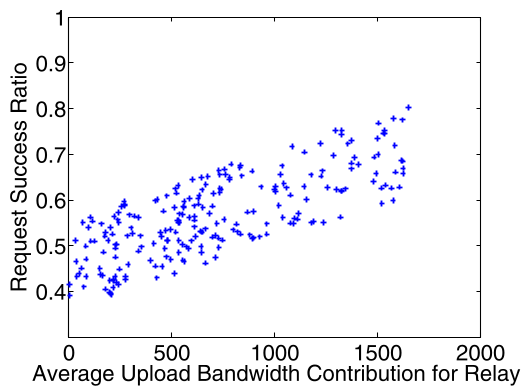 Fig 2: Comparison of mutual contribution between this design and random scheduling.
Critical Insight & Future Outlook
This paper shifts the perspective from purely algorithmic P2P (where every node is a number) to socially-aware P2P. By aligning the "Inductive Bias" of the scheduling algorithm with human social behavior, the researchers solved a technical problem with a sociological solution.
Limitations: The study assumes a static social graph. In real games, friendships are dynamic and social groups can be "cliquey," which might prevent new players from receiving relay help. Future work involving "game points" or hybrid currency/reciprocity models could solve this "cold-start" problem for new users.
Conclusion: For developers of the next generation of MMOGs or Metaverse platforms, integrating social graphs into the networking layer isn't just a feature—it’s a cost-saving necessity.