
Social Reciprocity: The Secret Sauce for Scaling P2P Media Streaming
8973_Peer-Assisted Social Media Streaming with Social Reciprocity.
This paper proposes a peer-assisted social media streaming system that leverages social reciprocity to reduce server costs. It introduces two metrics, Peer Contribution Ratio (PCR) and System Contribution Ratio (SCR), implemented via a Social Reciprocity Index (RI) to optimize contribution incentivization and resource scheduling among friends and strangers.
TL;DR
Researchers have found a way to slash massive server costs in social media streaming by turning users into "relay helpers." Unlike old-school P2P systems, this method uses Social Reciprocity—leveraging the fact that you're more likely to help a friend (or a proven contributor) than a stranger. By balancing direct and system-wide "give-and-take" ratios, the system achieves over 80% peer-assisted delivery with minimal server intervention.
Background & Motivation: Beyond YouTube's Server Bill
As platforms like Facebook, X (formerly Twitter), and TikTok merge social networking with heavy video consumption, the underlying infrastructure faces a "success paradox": more users mean exponentially higher bandwidth bills.
The authors observed a critical insight from Renren (China's Facebook) traces: video sharing isn't random. Roughly 40% of shares happen between friends. While traditional P2P systems use "Tit-for-Tat" (I give to you if you give to me), they ignore the social context. The motivation here is to build an incentive layer that feels "natural" to the social graph.
Methodology: The Social Reciprocity Index (RI)
The core of the paper is the Social Reciprocity Index (RI). It’s a mathematical representation of how much peer A "owes" peer B, or how much B has earned the right to be helped.
1. The Dual Ratios
- PCR (Peer Contribution Ratio): Tracks the specific history between two friends.
- SCR (System Contribution Ratio): Tracks a user's "global karma"—how much they've helped the entire network versus how much they've taken.
2. The RI Formula
The formula uses a weight (friendship strength). If you are close friends, your mutual history (PCR) dominates. If you are strangers, your global reputation (SCR) takes over.
3. Architecture for Dispatching
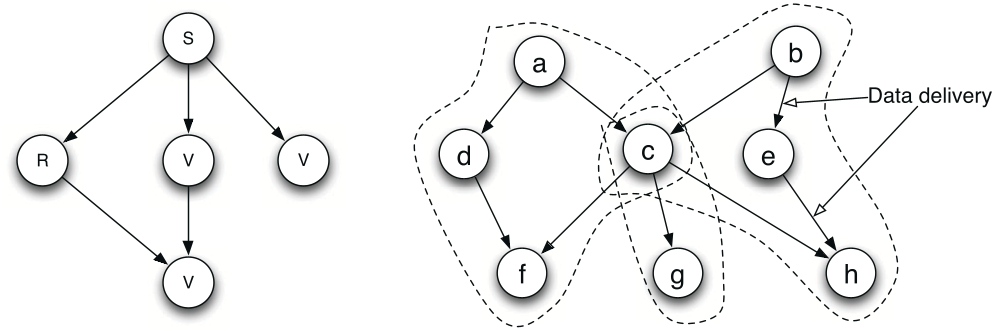 Fig 1. Illustration of the peer-assisted media sharing flow: Sources (S) use Relays (R) to serve Viewers (V).
Evaluation: Does Social Pressure Actually Work?
The authors deployed a prototype on 200 PlanetLab nodes. The results were telling:
- Incentive Alignment: There was a clear, positive correlation between how much a peer contributed and their success in finding help when they became a "Source."
- Load Balancing: By picking relays with the lowest RI, the system naturally rotates the burden, preventing "super-peers" from being overwhelmed.
- Social Preference: Help was significantly more concentrated among friend clusters, which reduces the "cold start" problem for new video segments.
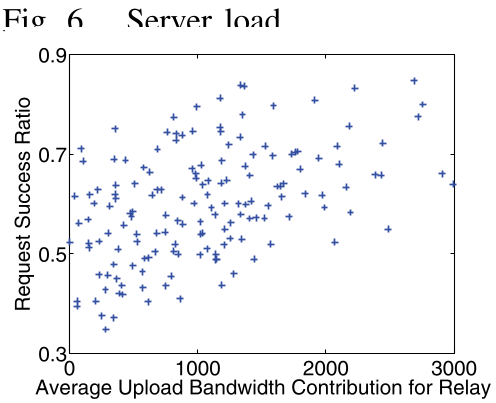 Fig 2. Mutual contribution levels between peers are far more balanced under this social design compared to random scheduling.
Critical Insight: Why This Works
The "magic" isn't just in the math; it's in the Inductive Bias of the social graph. Most P2P systems fail because users are selfish (the "free-rider" problem). By tying streaming quality to social reputation, the authors transform a technical problem into a social one. If you want your friends to see your uploaded video in high quality, you are incentivized to help relay their content first.
Conclusion & Future Look
The paper successfully demonstrates that "Social Awareness" is a high-performance heuristic for resource allocation. While the prototype used 400 Kbps streams (standard for the era), the logic scales to 4K/VR streaming where the bandwidth pressure is even more acute.
Limitations: The system assumes a relatively honest reporting of contribution, though the authors suggest using "credits" or "reputation-based" approaches to mitigate collusion attacks. Future work could explore how blockchain-based ledgers could replace the "Tracker" to make the system truly decentralized.