
Social Reciprocity: The "Hidden Engine" for Scaling Social Media Streaming
16660_Peer-Assisted Social Media Streaming with Social Reciprocity.
This paper proposes a peer-assisted social media streaming system that leverages Social Reciprocity to incentivize resource sharing. By introducing Peer Contribution Ratio (PCR) and System Contribution Ratio (SCR), the system shifts server load to edge peers, achieving low-cost, high-quality video distribution.
TL;DR
To address the massive server costs in social media video distribution, this paper proposes a peer-assisted system driven by social reciprocity. By quantifying mutual "give-and-take" between friends and the system, the authors create an incentive mechanism that balances load, rewards contributors, and maintains high streaming quality even with limited infrastructure.
Background & Motivation: Why Traditional P2P Fails Social Media
Traditional P2P systems like BitTorrent rely on Tit-for-Tat, a "quid-pro-quo" mechanism that only works when both parties are downloading simultaneously. However, social media content (e.g., YouTube or Renren videos) is often consumed asynchronously. The core challenge is: Why should a peer help relay a video if they don't need anything in return right now?
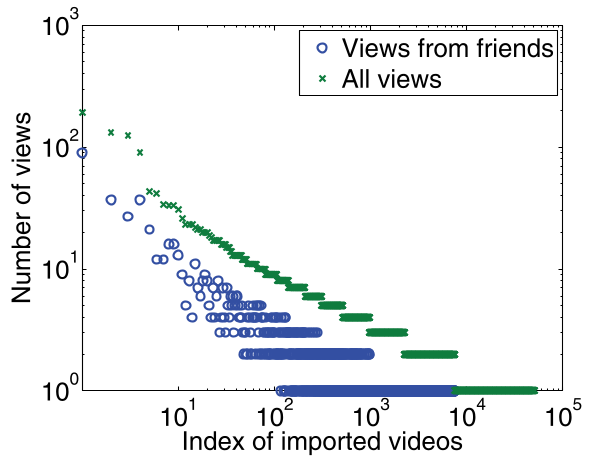
The authors observed from Renren traces that video consumption is deeply tied to social graphs—40% of shares happen between friends. Their insight is to leverage this "Social Capital" to solve the bandwidth dilemma.
Methodology: The Social Reciprocity Index (RI)
The architecture uses two lightweight ratios to track behavior:
- Peer Contribution Ratio (PCR): Tracking the historical balance between two specific friends.
- System Contribution Ratio (SCR): A global "reputation" score tracking overall help given vs. received.
Architecture Overview
The Social Reciprocity Index (RI) is the mathematical heart of the system: Where:
- is the social closeness (friendship strength).
- is the system-wide contribution (SCR).
- is the pairwise contribution (PCR).
If you are close friends ( is high), the system prioritizes direct reciprocity. If you are strangers, it relies on your global reputation ().
The Two-Sided Optimization
1. Source Peer Strategy: Finding the Right Helper
The source (video creator) ranks candidate relays by ascending RI. It chooses peers it has helped a lot in the past but hasn't asked for much in return. This "recalls" historical favors to ensure a high probability of assistance.
2. Relay Peer Strategy: Who to Help?
When a relay has spare bandwidth, it receives multiple requests. It solves an optimization problem to maximize rewarded RI, effectively prioritizing friends and high-contributing "good citizens" of the network.
Experimental Results & Performance
The system was validated on PlanetLab using 200 nodes.
Load Balancing and Reciprocity
As shown in the charts, mutual resource contribution between peer pairs becomes significantly more balanced compared to random scheduling.
Key Takeaways from Experiments:
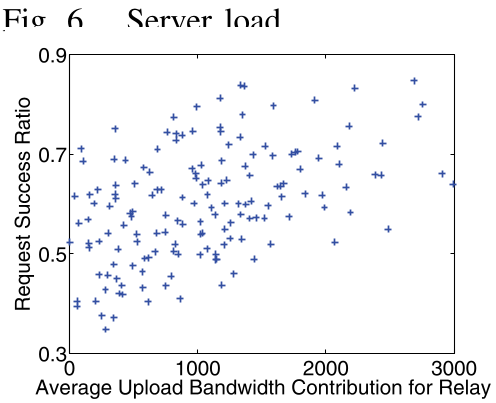
- Incentive Alignment: Peers who contribute more upload bandwidth enjoy a significantly higher Success Ratio when they need help themselves (a clear "help-the-helpers" correlation).
- Social Preference: The system demonstrates a 2x-3x improvement in fulfilling requests from social friends, aligning with human social expectations.
- Efficiency: Control overhead remains minimal (<1%), proving that tracking these ratios doesn't swamp the network.
Critical Analysis
Why it Works
By formalizing "social closeness" into the resource allocation logic, the researchers bridge the gap between human behavior and technical protocols. This reduces the "free-rider" problem because a user's future streaming quality is directly tied to their current "social helpfulness."
Limitations
A potential vulnerability is collusion. Malicious peers could fake upload claims to each other to boost their SCR. While the authors suggest reputation-based countermeasures, a truly robust implementation might require cryptographic verification or a blockchain-based ledger for contribution records.
Conclusion
This work provides a roadmap for "Socially-Aware Systems." As video data continues to explode, moving away from centralized servers to a decentralized, socially-motivated mesh is not just an optimization—it is a necessity for the next generation of social platforms.