
Peer-Assisted Swarming: Breaking the Cellular Bandwidth Bottleneck in Critical Reporting
Peer-Assisted Timely Report Delivery in Social Swarming Applications
This paper introduces the Timely Report Delivery (TRD) framework for social swarming applications, utilizing a hybrid 3G/WiFi peer-assistance mechanism to maximize the number of voluminous reports delivered before strict deadlines. The core methodology involves the Iterative Frame Generation (IFG) and Reverse-IFG (RIFG) heuristics, which achieved 2–4× improvement in report delivery success over standard cellular-only approaches.
TL;DR
In emergency scenarios like search-and-rescue, mobile 3G/4G networks are often too slow to handle high-definition video uploads before a deadline expires. This paper proposes a peer-assistance framework where nearby smartphones use fast WiFi to share the upload load. By transforming a theoretically NP-hard scheduling problem into practical heuristics (IFG/RIFG), the authors achieved a 2-4x increase in successful report deliveries on real Android devices.
Background: The Social Swarming Challenge
"Social Swarming" refers to coordinated teams (firefighters, volunteers, researchers) using smartphones to provide situational awareness to a central commander. The fatal flaw? A single user's 3G/4G link is a bottleneck. If one person has a 10MB video and a 30-second deadline, they will likely fail. However, a nearby teammate might have an idle 3G link. The core intuition of this work is to treat the swarm as a virtual distributed antenna system, using high-speed local WiFi to move data bits to neighbors who then relay them to the goal.
The "One-Sided" Reality: Why This Problem is Hard
While the concept of helping a neighbor seems simple, the physics and OS constraints of smartphones make it a nightmare for optimization.
- Radio Interference: Most mobile OSs (Android/iOS) disable the 3G radio when the WiFi is in "client mode." This means if you are receiving data from a peer to help them, you can't upload to the commander at the same time.
- Setup Overhead: Connecting to a WiFi AP isn't instant; it takes 4-10 seconds—a massive penalty when your total deadline might only be 60 seconds.
The authors prove that when these delays are non-zero, the scheduling problem becomes strongly NP-hard.
Methodology: IFG and RIFG Heuristics
To solve the NP-hard TRD problem, the authors developed two primary heuristics:
- Iterative Frame Generation (IFG): Splits time into frames based on report deadlines. It identifies "Quiescent Periods" (QPs)—gaps where a reporter’s 3G link is idle—and fills them with segments from peers who are struggling to meet their deadlines.
- Reverse-IFG (RIFG): A variation that schedules a reporter’s own data as late as possible to prioritize helping others first.
 Figure 1: Mathematical formulation for accounting for ES (Extra Segments) that compensate for 3G airtime lost during WiFi transfers.
Experiments and Real-World Performance
The authors didn't just stop at theory; they built a prototype on Android 2.3 (Nexus One) and tested it in real indoor environments with China Unicom WCDMA networks.
Key Findings:
- Profit Ratio: The number of successful reports increased by up to 300% when report size variability was high (i.e., some users had small tasks and could act as dedicated helpers).
- Optimality: Despite being heuristics, IFG/RIFG stayed within 60-70% of the Linear Programming relaxation (the "best-case" theoretical limit).
- Robustness: Real 3G bandwidth is "jittery." By using a conservative estimate (80% of average bandwidth) for the scheduler, the system successfully completed over 90% of tasks.
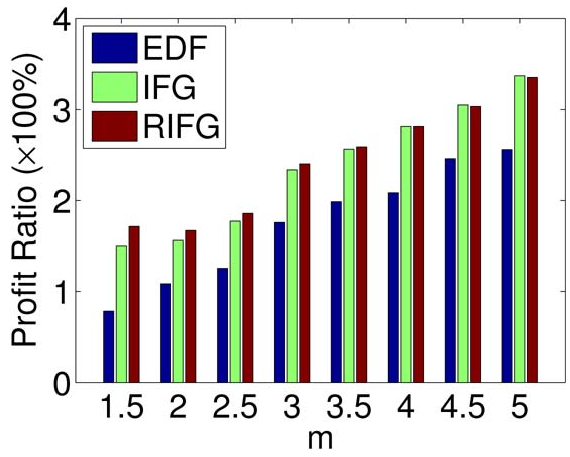 Figure 2: Performance gains (Profit Ratio) showing massive improvements as report sizes and the number of reporters increase.
Critical Insight: The Sweet Spot of Cooperation
The research highlights that peer-assistance is most effective when there is heterogeneity in the swarm. If everyone has a giant file and the same deadline, no one can help. But in reality, tasks are varied. The IFG algorithm successfully identifies these "utility gaps" and reallocates the swarm's total collective bandwidth toward the most urgent deadlines.
Conclusion & Future Outlook
This work provides a solid bridge between combinatorial optimization and mobile networking. While newer technologies like 5G and WiFi 6 reduce some latencies, the fundamental problem of coordinated scheduling under switching costs remains relevant. Future iterations could explore incentives (how to pay users to use their battery to help others?) and mobility (what happens when the "helpers" walk away?).
Takeaway: In the world of high-stakes data delivery, your neighbor's idle radio is your most valuable asset.