
Beyond Proximity: Enhancing D2D Discovery via Social-Service Attribute Integration
Peer discovery for D2D communications based on social attribute and service attribute
This paper introduces a novel D2D peer discovery scheme that integrates social and service attributes through a two-dimensional abstract model called SSAN. By leveraging the Chinese Restaurant Process (CRP) for neighbor cluster recommendation, the method significantly enhances discovery efficiency and link security in cellular underlay networks.
TL;DR
Device-to-Device (D2D) communication is a cornerstone of future 5G/6G networks, but finding the right peer is more than just a matter of signal strength. This paper introduces the SSAN (Service-Social Attributes Network) model, a dual-layer approach that filters potential D2D peers not just by where they are, but by who they trust and what they want to share.
The Context: Why Physical Location is Not Enough
Standard D2D discovery mechanisms are "service-oriented." They assume that if Device A is close to Device B and the channel is good, a link should be established. However, this ignores the human element:
- Willingness: A stranger might not want to share their bandwidth or files with you.
- Security: Proximity discovery makes it easy for malicious "virus nodes" or "advertising nodes" to spam nearby users.
- Efficiency: Probing every neighbor regardless of interest leads to massive signaling overhead.
Methodology: The SSAN Model
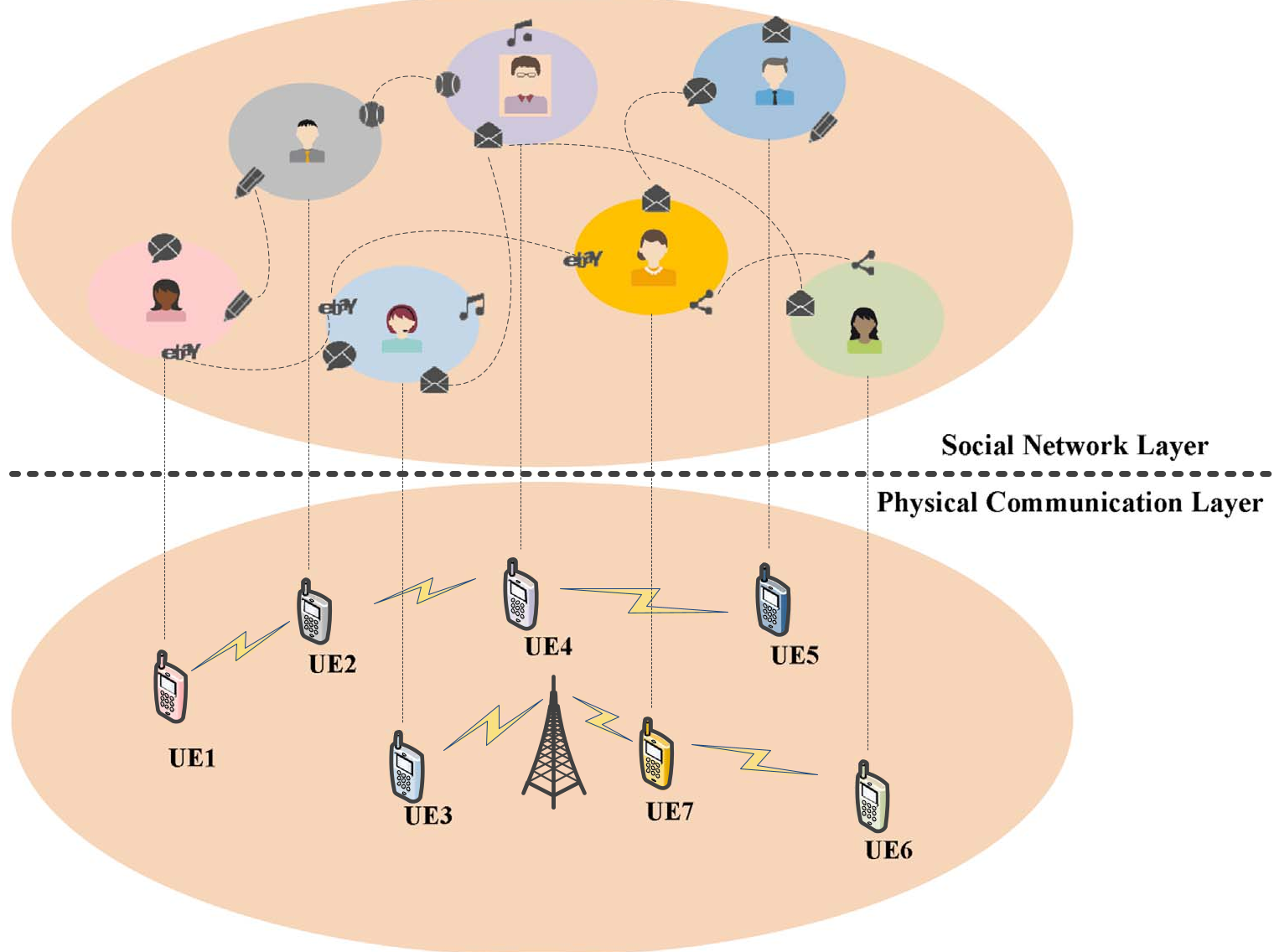
The authors solve this by decoupling the network into two abstracted layers:
- Physical Communication Layer (PCL): Captures service attributes like encounter history, link duration, and signal quality.
- Social Network Layer (SNL): Maps social ties, interests, and interaction habits.
1. Quantifying Trust
Trust isn't binary. The paper uses a Markov chain-based random walk process to calculate transition probabilities between nodes. The strength of social ties () is derived from:
- Contact Interval (CI): How often do these devices meet?
- Contact Duration (CD): How long do they stay in range?
- Social Context (SC): Does the meeting happen during work hours (colleagues) or leisure time (friends)?
2. The Clustering Engine: Chinese Restaurant Process (CRP)
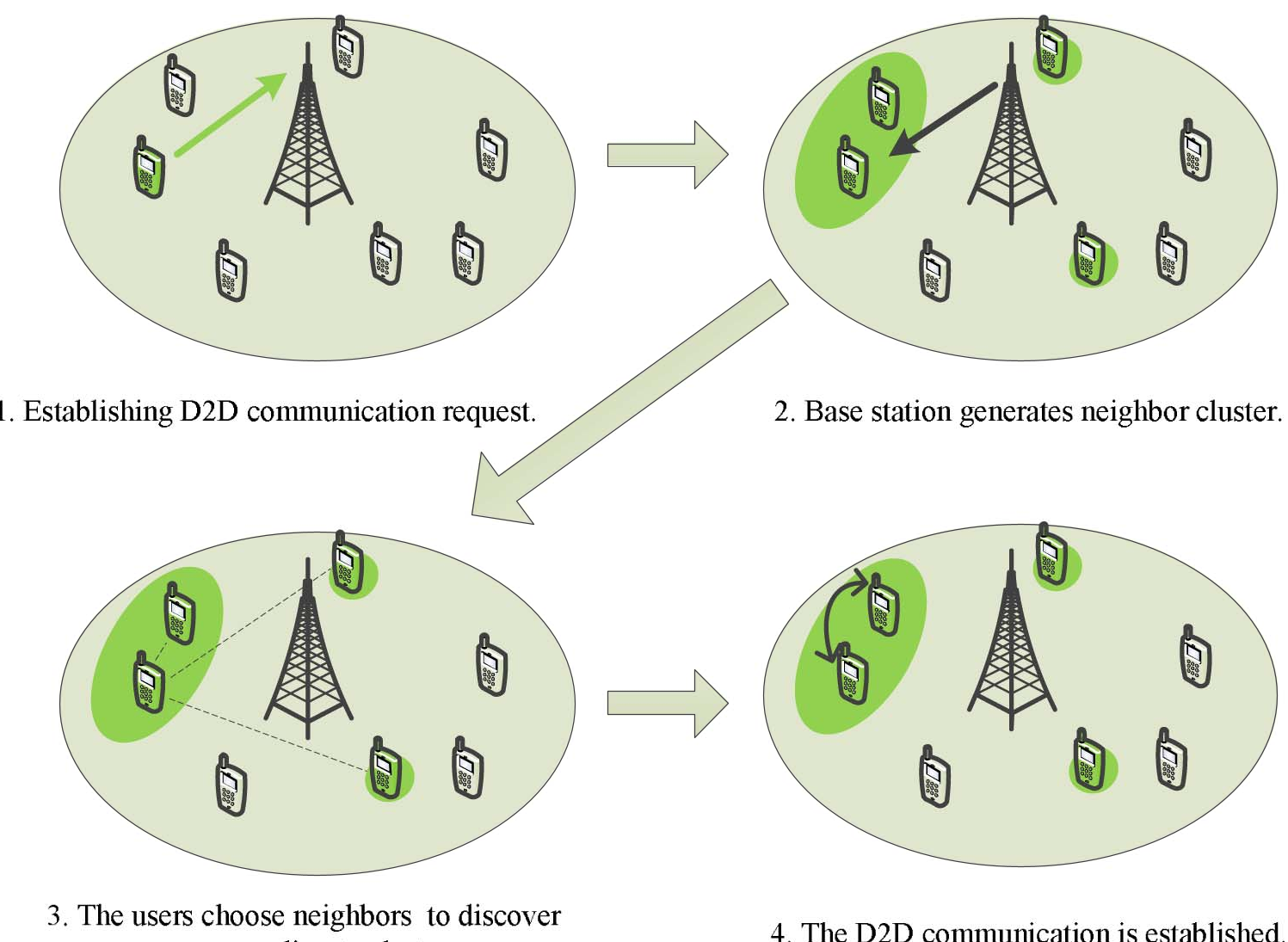
To recommend neighbors, the system uses the CRP model. In this analogy, a new user (customer) chooses to join a "table" (neighbor cluster) based on:
- The Trust Degree of the cluster center.
- The Demand Probability (similarity in social attributes).
This creates a logical grouping that ensures users are only recommended peers they are likely to actually communicate with.
Experiments & Results
The researchers simulated a sector with a 500m radius and a D2D discovery range of 50m.
Success Rate
Compared to purely location-based clustering, the SSAN-based scheme showed a significantly higher Discovery Success Rate. While location-based methods often find "dead" peers (users with no interest in the service), the proposed method identifies peers with high "communication willingness."
Security Benchmark
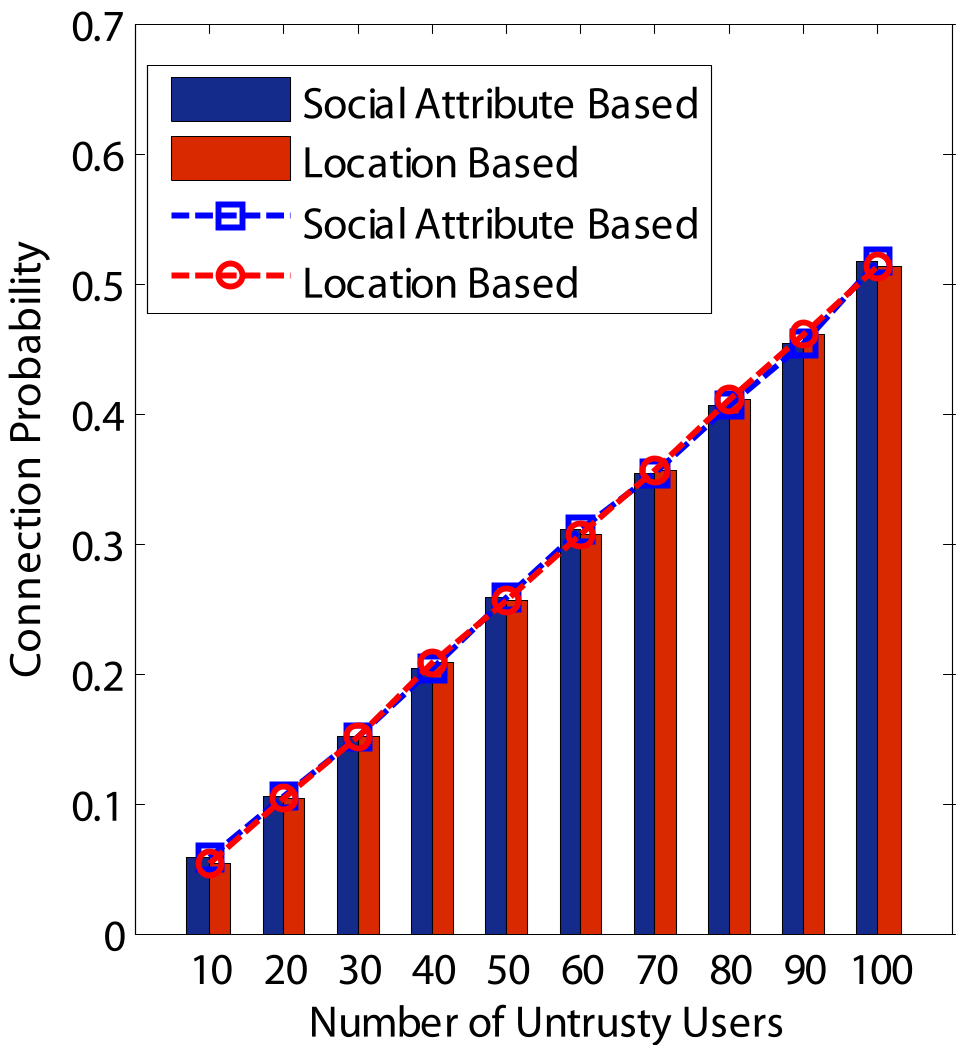
The most striking result is in link security. By setting a trust threshold (), the proposed scheme effectively blocks untrustworthy nodes.
- Location-based/Standard Social schemes: Connection to malicious nodes increases linearly as attrackers enter the area.
- SSAN Scheme: Connection probability to untrustworthy nodes remains near 0, even as the number of malicious nodes scales up to 100.
Critical Insight & Conclusion
The genius of this work lies in treating peer discovery as a recommender system problem rather than a pure radio resource problem.
Takeaways:
- Security by Design: Trust quantification acts as a decentralized firewall.
- Efficiency: By reducing the candidate list to high-probability peers, the system saves battery and radio spectrum.
- Limitation: The "Cold Start" problem remains a challenge for entirely new users with no history, though the authors attempt to mitigate this by assigning an initial baseline trust value ().
This paper paves the way for a more "human-centric" wireless architecture where the network understands the social bond between the devices it connects.